63
William Eggleston
Untitled from The Democratic Forest
Overall 44 1/4 x 66 1/2 in. (112.4 x 168.9 cm)
Full-Cataloguing
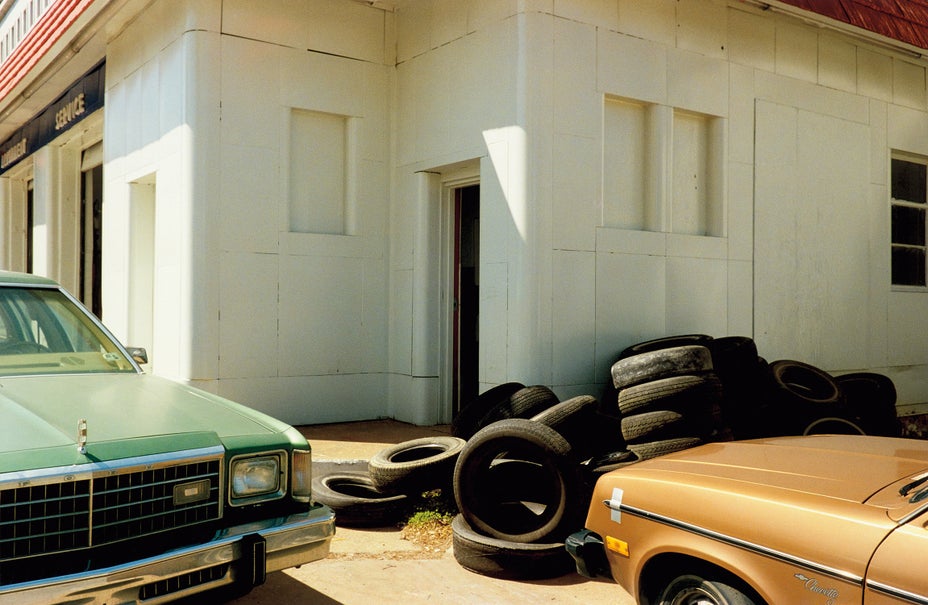
Brilliantly evident in this photograph from the early 1980s, and indeed throughout his best work, is Eggleston’s mastery of framing a scene; his ability to perfectly position his camera to capture exactly what is needed to convey the essence of a scene, nothing more and nothing less. He is a curator of the ordinary: presenting a simplified and nuanced snapshot of what could easily be overlooked amidst the visual chaos of the world around us. Here, the two cars emerge from the edges of the image; their hard angles mimic those created by the building along the top edge, and all flank the collapsing pile of round tires at center. It is about line, form and color, three of the most important elements of art, found and captured so succinctly in the real world by Eggleston’s unparalleled eye.
William Eggleston
American | 1939William Eggleston's highly saturated, vivid images, predominantly capturing the American South, highlight the beauty and lush diversity in the unassuming everyday. Although influenced by legends of street photography Robert Frank and Henri Cartier-Bresson, Eggleston broke away from traditional black and white photography and started experimenting with color in the late 1960s.
At the time, color photography was widely associated with the commercial rather than fine art — something that Eggleston sought to change. His 1976 exhibition at the Museum of Modern Art, Color Photographs, fundamentally shifted how color photography was viewed within an art context, ushering in institutional acceptance and helping to ensure Eggleston's significant legacy in the history of photography.