17Ο︎◆︎
Robert Mapplethorpe
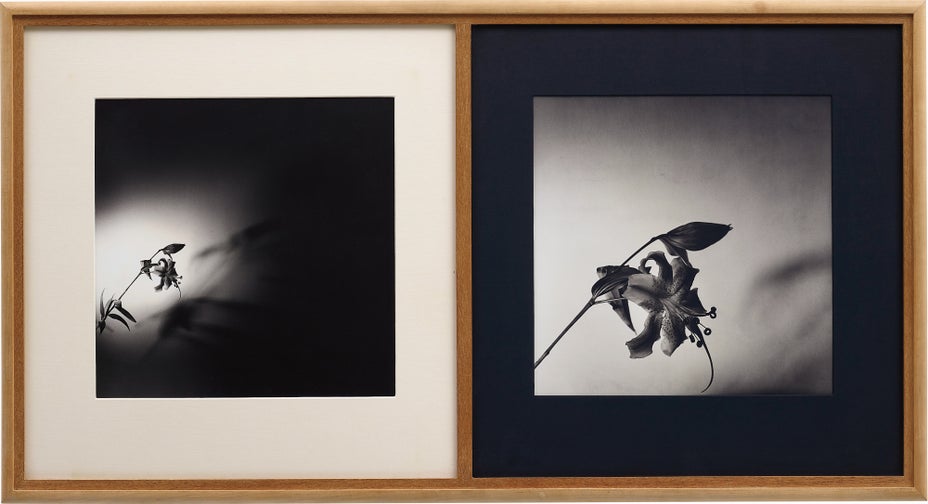
Double Tiger Lily
Frame: 58.3 x 107.5 cm (22 7/8 x 42 3/8 in.)
This work is unique.
Full-Cataloguing
Robert Mapplethorpe
In 1977 Robert Mapplethorpe made his first significant impact on the art world with his twin solo shows in New York: Portraits at Holly Solomon Gallery and a selection of male nudes and S&M images at The Kitchen. Later that year, Holly Solomon followed with Flowers, which debuted Double Tiger Lily, 1977, the unique, early masterwork offered here. The total number of works included in the Flowers show is unknown. Aside from Tulips, 1977, which has twice appeared at auction, this is the only other known work from the show to date.
Mapplethorpe embraced the sexuality of flowers and they were to become a permanent fixture in his oeuvre. His approach to flowers was similar to the way in which he photographed his human subjects in that he frequently isolated them in the frame as seen here. The elegant and charged lily, the subject of the present work, would feature prominently throughout his floral imagery. In Double Tiger Lily, he juxtaposes the shadowy realms of the left image with a tonally light silk overmat, drawing out the halo of light that encircles the lily’s head. For the right-hand panel, he contrasts the lighter background of the close-up lily with a luxurious black silk overmat, underlining the dramatic nature of the composition. Double Tiger Lily demonstrates not only his exquisite handling of light and shadow but also his desire to reinforce the physicality of the work.
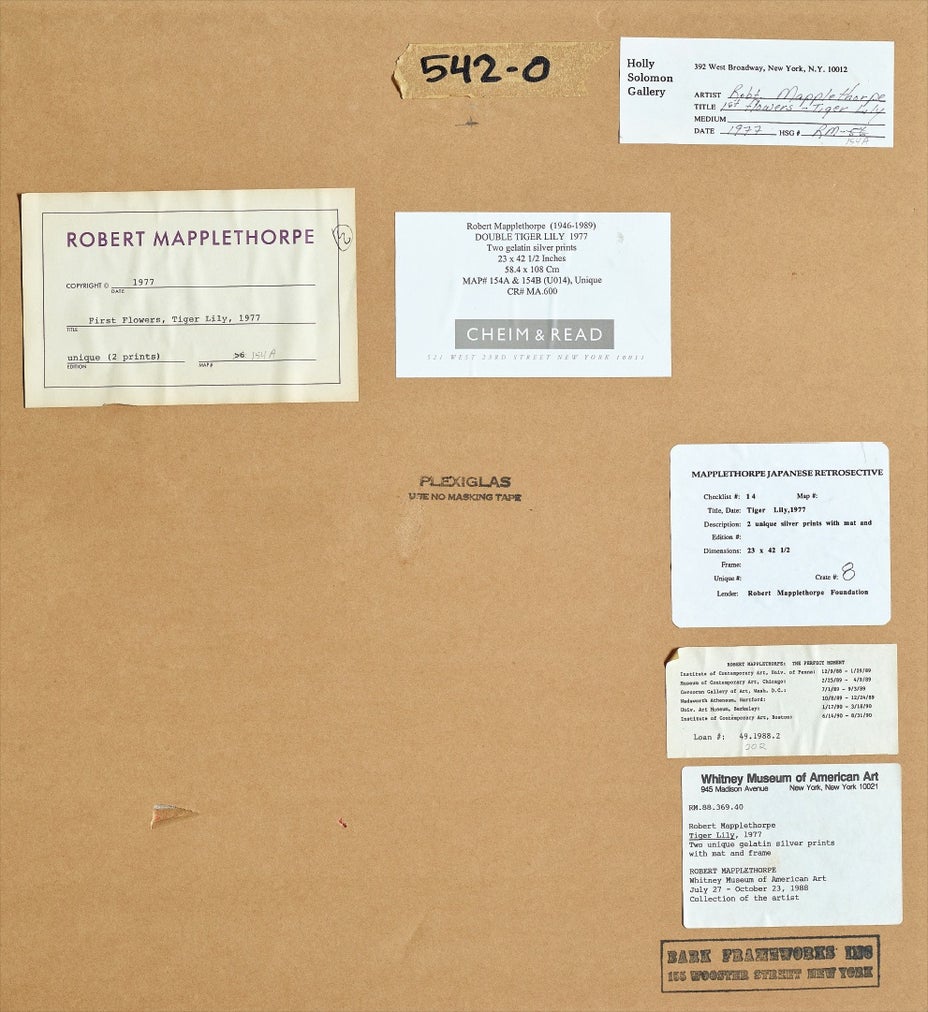
At a time when the art market made clear distinctions between art and photography, Mapplethorpe sought to present his photographs as art with his intricate frames. For him, the frame was not merely the means by which to formally present a photograph, but formed a crucial part of his artistic practice. From the early 1970s, Mapplethorpe presented his artwork within expensive, custom designed wood frames and maintained a similarly discerning approach to the mats. He was known to spend hours at Bark Frameworks on Grand Street in New York, examining swatches of silk for the mats. ‘Robert’s frames were really more theatrical than anything else,’ observed owner Jared Bark, ‘but the mats also functioned as a door – a door to his inner life more than a window on the world’ (Mapplethorpe: A Biography, p. 179). Mapplethorpe’s selection of contrasting silk overmats for his dramatic Double Tiger Lily reflects his refined and meticulous approach in the creation of his unique compositions.
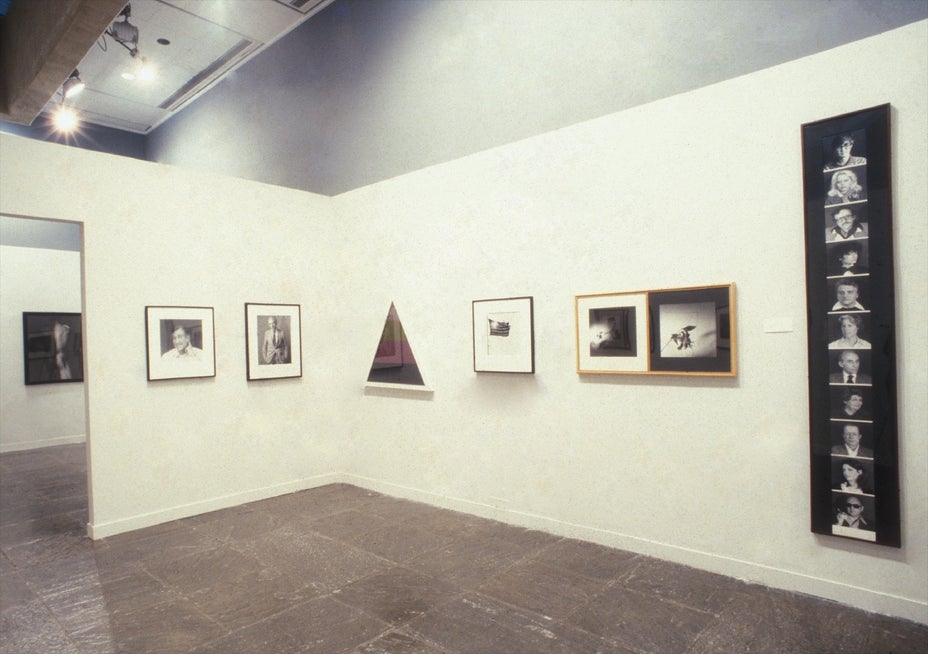
The significance of Double Tiger Lily within Mapplethorpe’s oeuvre is reflected in its impressive exhibition history. He selected this unique work to be included in two major retrospectives, both opening in 1988, just before the artist's death, at the age of 42, from AIDS-related complications. The first was Robert Mapplethorpe, his maiden US retrospective, which opened at the Whitney Museum of American Art in New York on 28 July and ran until 23 October 1988; the museum reported that it was one of the most highly attended events in its history. The second was Robert Mapplethorpe: The Perfect Moment, the groundbreaking and controversial exhibition that opened on 9 December 1988 at the Institute of Contemporary Art, Philadelphia and then travelled to six other US cities: Chicago, Washington D.C., Hartford, Berkeley, Cincinnati and Boston. In 1992-93, Double Tiger Lily was also exhibited in his Japanese retrospective, which travelled to five cities/prefectures in Japan.
Acquired from Cheim & Read in the late 1990s, Double Tiger Lily, 1977, has been in the same private collection for two decades and is appearing at auction for the first time.
Phillips Photographs extends our sincere thanks to the Robert Mapplethorpe Foundation and the Institute for Contemporary Art, Philadelphia for their assistance with our research.
Robert Mapplethorpe
American | B. 1946 D. 1989After studying drawing, painting and sculpture at the Pratt Institute in the 1960s, Robert Mapplethorpe began experimenting with photography while living in the notorious Chelsea Hotel with Patti Smith. Beginning with Polaroids, he soon moved on to a Hasselblad medium-format camera, which he used to explore aspects of life often only seen behind closed doors.
By the 1980s Mapplethorpe's focus was predominantly in the studio, shooting portraits, flowers and nudes. His depiction of the human form in formal compositions reflects his love of classical sculpture and his groundbreaking marriage of those aesthetics with often challenging subject matter. Mapplethorpe's style is present regardless of subject matter — from erotic nudes to self-portraits and flowers — as he ceaselessly strove for what he called "perfection of form."