149
Pablo Picasso
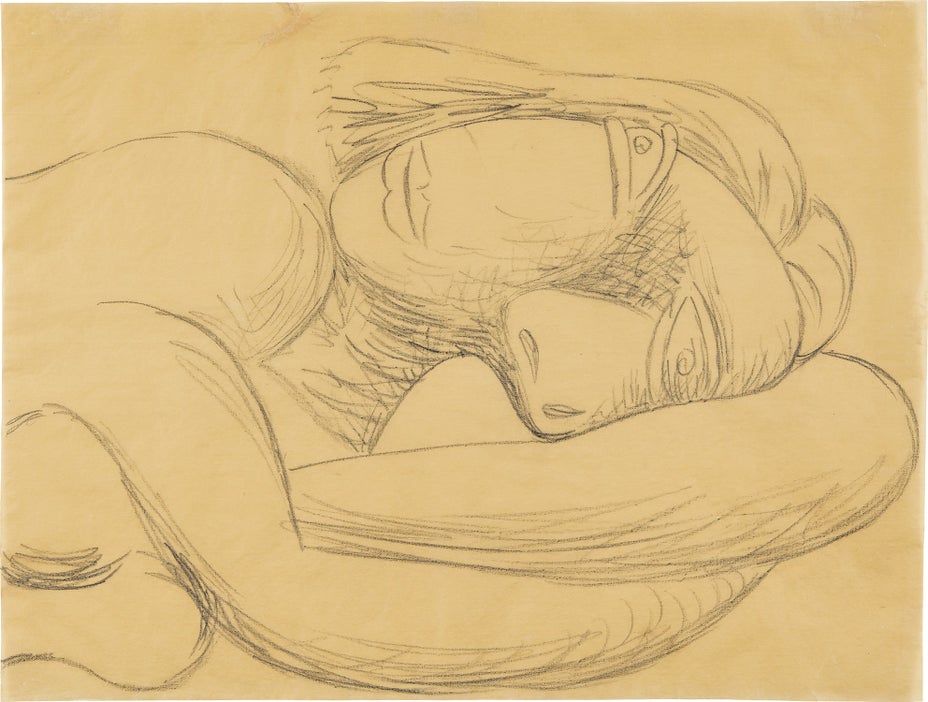
Femme en buste/ Buste de femme couchée
The Comité Picasso confirmed the authenticity of this work on June 19, 1987.
Full-Cataloguing
A delectable image exuding lyrical calm and beauty, Femme en buste (Marie-Thérèse) is emblematic of Picasso’s vision of Marie-Thérèse. As opposed to Dora, whom he painted with the dark and ominous traits that characterized her high wit and heated temper, Marie-Thérèse was always illustrated as a pristine beauty, whose pale features and primeval blonde locks echoed her composed countenance. Residing in the same home and sharing a family with the artist since 1934, Marie-Thérèse symbolized peacefulness, stability and quiet domesticity, as evidenced in the present work’s gentle forms and unthreatening abstraction. "Dora would be the public companion, Marie-Thérèse and Maya continued to incarnate private life” Pierre Daix wrote. “Painting would be shared between them... Each woman would epitomize a particular facet of a period rich in increasingly dramatic repercussions" (Pierre Daix, Picasso: Life and Art, New York, 1993, p. 239).
Pablo Picasso
Spanish | B. 1881 D. 1973One of the most dominant and influential artists of the 20th century, Pablo Picasso was a master of endless reinvention. While significantly contributing to the movements of Surrealism, Neoclassicism and Expressionism, he is best known for pioneering the groundbreaking movement of Cubism alongside fellow artist Georges Braque in the 1910s. In his practice, he drew on African and Iberian visual culture as well as the developments in the fast-changing world around him.
Throughout his long and prolific career, the Spanish-born artist consistently pushed the boundaries of art to new extremes. Picasso's oeuvre is famously characterized by a radical diversity of styles, ranging from his early forays in Cubism to his Classical Period and his later more gestural expressionist work, and a diverse array of media including printmaking, drawing, ceramics and sculpture as well as theater sets and costumes designs.