148
Joan Miró
Untitled III
Estimate
$300,000–400,000
signed "Miró" lower right; further signed, titled and dated "30/XI/'64 III MIRÓ 30/XI/64 III" on the reverse
gouache, watercolor, watercolor crayon, pastel and collage on paper
29 1/8 x 42 5/8 in. (73.9 x 108.2 cm.)
Executed on November 30, 1964, this work is accompanied by a photo certificate of authenticity issued by Mr. Jacques Dupin.
Full-Cataloguing
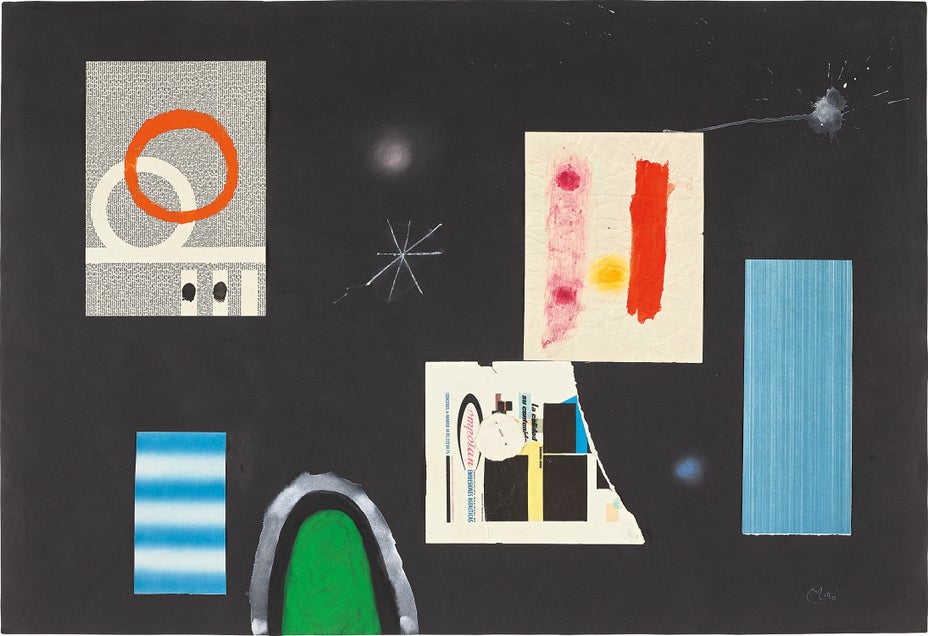
Executed in 1964, Untitled IIIis a lyrical black-paper manifestation of the cosmic landscape collages that Joan Miró returned to again and again throughout his oeuvre. Star-like markings in chalky white gouache and pastel allude to the celestial, while cut-out paper fragments dance across the stark, black paper surface. Miró delights in the contrast between textures and brushstrokes – an orange circle gliding over cryptic text, red paint on a rectangular white prism, a torn French magazine advertisement – which shine brightly out of the black paper like extraterrestrial bodies in a dark night sky.
Miró was entranced by the constellations, and his retreat to an imaginary world of the cosmos can be traced to the end of World War II, when he became a part of a generation of artists who withdrew from the traumatic violence wrought by war. In 1964, Miró was living under Franco’s Spain and had begun producing increasingly political variations of his surreal compositions. The date and subject of Untitled III suggests it may be related to Miró’s 1964 painting Message from a Friend, which depicts an amorphous black shape in space. In a 1964 interview, Miró told the French writer Yvon Taillandier that the painting was about an apocalyptic dream Miró had had in which, "humanity could die, but would not die out completely. A part of it would survive to fly off to the stars” (Yvon Taillandier, “Pour une cosmogonie de Miró”, XXe Siècle, vol. 24, December 1964, p. 111).
While the journey into the cosmos is paradigmatic of Miró’s most notable works, Untitled III indicates a compositional blend of traditional Miró motifs with the influence of international aesthetic trends. Following the example of the postwar movement Art Informel, which allowed for a very emotional, large-scale way of working, Miró’s art became less detailed. In consequence, Untitled III eschews the intricate decorative motifs of earlier works for a bold evocation of the artist’s dreamscape. The milky paint splashed across the upper right represents Miró’s own version of drip painting, which he had admired in Jackson Pollock’s work. Combining playful irreverence with a masterly understanding of surrealist form, Untitled III is a scintillating example of the artist’s persistent experimentation and exploration of the relationship between the figurative and the surreal.
Miró was entranced by the constellations, and his retreat to an imaginary world of the cosmos can be traced to the end of World War II, when he became a part of a generation of artists who withdrew from the traumatic violence wrought by war. In 1964, Miró was living under Franco’s Spain and had begun producing increasingly political variations of his surreal compositions. The date and subject of Untitled III suggests it may be related to Miró’s 1964 painting Message from a Friend, which depicts an amorphous black shape in space. In a 1964 interview, Miró told the French writer Yvon Taillandier that the painting was about an apocalyptic dream Miró had had in which, "humanity could die, but would not die out completely. A part of it would survive to fly off to the stars” (Yvon Taillandier, “Pour une cosmogonie de Miró”, XXe Siècle, vol. 24, December 1964, p. 111).
While the journey into the cosmos is paradigmatic of Miró’s most notable works, Untitled III indicates a compositional blend of traditional Miró motifs with the influence of international aesthetic trends. Following the example of the postwar movement Art Informel, which allowed for a very emotional, large-scale way of working, Miró’s art became less detailed. In consequence, Untitled III eschews the intricate decorative motifs of earlier works for a bold evocation of the artist’s dreamscape. The milky paint splashed across the upper right represents Miró’s own version of drip painting, which he had admired in Jackson Pollock’s work. Combining playful irreverence with a masterly understanding of surrealist form, Untitled III is a scintillating example of the artist’s persistent experimentation and exploration of the relationship between the figurative and the surreal.