45
Herbert Ponting
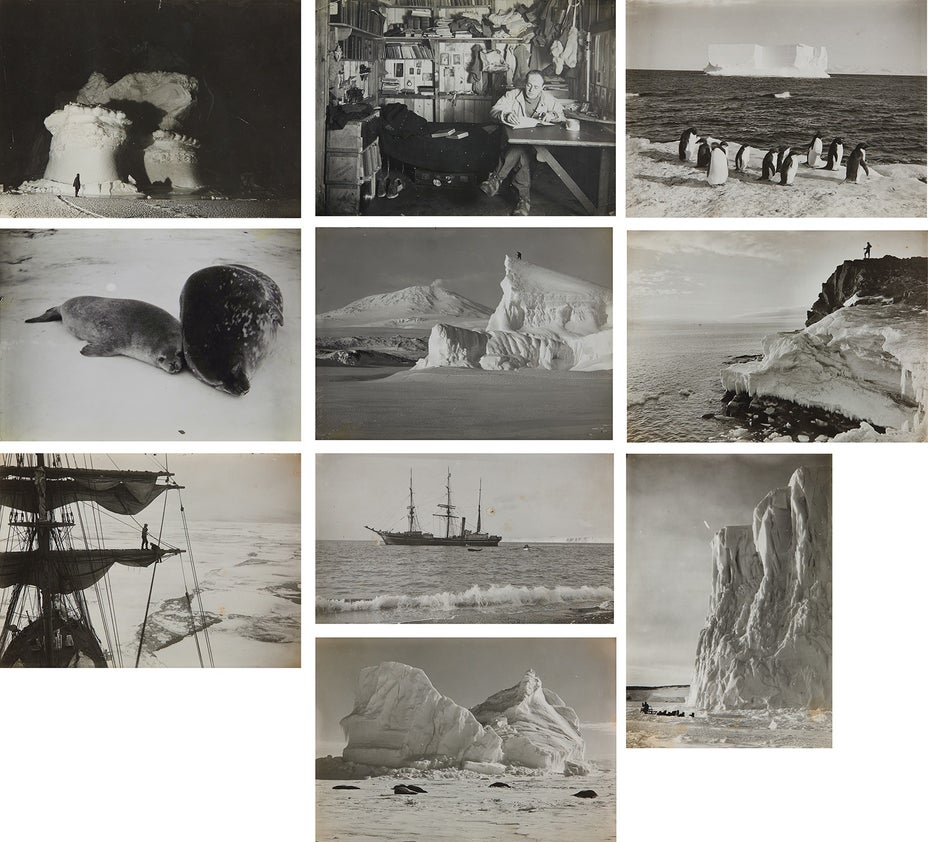
Selected Images of Captain Robert Falcon Scott’s Expedition to the Antarctic
Full-Cataloguing
Scott faced competition in his race to claim the South Pole, from his fellow Britain Ernest Shackleton and the Norwegian Roald Amundsen. Scott and a small team, not including Ponting, ultimately did reach the Pole, after great difficulty, only to find that Amundsen had gotten there several weeks before. Demoralized, Scott and his team began the return journey, only to perish in the sub-zero cold. Scott had intended to use Ponting’s photographs, as well as his motion pictures, as an integral part of his post-expedition publicity, exhibitions, and as illustrations for lectures and other public events that would cover the expenses of the journey and provide and him an income. While that role for the photographs would go unfulfilled, Ponting’s images remain an indelible document of the expedition and of the human drive to explore.
Herbert Ponting
British | B. 1870 D. 1935Herbert Ponting was a self-taught photographer with a particular interest in stereographs. He turned his hobby into a career in 1900 after winning a world prize for a telephoto of San Francisco Bay, and another work, Mules at a Californian Roundup, that became a centerpiece for Kodak's exhibit at the World Fair in St. Louis. Afterward, he started selling stereograph negatives for publications in European and American magazines and was invited to New York for syndicated magazine work. These documentary photography contributions required him to travel the world extensively. In 1902 and 1905 he made several trips to Japan and published a highly-acclaimed book on Japanese culture entitled Lotus-land Japan. In 1909 and from 1910 to 1912 he was the photographer for the expeditions to the Antarctic led by Captain R.F. Scott, thus becoming the first official photographer ever to join an Antarctic expedition. The work from his Antarctic series received critical acclaim for their outstanding use of light, composition and dramatic effects of ridges, castle icebergs and polar icebergs.