401
Carlo Scarpa
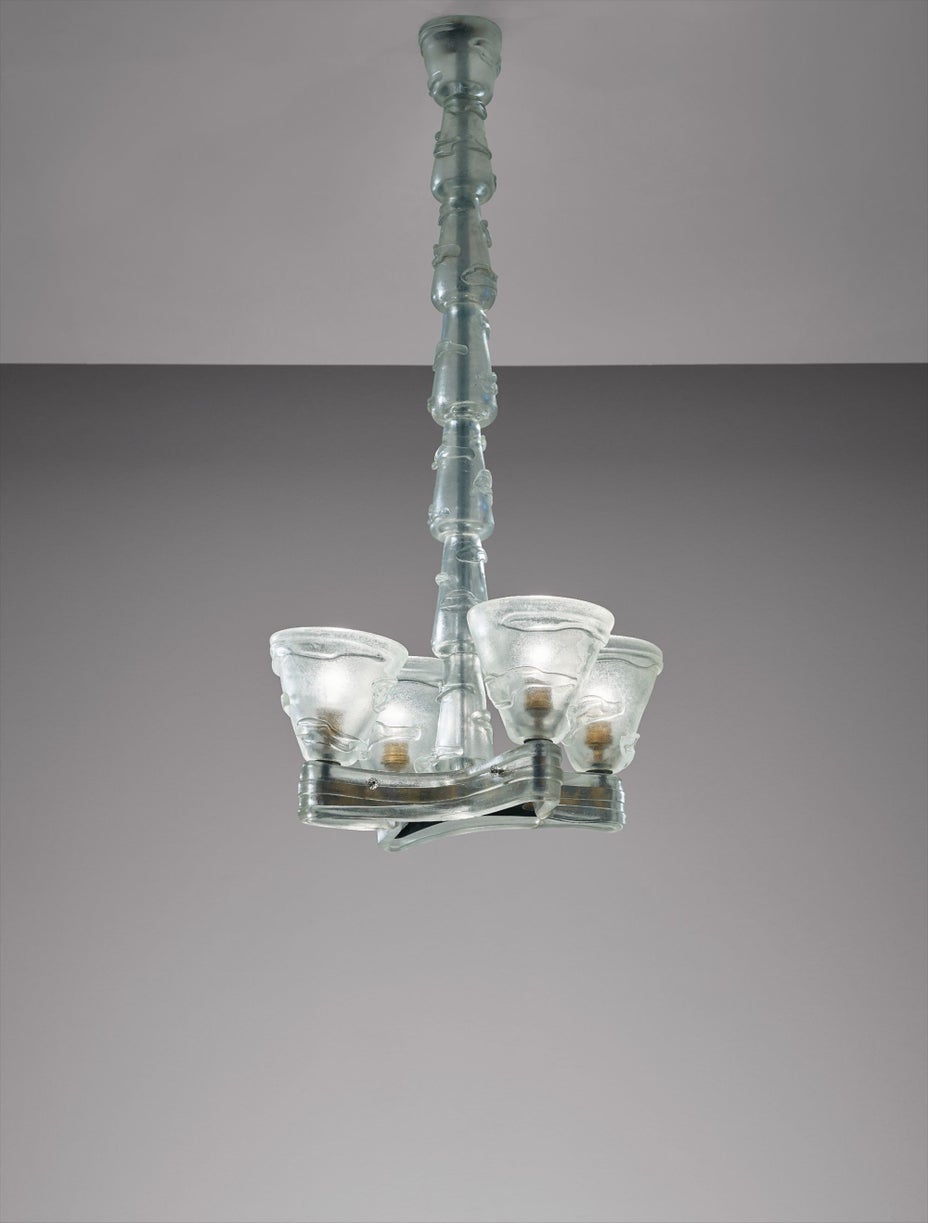
Rare ceiling light, model no. 5283
Full-Cataloguing
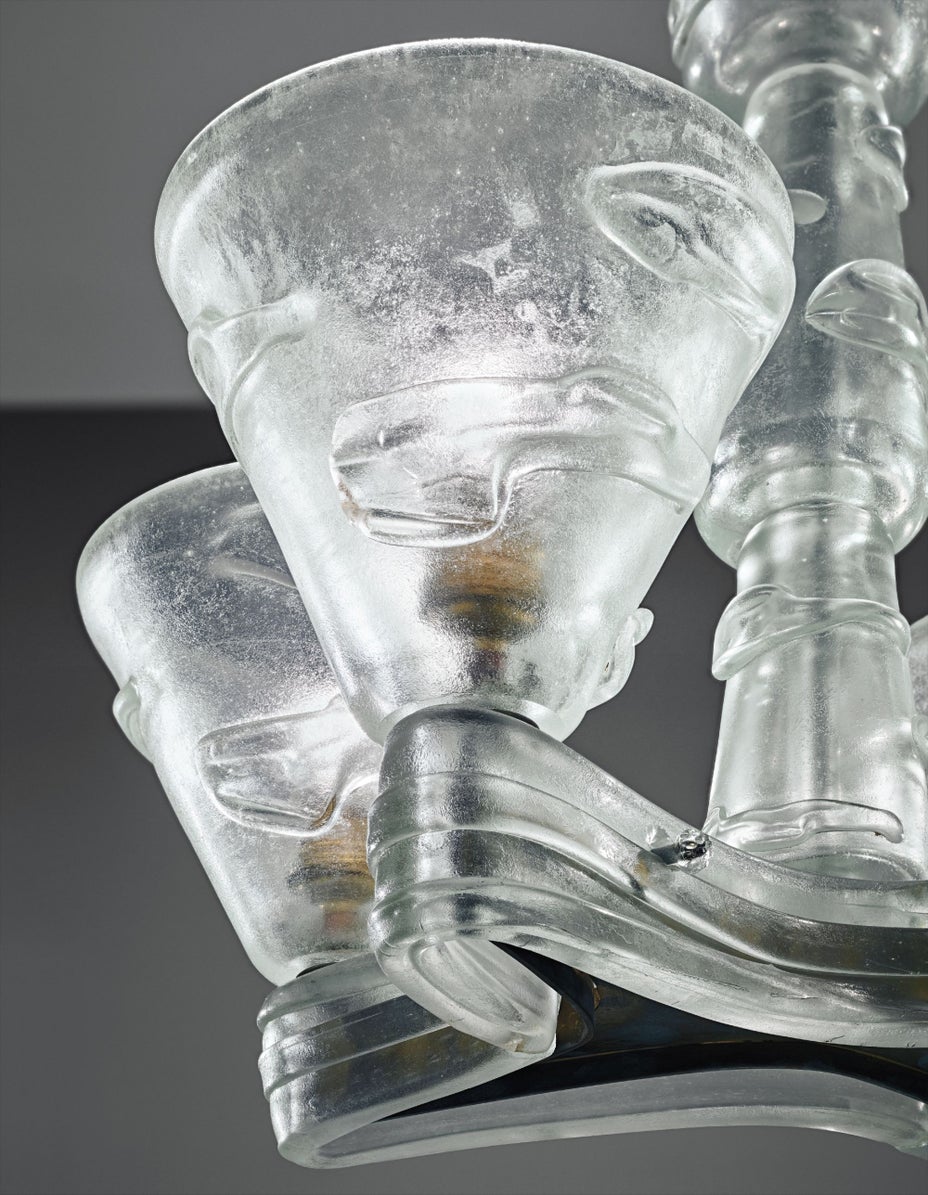
The Corroso technique, employed on the present chandelier, was first used in France at the turn of the century and introduced to Murano by Scarpa, where it became a popular and iconic technique of the highest Venini production. Corroso glass evokes the softly corroded surfaces of ancient artifacts, overlaid with a faint layer of iridescence. The effect was achieved through covering the glass in sawdust soaked in hydrofluoric and sulphuric acid. The process allowed for subtle distinctions in the texture, as the amount of acid used, the temperature and its duration would impact the result. Corroso was first presented to the public at the VI Milan Triennale of 1936 alongside a few murrine vases by Paolo Venini and a variety of ceiling lights. The Corroso technique was itself well-suited to lighting, as its texture allowed for a soft and diffused passage of light. Due to its toxicity, the technique was slowly discontinued following the Martellato series of 1938.
The present chandelier was originally installed in the Montaldo Palace in Turin, and is fitted with additional columnar components to allow for a longer drop. These components, the central glass structure that covers the metal frame, and the four shades (model number 3694 in the Catalogo Blu) have all been additionally decorated with applications of glass, themselves also treated with the Corroso technique. Representative of one of Scarpa’s most refined and iconic series, the present chandelier embodies all the elements and most recognizable features of the Corroso vases, today some of the most sought-after objects by glass collectors.
Carlo Scarpa
Italian | B. 1906 D. 1978Phillips Design has a deep-rooted passion for the work of Carlo Scarpa, one of the twentieth century's great poets, whose rhythms, lines and materials — a grammar of space — appeal both as a local response to the architect's birth city, Venice, and a universal language of ordered dynamism.
Carlo Scarpa graduated with a degree in architectural drawing from the Accademia di Belle Arti in Venice in 1926. In the years that followed, he worked as a teaching assistant for a former professor, ran his own architectural practice in Venice and worked as a freelance artist for M.V.M. Cappellin glassworks. When M.V.M. Cappellin went bankrupt in 1932, Scarpa joined Venini & C. in Murano, where he served as artistic director until 1947. During his tenure at Venini, Scarpa developed a host of new techniques — in particular, mezza filigrano, a bollicine and corroso — that catapulted the centuries-old tradition of Venetian glassblowing to the forefront of modernist design.