15
Edward Steichen
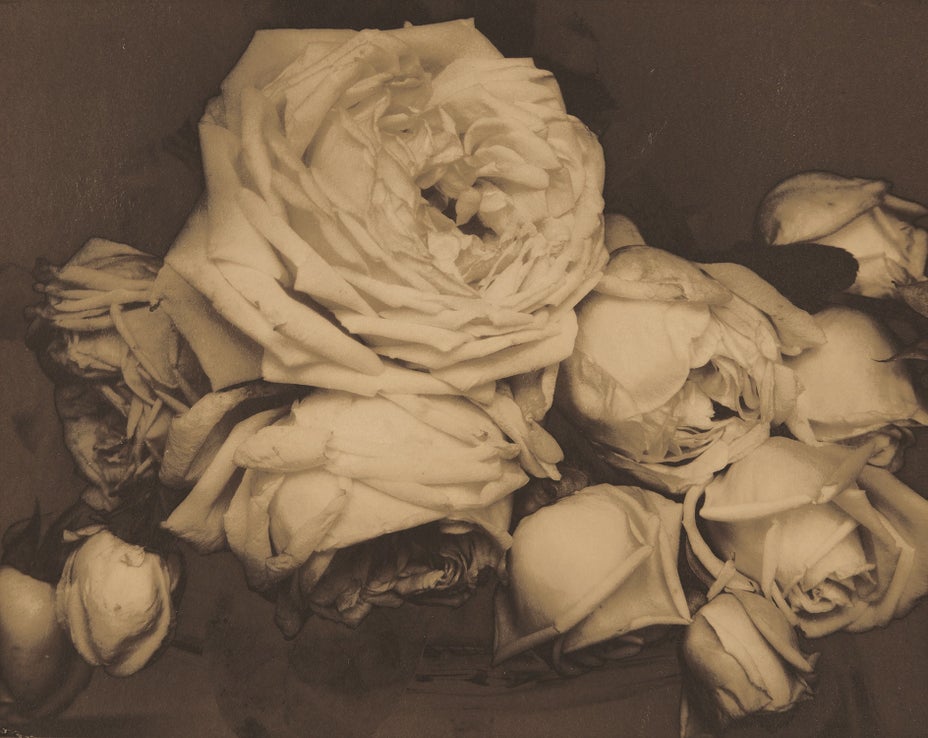
Heavy Roses, Voulangis, France
Estimate
$400,000–600,000
Sold For
$524,000
1914
Palladium print, solarized.
7 1/2 x 9 1/2 in. (19.1 x 24.1 cm)
Full-Cataloguing
Heavy Roses, Voulangis, France, was made shortly before Edward Steichen left the country at the outset of World War I. Steichen’s extended French sojourn, living in Voulangis in a cottage surrounded by flower gardens, was an especially formative time in his career. During this time, painting gave way to photography as his chief artistic pursuit, and he continued to experiment and refine his approach to the modern medium. In Steichen’s photography, this period marked a slow but steady trend away from the atmospheric effects of Pictorialism toward a fuller exploitation of the camera’s capacity to capture the detail and volume of objects. It has been suggested that Heavy Roses was the last photograph Steichen made before fleeing Europe. Whether or not this is the case, the photograph has an elegiac quality. Its detailed account of its subject matter suggests an acceptance of the realities that faced Steichen at this junction.
The unifying constant throughout Steichen’s long career in photography is his rigorous attention to craft. The present print is an exceptional example of this. Steichen solarized the print slightly by exposing it to light during development, creating a subtle but significant reversal of tones in the dark areas that gives the image a nearly three-dimensional appearance. The deft employment of this technique heightens the photograph’s intensity, and reinforces Steichen’s reputation as one of the finest photographic printers in the history of the medium.
Heavy Roses, Voulangis, France, remains one of Steichen’s most celebrated images, yet early prints of it are scarce. The Museum of Modern Art, New York, has in its collection a palladium print believed to have been made close to the time of the negative. Three gelatin silver prints made by Steichen at various dates have appeared at auction, as well as several prints made much later by Rolf Petersen. It is believed that the present photograph is the only palladium print to appear at auction.
The unifying constant throughout Steichen’s long career in photography is his rigorous attention to craft. The present print is an exceptional example of this. Steichen solarized the print slightly by exposing it to light during development, creating a subtle but significant reversal of tones in the dark areas that gives the image a nearly three-dimensional appearance. The deft employment of this technique heightens the photograph’s intensity, and reinforces Steichen’s reputation as one of the finest photographic printers in the history of the medium.
Heavy Roses, Voulangis, France, remains one of Steichen’s most celebrated images, yet early prints of it are scarce. The Museum of Modern Art, New York, has in its collection a palladium print believed to have been made close to the time of the negative. Three gelatin silver prints made by Steichen at various dates have appeared at auction, as well as several prints made much later by Rolf Petersen. It is believed that the present photograph is the only palladium print to appear at auction.