7Ο︎◆︎
David Hammons
Untitled (Body Print)
Full-Cataloguing
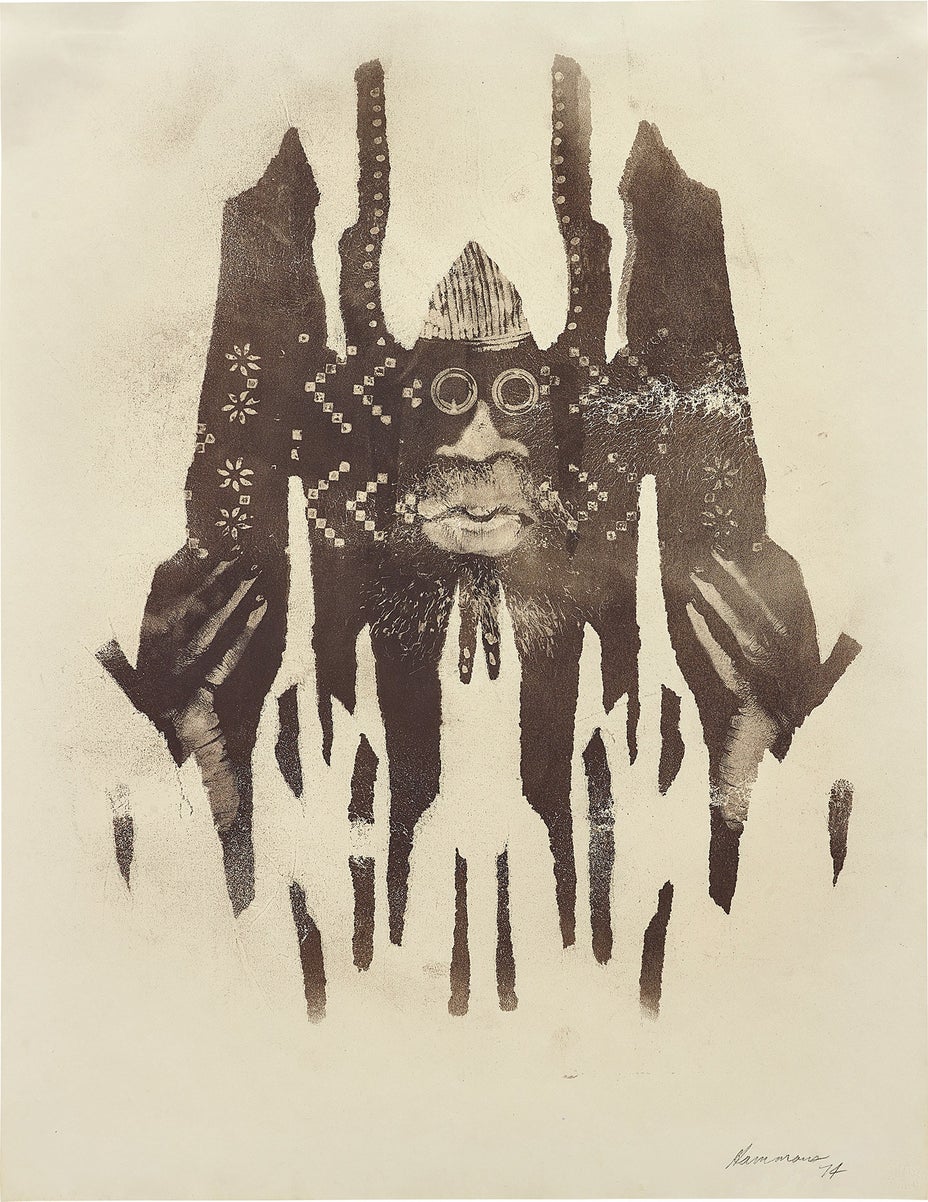
Straddling X-ray precision and pictorial elusiveness, Hammons’ body prints are at once fleeting and deeply corporeal, emulating photographic clarity whilst conjuring an otherworldly image. Capturing a blurry yet extremely detailed record of the artist’s presence, the present work manipulates the qualities of one-to-one transfer, honing in on distinct facial features within a patterned torso, whilst fading the upper and lower parts of the model’s body. Evincing the contours of a fantastical creature, Untitled (Body Print) transcends its reflective quality and enters a surrealist realm; with large goggly eyes and bold facial features, the central figure sits somewhere between bizarre figuration and imaginative abstraction. Executed in a climate of burgeoning black nationalism in the United States in the 1960s and 1970s, Hammons’ methodical prints use the body as a vital expressive tool to balk against the pervasive phenomena of alienation and ostracisation.
Building on the social and political dimension of the artist’s body prints, Gylbert Coker remarked: ‘Much more subtle in their identifiable element, the prints nonetheless grew from a black object—grease. How many times has your Momma told you to get yourself some grease ’cause your legs are ashy?’ (Gylbert Coker, ‘Human Pegs/Pole Dreams,’ Village Voice, 28 September 1982, p. 79). Highlighting the appropriative fetishisations imposed onto black bodies over the course of history, Untitled (Body Print) departs from its innocuous figurative associations and summons politically loaded symbols and imagery. Taking on the appearance of a traditional African mask, the subject of the work reveals deep historical undercurrents, namely the quasi-talismanic quality that masks took as a symbol for blackness in the late 19th and early 20th century. Claiming unique creative agency through standardised self-embedding, Hammons raises poignant questions in response to these pervasive and fallacious stereotypes: Does an autonomous creative gesture constitute a safe and empowered method of expression? Or does the flatness of a ‘black’ picture, regardless of the identity of its maker, bring attention to the racial gaze?
Enticing and open-ended, Untitled (Body Print) merges the existence of an aesthetically beautiful composition with underlying anonymity. The novelty of the technique paired with the mystery of the work's form seamlessly unite to create an unexpected and relentlessly intriguing whole. Relating the elusiveness of Hammons’ work to the spontaneity of music, Anthony Huberman remarked: ‘Raw, spiritual and always politically charged, Hammons’ work plays with art the way a jazz musician plays with sound — he gets inside it, bends it, twists it around and keeps it from sitting too still or getting too comfortable’ (Anthony Huberman, ‘David Hammons?’, FlashArt, no. 308, May 2016, online).
David Hammons
American | 1943Few artists are afforded the liberty to dictate exhibition schedules and public appearances, but David Hammons eschews the spotlight and rebels against the conventions of the art world. Whether intentionally or not, Hammons creates works so laden with spell-binding metaphor that they have become symbols for movements both in the art world as well as in the public domain. (His now-iconic In the Hood sculpture has been used by Black Lives Matter activist group.)
Hammons doesn't work in mediums or any formal or academic theory—he famously has said, "I can't stand art actually." Still, with controversial works including his PETA-paint-splashed Fur Coat sculpture, Hammons remains one of contemporary art's most watched artists. Hammons also doesn't frequently exhibit, and his last major gallery show, 2016's "Five Decades," only featured 34 works. With a controlled market, Hammons saw Untitled, a basketball hoop with dangling candelabra, achieve $8 million at Phillips in 2013.