26
Damien Hirst
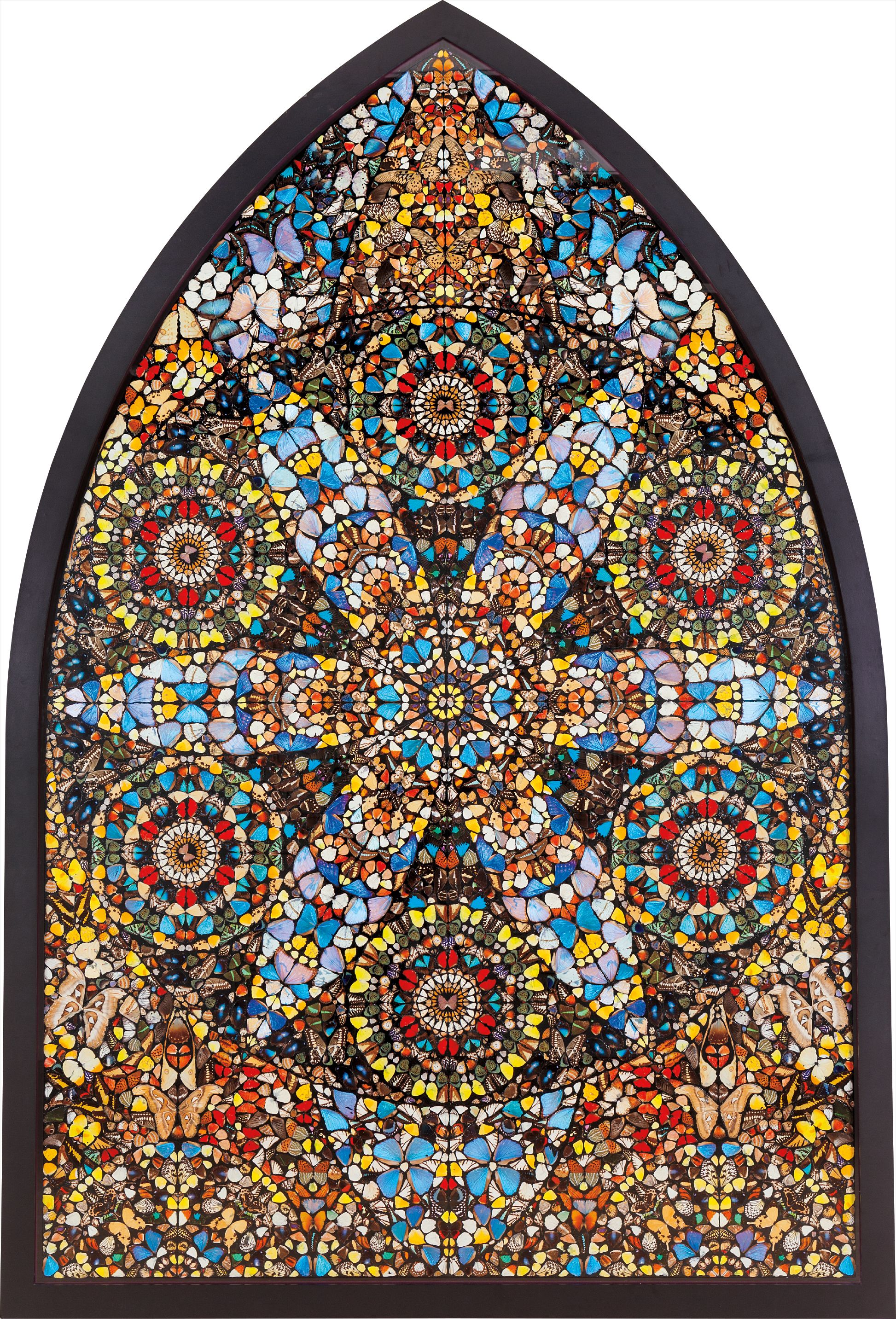
Disintegration - The Crown of Life
Full-Cataloguing
Hirst’s Kaleidoscope paintings are created by laying colorful butterfly wings into household paint and arranging them according to a very specific pattern, laid out and executed by Hirst. While the complete series is inspired by the religious iconography of stained glass, some of the pieces even reference specific, existing windows in churches throughout London. The spiritual nature of present lot and of the series is conveyed through not only the title, The Crown of Life, but also the symbolism of the butterfly. The "Crown of Life" refers directly to a line in the Bible, James 1:12 which states that those who remain steadfast under trial will be blessed to receive the crown of life promised to those who love God. This promise of life and resurrection is illustrated in the physical life of a butterfly. In antiquity, the image of the butterfly emerging form the chrysalis stood for the soul leaving the body at death. In Christian art the butterfly is a symbol of the resurrected human soul. The life-cycle of the caterpillar, chrysalis and butterfly symbolizes life, death and resurrection. As Hirst explains, “The death of an insect …. still has this really optimistic beauty,” which can be seen within the present lot. The Kaleidoscope paintings are created with only the iridescent wings of the butterfly, according to Hirst, this is done strategically to separate the dead butterflies from “the real thing.” (Damien Hirst in Damien Hirst, I Want to Spend the Rest of My Life Everywhere, with Everyone, One to One, Always, Forever, Now, 2005, p. 135) Hirst who has explained his obsession with death as “a celebration of life rather than something morbid,” strives artistically to find the beauty within the gruesome. (Damien Hirst cited in Damien Hirst and Gordon Burn, On the Way to Work, 2001, p. 21) The fragility of the natural world is clearly exposed in the present lot, laid out for the viewer to admire the permanence or hopeful non-permanence of death. The Crown of Life, 2006 beautifully conveys Hirst's obsession with color and light and the dichotomy of life and death, elegance and obscenity, immortality and extinction.
Damien Hirst
British | 1965There is no other contemporary artist as maverick to the art market as Damien Hirst. Foremost among the Young British Artists (YBAs), a group of provocative artists who graduated from Goldsmiths, University of London in the late 1980s, Hirst ascended to stardom by making objects that shocked and appalled, and that possessed conceptual depth in both profound and prankish ways.
Regarded as Britain's most notorious living artist, Hirst has studded human skulls in diamonds and submerged sharks, sheep and other dead animals in custom vitrines of formaldehyde. In tandem with Cheyenne Westphal, former Chairman of Phillips, Hirst controversially staged an entire exhibition directly for auction with 2008's "Beautiful Inside My Head Forever," which collectively totalled £111 million ($198 million).
Hirst remains genre-defying and creates everything from sculpture, prints, works on paper and paintings to installation and objects. Another of his most celebrated series, the 'Pill Cabinets' present rows of intricate pills, cast individually in metal, plaster and resin, in sterilized glass and steel containers; Phillips New York showed the largest of these pieces ever exhibited in the United States, The Void, 2000, in May 2017.