122
Gerrit Thomas Rietveld
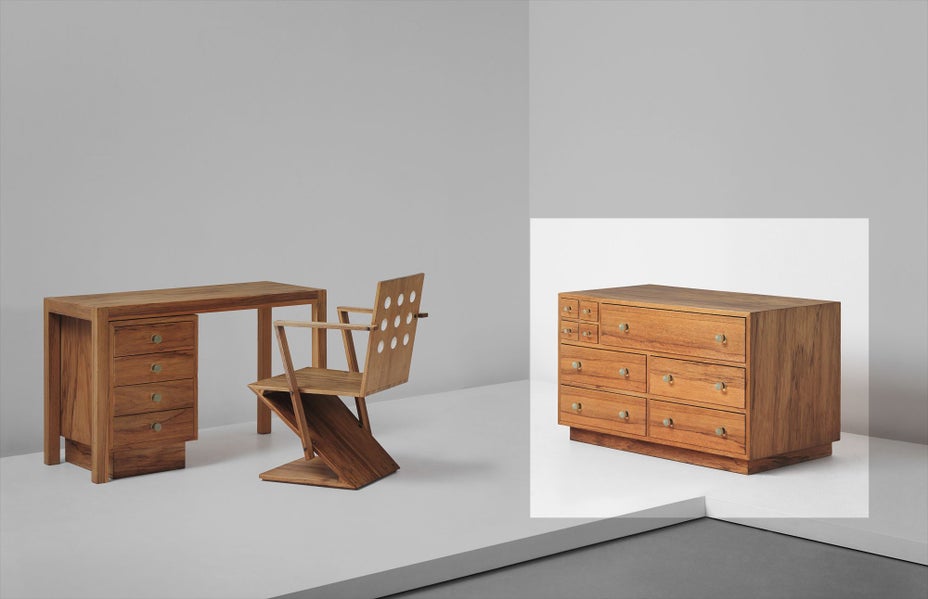
Cabinet, from the Redelé house, Dordrecht
Full-Cataloguing
The Rietveld-Schröder Archive in Utrecht contains drawings of the present desk and cabinet, along with multiple sketches of the floor plan and an extensive correspondence between Mr. and Mrs. Redele and Gerrit Rietveld and Truus Schröder. The Redelé commission is also recorded in the Rietveld literature, and is noted in what is essentially considered the Rietveld catalogue raisonné: Marijke Kuper and Ida van Zijl, Gerrit Th. Rietveld 1888-1964: The Complete Works, Centraal Museum, Utrecht, 1992, p. 224, cat. no. 376.
Gerrit Thomas Rietveld
Dutch | B. 1888 D. 1964Gerrit Thomas Rietveld began as an apprentice in his father's cabinetmaking workshop, going on to train and work as a draftsman. In 1917 he started his own furniture-making workshop in Utrecht. Positive critical review by Theo van Doesburg in his journal De Stijl resulted in near-instantaneous influence on broader developments in European modernism. This connection to the De Stijl movement also inspired him to introduce color to the posts, rails and terminals of his furniture. His resulting "Red-blue" armchair is among the most iconic chair designs of the twentieth century.
From the beginning, Rietveld embraced modernist principles of functionalism, simplicity of form and mass-production, and eventually moved away from De Stijl to become a member of the Congrès Internationaux d'Architecture Moderne (CIAM). Rietveld worked through the post-war years, completing a number of private residences, housing developments and institutions. He continued to design furniture for these commissions as well as for retailers like Metz & Co.