10
Damien Hirst
Lucy
Full-Cataloguing
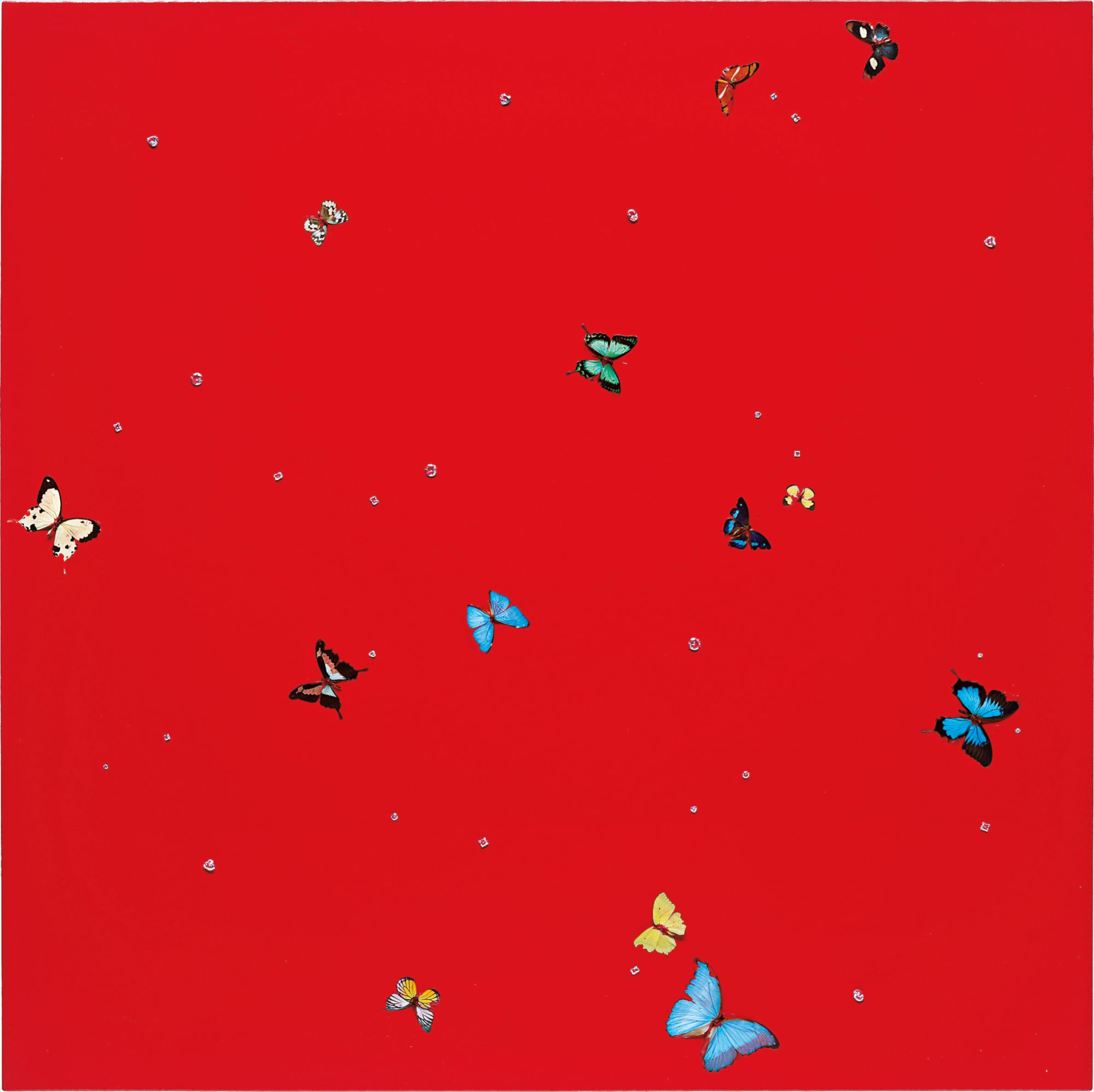
Created between 2008 and 2009, the refined and poetic Lucy is emblematic of Hirst’s single- panel butterfly monochromes. The exotic butterflies are affixed across the canvas against a saturated red background suggesting passion and love. The present lot is a vivid example of one of most definitive themes in Hirst’s artistic production: a dialogue between birth and death, beauty and cruelty; decisive identities that lie at the very core of existence and irrefutable poles in the artist’s theatrical style. Hirst’s appeal for butterflies is shaped by the seemingly life-like appearance in death. Regarding his source of inspiration for ‘In and Out of Love’ installation Hirst explained: “I worked out many possible trajectories for these things, like the way the real butterfly can destroy the ideal (birthday-card) kind of love; the symbol exists apart from the real thing. Or the butterflies still being beautiful even when dead.” (Damien Hirst & Sophie Calle:Internal Affairs (Jay Jopling/ICA, 1991))
The butterfly as a symbol of love and life is undermined in these works as the viewer is brutally confronted with the inescapable reality of death. The tragic beauty embodied in the butterfly emblem captures the seemingly physical presence of life retained in his sumptuous dead forms. The inescapable tension between the deep red monotone background and the exquisite diaspora of extravagant butterflies across the canvas magnifies the vanity implied in beauty. Loaded with bipolar symbols of life and death, splendour and decay, beauty and horror, fragility and preservation, Lucy constitutes Hirst’s tribute to the eternal circle of life and death; “when you get too deep into the darkness, you need to move it towards the light. The butterflies were a good way to get away”.
Damien Hirst
British | 1965There is no other contemporary artist as maverick to the art market as Damien Hirst. Foremost among the Young British Artists (YBAs), a group of provocative artists who graduated from Goldsmiths, University of London in the late 1980s, Hirst ascended to stardom by making objects that shocked and appalled, and that possessed conceptual depth in both profound and prankish ways.
Regarded as Britain's most notorious living artist, Hirst has studded human skulls in diamonds and submerged sharks, sheep and other dead animals in custom vitrines of formaldehyde. In tandem with Cheyenne Westphal, former Chairman of Phillips, Hirst controversially staged an entire exhibition directly for auction with 2008's "Beautiful Inside My Head Forever," which collectively totalled £111 million ($198 million).
Hirst remains genre-defying and creates everything from sculpture, prints, works on paper and paintings to installation and objects. Another of his most celebrated series, the 'Pill Cabinets' present rows of intricate pills, cast individually in metal, plaster and resin, in sterilized glass and steel containers; Phillips New York showed the largest of these pieces ever exhibited in the United States, The Void, 2000, in May 2017.