6
Henri Cartier-Bresson
Cuba
Full-Cataloguing
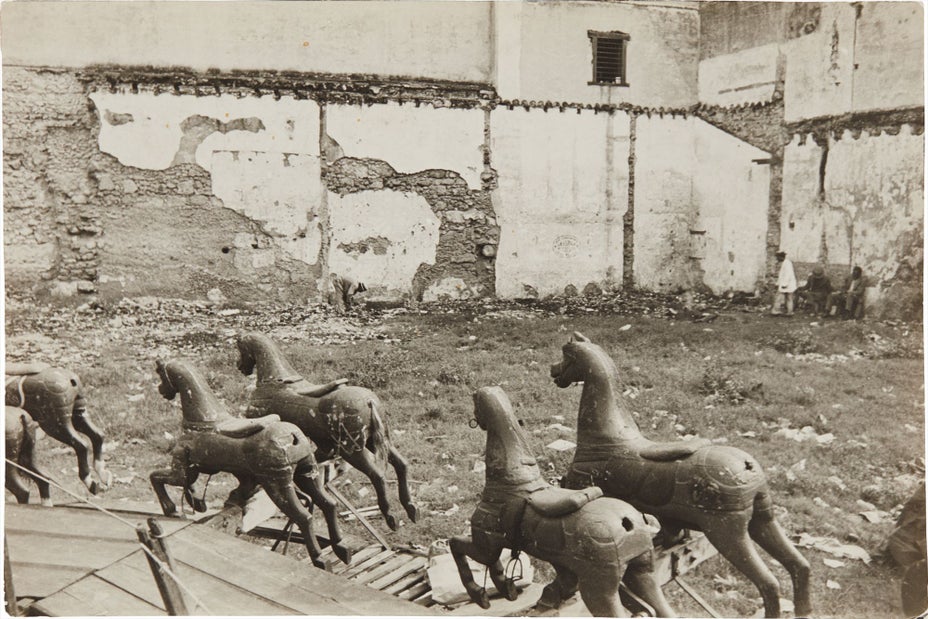
Nearly absent of any human presence, the derelict carousel, crumbling walls, and littered field are simultaneous signs of a socially conscious ethos and Surrealist eye. “Surrealism has had a profound effect on me,” Cartier-Bresson stated, “and all my life I have done my utmost never to betray it." That this particular image survived the photographer’s stringent editing just prior to the Second World War, when he disposed of a good number of negatives, is significant. The image stands as a striking combination of both Cartier-Bresson’s larger body of work during the 1930s that focused on the public lives of the poor in Europe and Latin America, as well as his personal interest in Surrealism.
The present lot belonged to critic, historian and author Ben Maddow, a gift from the photographer, whom he met in New York in 1935 through a leftist filmmaking group, Nykino that was led, in part, by Paul Strand. Maddow reviewed Cartier-Bresson’s seminal 1947 exhibition at the Museum of Modern Art for The Photo League Bulletin, writing of his work that “time is dissected here by the shutter of his Leica as if by the sectioning knife in a biological laboratory. It is the freezing, the preservation of the second that otherwise decays so easily. But in this process, the slice through time becomes enlarged, becomes gigantic in its human implications.”
Some sixty years following, this print was sent to Cartier-Bresson for his signature. When returned, it featured more than a simple signature, but rather an extensive inscription on the verso, which, among other things, noted that Cartier-Bresson had given other prints of the image to the cultural luminaries Beaumont Newhall, Julien Levy and Lincoln Kirsten. He further remarked on the print’s rarity: “A real ‘vintage’, one of the few I printed myself at the time.”
Henri Cartier-Bresson
French | B. 1908 D. 2004Candidly capturing fleeting moments of beauty among the seemingly ordinary happenings of daily life, Henri Cartier-Bresson's work is intuitive and observational. Initially influenced by the Surrealists' "aimless walks of discovery," he began shooting on his Leica while traveling through Europe in 1932, revealing the hidden drama and idiosyncrasy in the everyday and mundane. The hand-held Leica allowed him ease of movement while attracting minimal notice as he wandered in foreign lands, taking images that matched his bohemian spontaneity with his painterly sense of composition.
Cartier-Bresson did not plan or arrange his photographs. His practice was to release the shutter at the moment his instincts told him the scene before him was in perfect balance. This he later famously titled "the decisive moment" — a concept that would influence photographers throughout the twentieth century.