Article | Think You Know How To Read The Time Part Two Unconventional Watch Displays Phillips Hong Kong Fall 2026 Online Auction
Think You Know How to Read the Time? Think Again – Part Two
Nine watches that challenge our most basic assumptions about how time should be displayed – and how we should read it.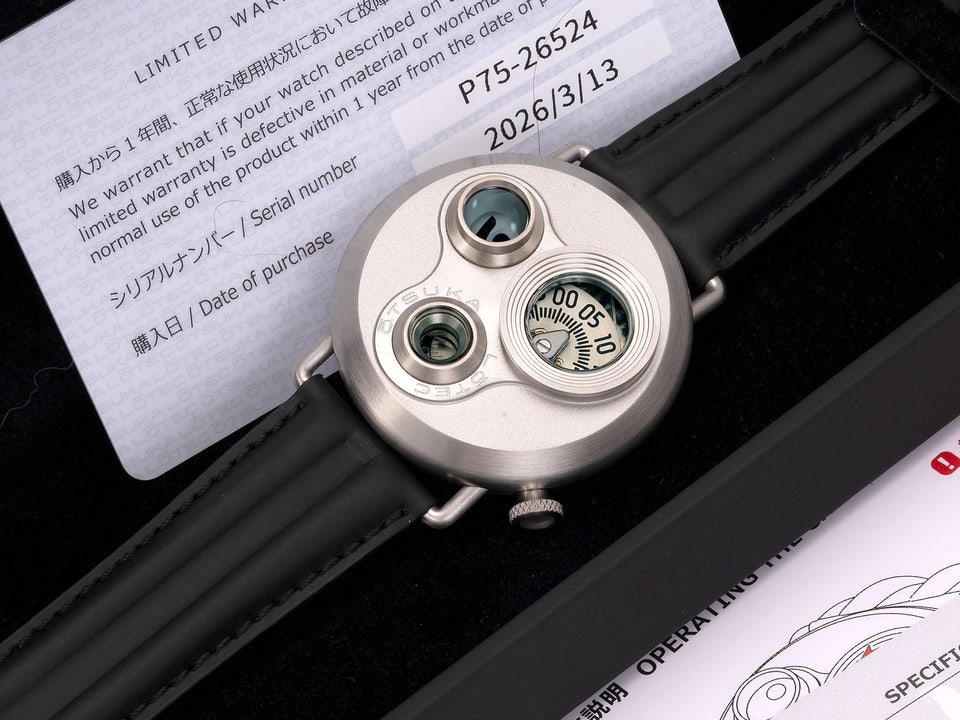
Phillips in Association with Bacs & Russo is pleased to present The Hong Kong Sessions, Fall 2026, an online auction running from 17–24 September. Featuring more than 150 exceptional luxury timepieces from leading makers including A. Lange & Söhne, Audemars Piguet, F.P. Journe, Vacheron Constantin and Patek Philippe, the sale includes all nine watches featured in this story.
Earlier this month, ahead of The Geneva Sessions, Fall 2026, we looked at five watches that challenged some of the basic rules we learn when first being taught to tell the time. We found that numerals could be scrambled, hours could wander, hands can refuse to travel in circles, and, in one mischievous example, the dial can smile back at you.
As it turns out, we had barely scratched the surface.
For all the familiarity of the conventional watch dial – two or three hands rotating clockwise at the center of 12 ordered numerals – watchmakers have devised an impressive number of alternatives.
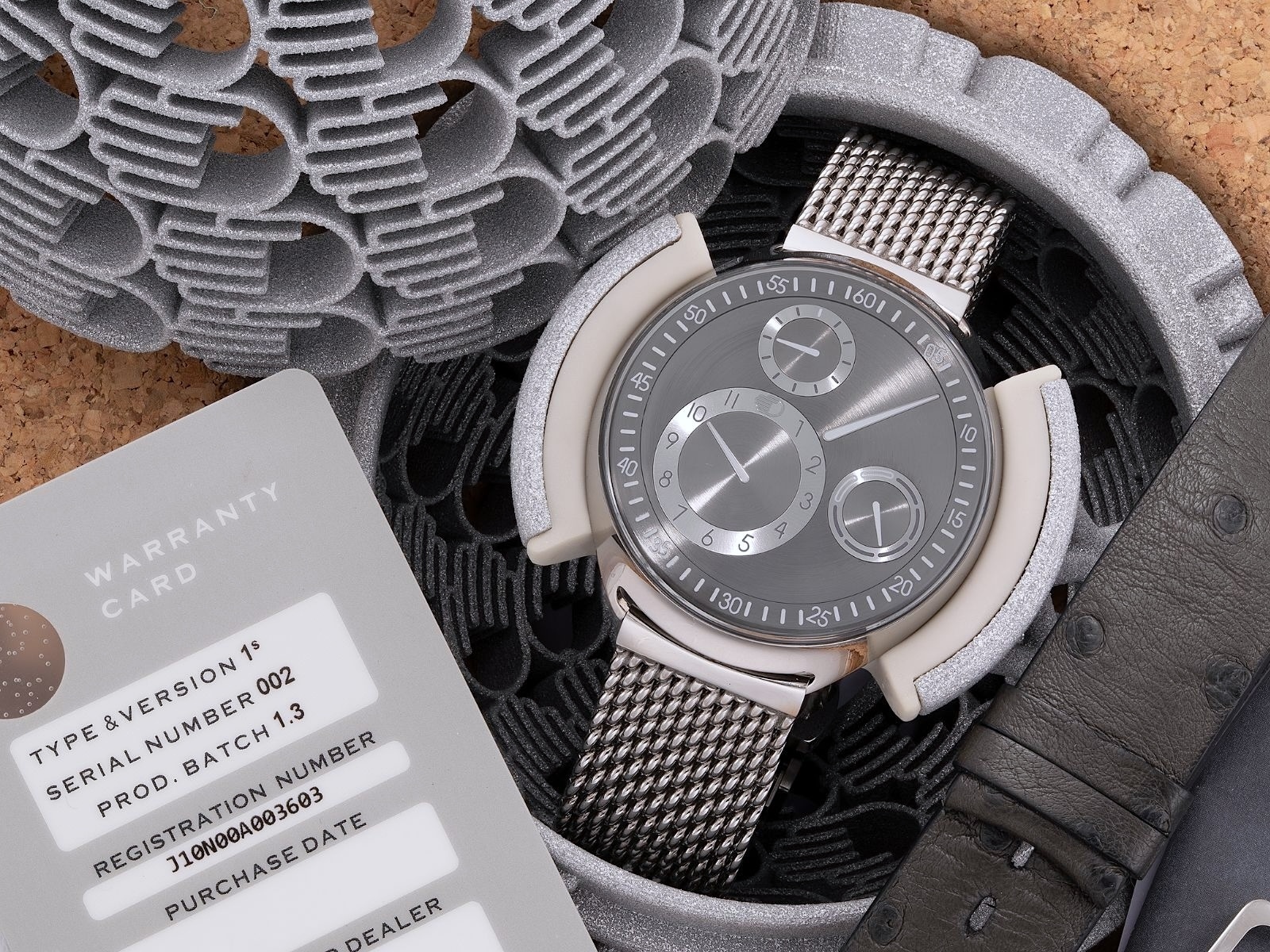
Lot 8111: A circa 2019 Ressence Type 1 Slim “Ruthenium/Silver” Ref. Type 1S in titanium, included in the Phillips Hong Kong Sessions, Fall 2026. Estimate: HKD $75,000–150,000
It so happens that hours and minutes can jump instantaneously in windows. The dial itself can rotate. Hands can be separated and given different jobs, while the architecture of a camera or an analog pressure gauge can provide a completely different starting point for displaying the time.
The nine watches gathered here – all included in The Hong Kong Sessions, Fall 2026 – take us further down that particular rabbit hole. Some draw on ideas that are centuries old, while others could hardly look more contemporary – and several make you stop for a moment to work out what exactly you are looking at.
So, think you know how to read the time? Once again, think again…
The Hours Don't Have to Stay Put
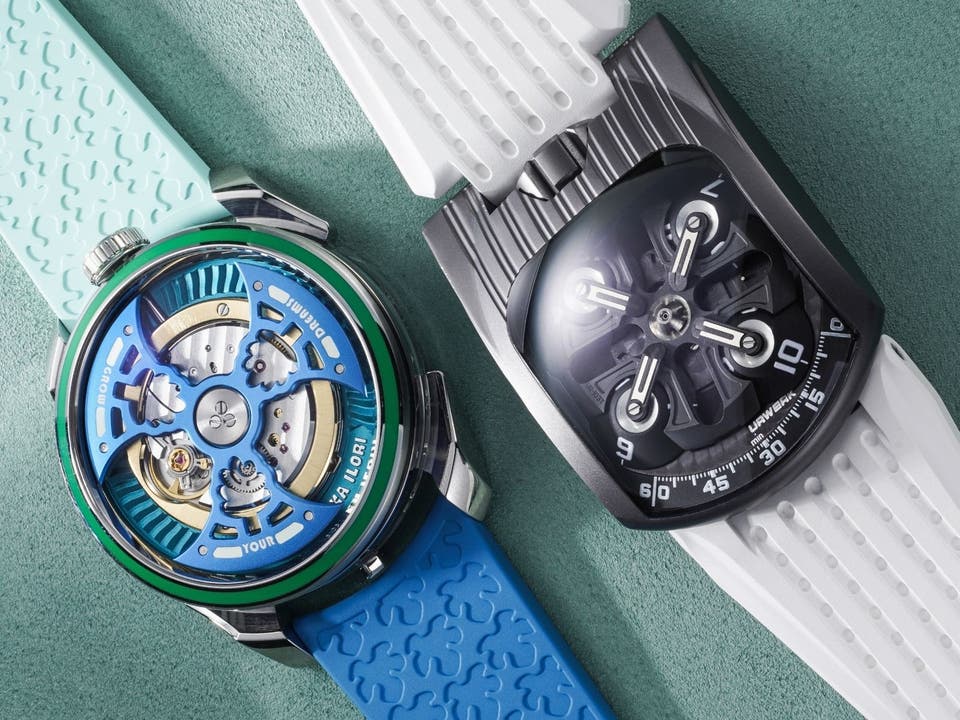
We encountered wandering hours in Part One, but the concept leaves plenty of room for interpretation. Urwerk has spent much of its three-decade existence proving precisely that. Its UR-105 TA, introduced in 2015, uses four satellites, each carrying three hour numerals, which orbit beneath the case's protective cover and take turns traversing the minute scale.
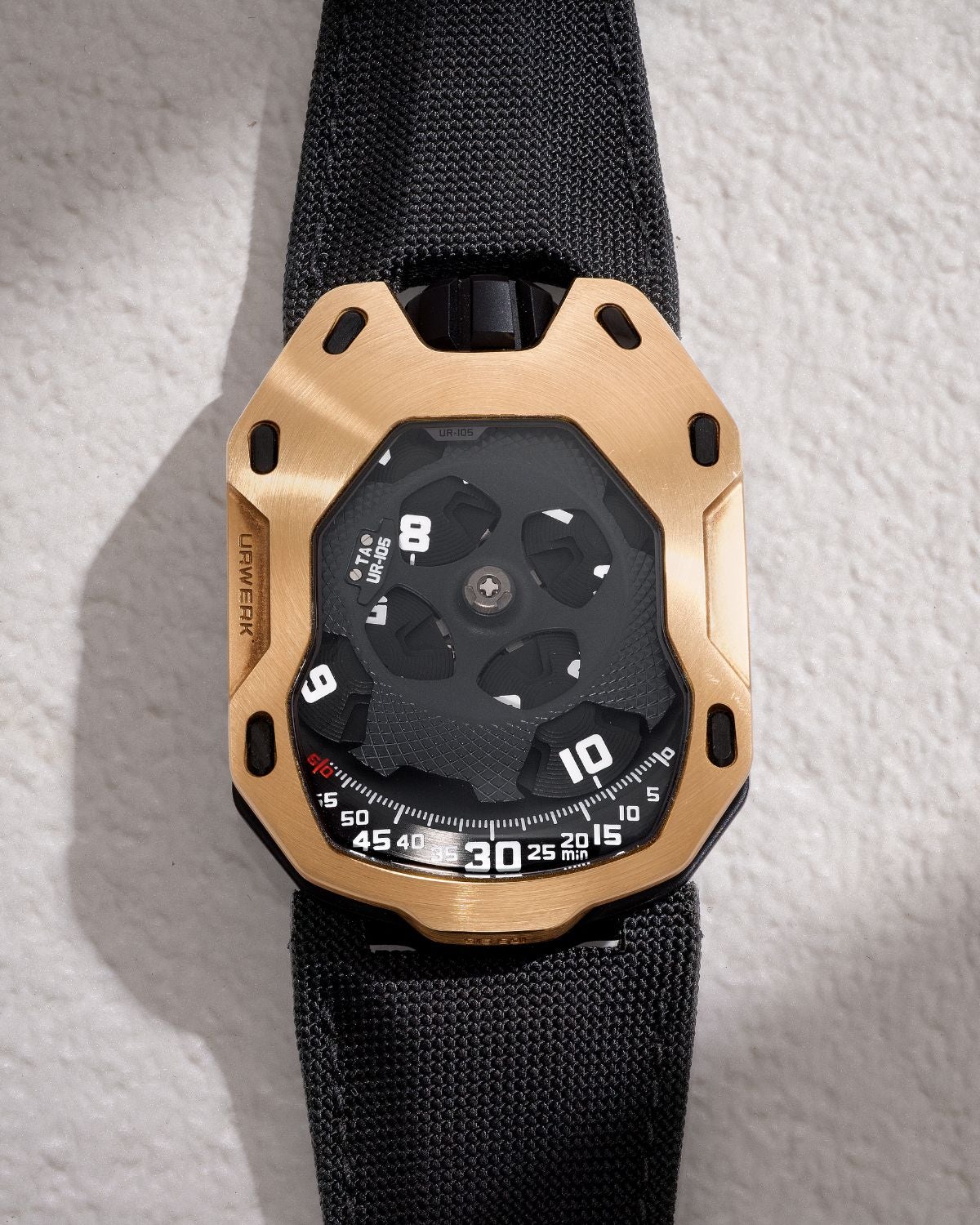
Lot 8020: A circa 2015 Urwerk UR-105 TA “Knights” Ref. UR-105 TA RG in titanium and 18k pink gold, included in the Phillips Hong Kong Sessions, Fall 2026. Estimate: HKD $100,000–200,000
The UR-105 TA RG offered here – number 27 of 100 – adds another layer to the watch's machine-age personality, pairing black PVD-coated titanium with an 18K pink gold bezel, if you can call it that. Its armor-like construction inspired brand co-founder and design ace Martin Frei to describe the model as the “URWERK Knight.”
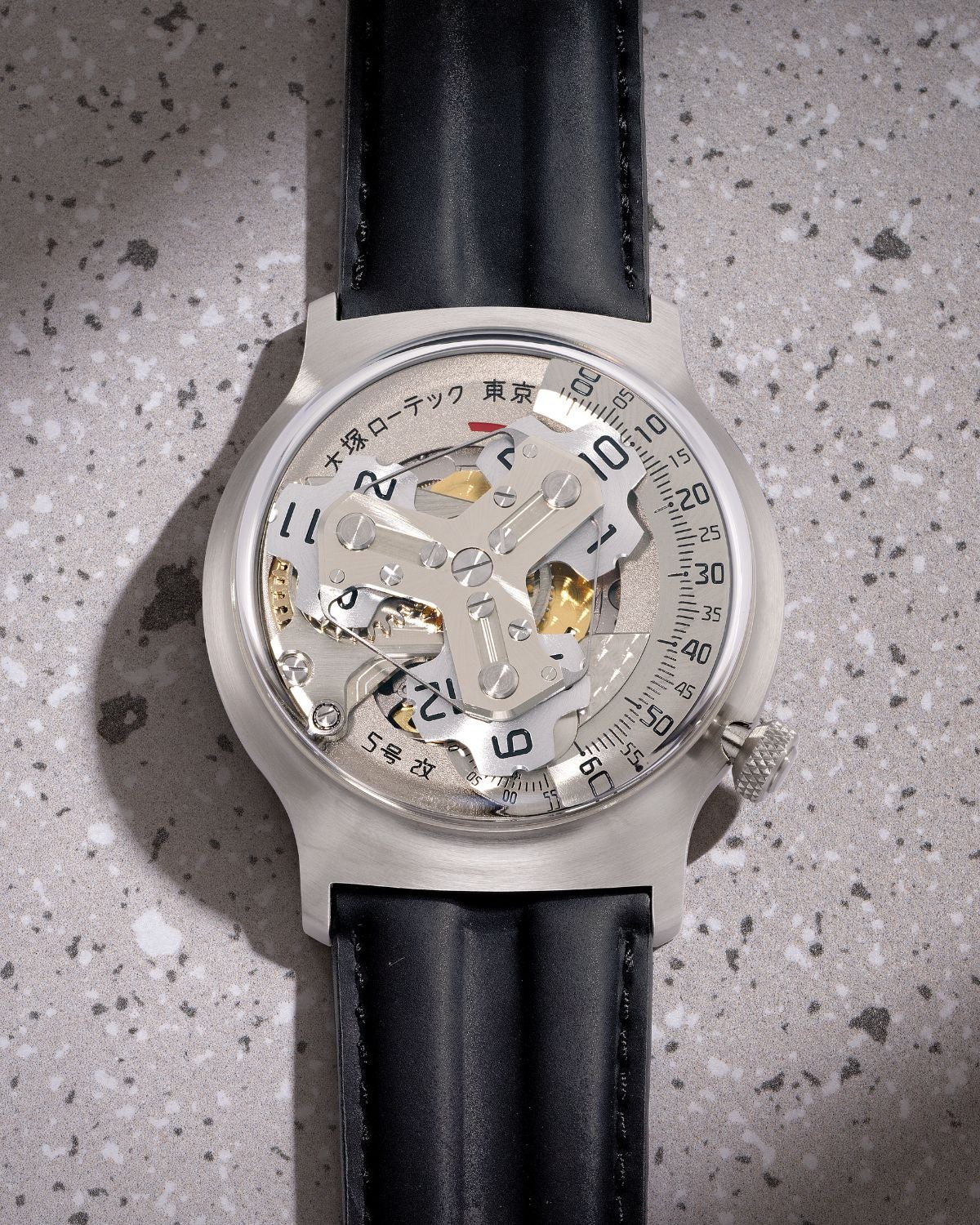
Lot 8152: A circa 2026 Otsuka Lotec Model No. 5 Kai in stainless steel, included in the Phillips Hong Kong Sessions, Fall 2026. Estimate: HKD $30,000–50,000
Otsuka Lotec's Model No. 5 Kai approaches satellite hours from a very different direction. Introduced by brand founder and former automotive designer Jiro Katayama in 2025 as a complete reworking of the original Model No. 5, it replaced that watch's regulator-style mechanism with three rotating hour discs. As each takes its turn indicating the time, the numeral itself becomes part of the machinery in motion.
Hands Can Reach the End of the Line
The hands of Otsuka Lotec's Model No. 6 have somewhere to go – and, more importantly, somewhere from which to return.
Inspired by analog measuring instruments, Katayama arranged the hours and minutes across a fan-shaped display, with two superimposed retrograde hands sharing the same axis. The minute hand takes an hour to cross its 60-minute scale, while the hour hand makes the same journey over 12 hours. At noon and midnight, both whip back simultaneously to zero and begin again.
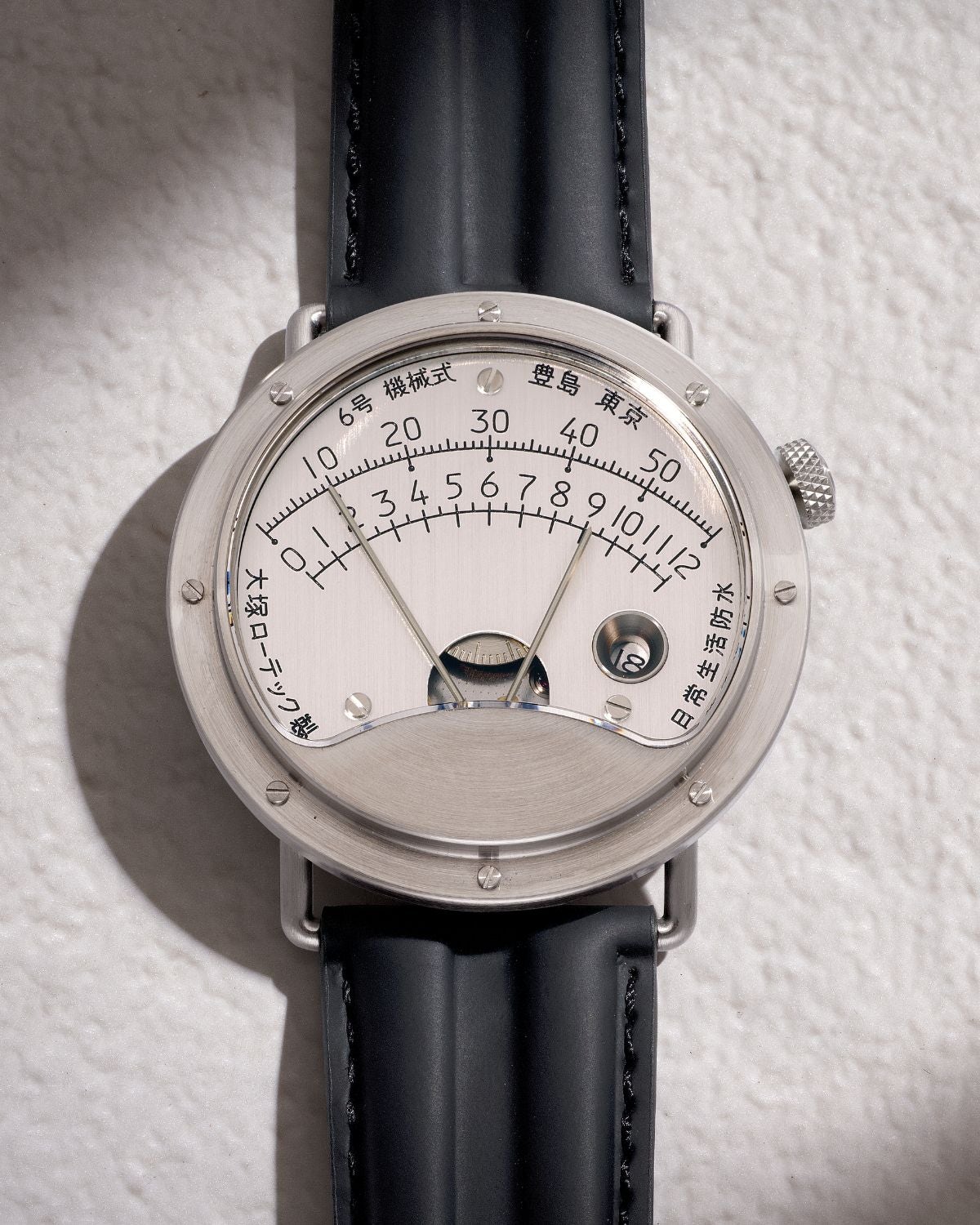
Lot 8153: A circa 2026 Otsuka Lotec Model No. 6 in stainless steel, included in the Phillips Hong Kong Sessions, Fall 2026. Estimate: HKD $30,000–50,000
It is a fine example of Katayama's fascination with industrial apparatus. The dial could almost have been lifted from a pressure gauge, right down to its Japanese inscriptions and functional typewriter font, while the modified Miyota caliber 9015 beneath it carries an in-house retrograde module.
That approach earned the Tokyo-based maker the Challenge Watch Prize at the 2024 Grand Prix d'Horlogerie de Genève – further evidence that a pair of hands can get surprisingly far without ever completing a circle.
The Dial Doesn't Have to Stand Still
With the Ressence Type 1 Slim, it is tempting to ask a different question: where – or even what – is the dial?
Ressence founder Benoît Mintiens' answer comes through the Ressence Orbital Convex System, or ROCS, a display concept that can be traced back to the brand's first watches in 2010.
Instead of conventional hands turning above a fixed surface, the Type 1 Slim uses a rotating main disc to indicate the minutes, carrying with it three smaller displays for the hours, seconds, and day of the week. Those discs also rotate on their own axes. Think of moons traveling around a planet and you begin to get the picture.
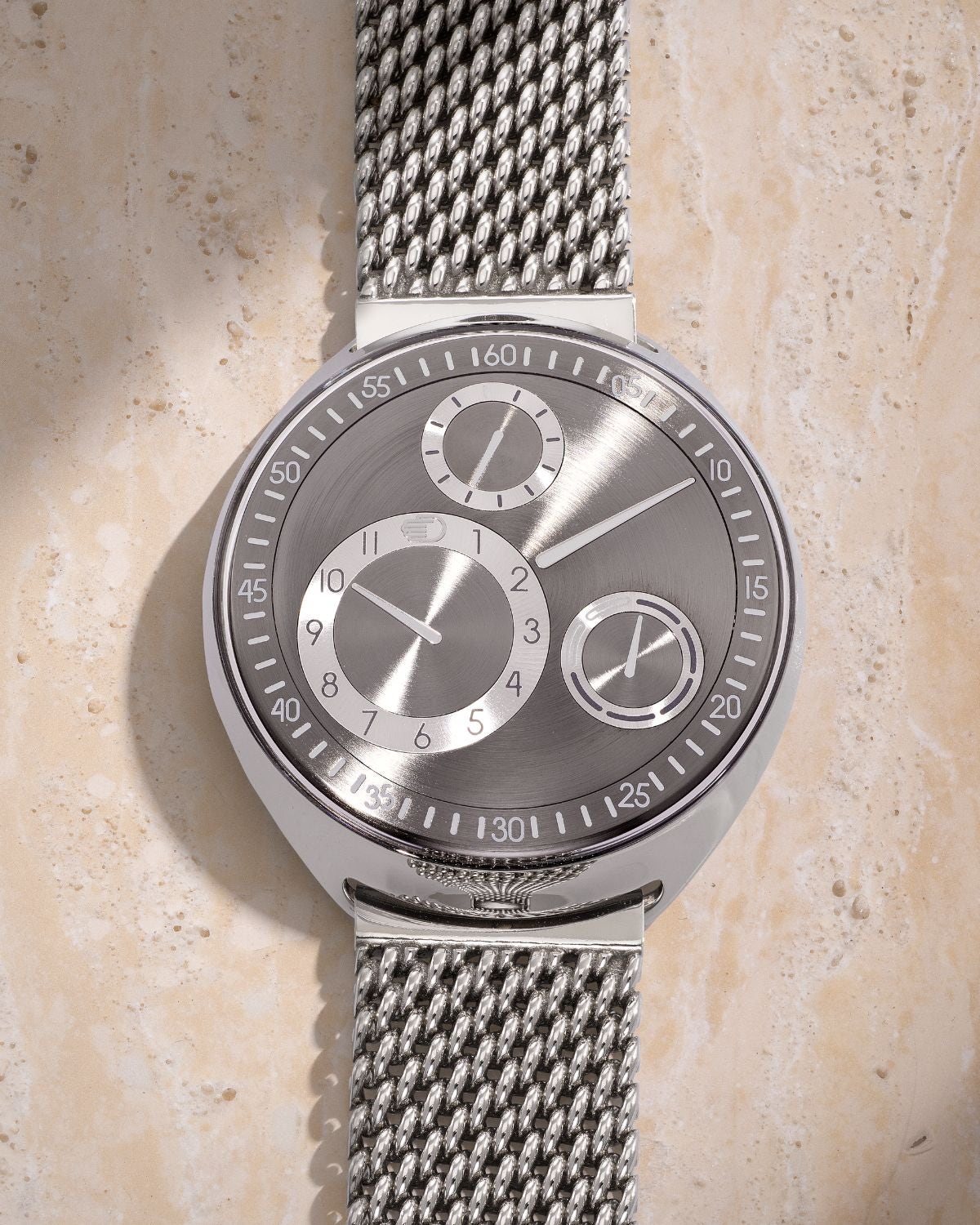
Lot 8111: A circa 2019 Ressence Type 1 Slim “Ruthenium/Silver” Ref. Type 1S in titanium, included in the Phillips Hong Kong Sessions, Fall 2026. Estimate: HKD $75,000–150,000
The system also does away with the usual visual hierarchy of hands sitting above a dial. Everything occupies the same gently curved surface, which in the example offered here is silver coated with ruthenium.
Introduced in 2019, the Slim retained the Type 1's 42mm diameter but reduced its thickness from 13mm to 11mm, with a redesigned case and more integrated lugs. It also replaced the earlier Type 1's rotating sapphire caseback with a recessed lever for winding and setting – a more compact system that helped make that slimness possible.
You Can Read the Time Straight From a Number
Most analog watches ask us to perform a tiny piece of mental geometry. We judge the position of a hand against a scale and translate its angle into a number. The A. Lange & Söhne Zeitwerk dispenses with that calculation.
Introduced in 2009, the Zeitwerk presents the time digitally, with jumping hours and minutes displayed horizontally across two apertures and changing instantaneously when required.
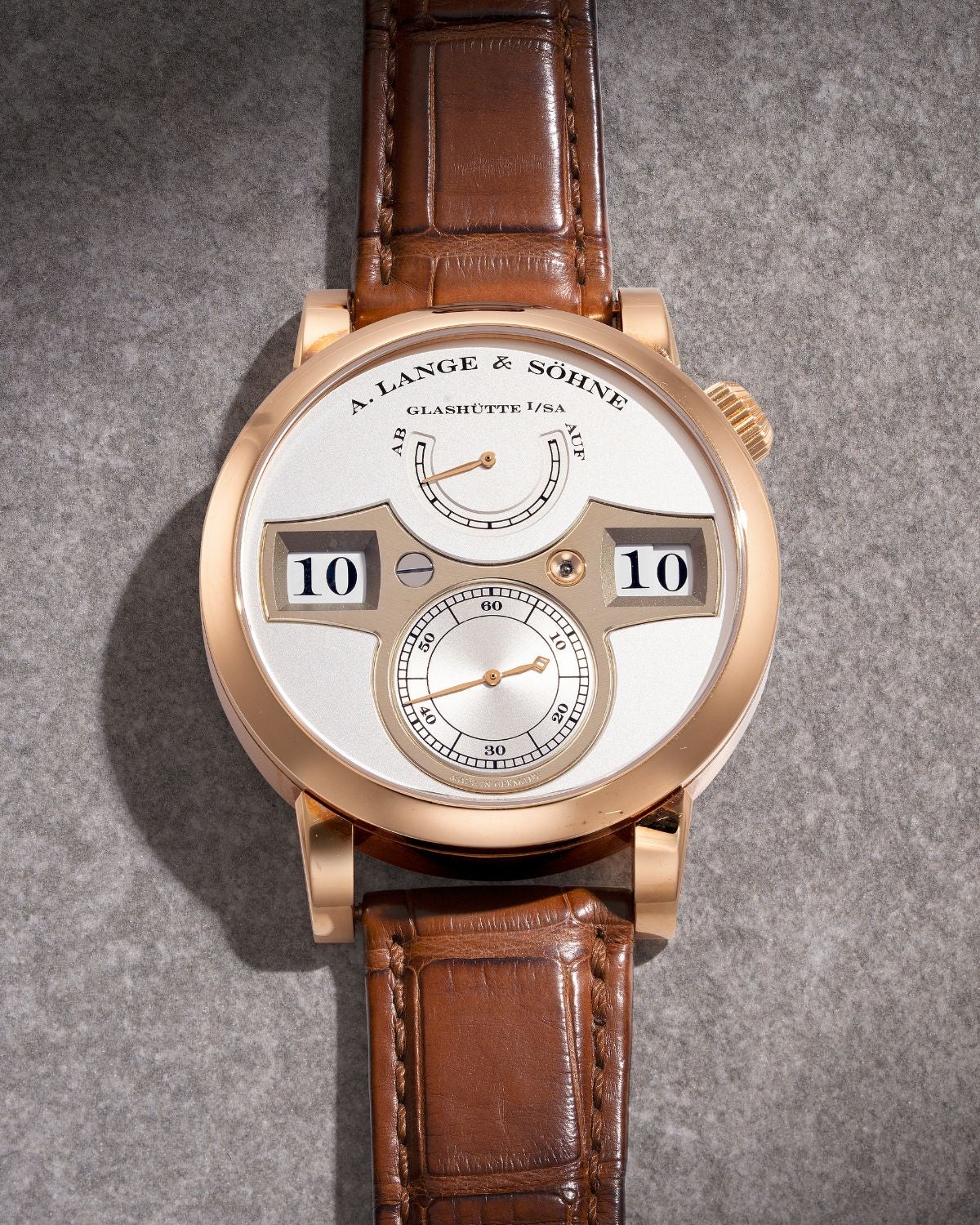
Lot 8050: A circa 2020 A. Lange & Söhne Zeitwerk Ref. 140.032F in 18k pink gold, included in the Phillips Hong Kong Sessions, Fall 2026. Estimate: HKD $250,000–450,000
The idea has considerable history behind it. In 1883, Austrian watchmaker Josef Pallweber patented a system for displaying jumping hours and minutes through apertures, which was subsequently used in pocket watches by makers including IWC. By the early 20th century, the idea had migrated to the wrist, with Cartier's Tank à Guichets of 1928 among its best-known expressions.
The Zeitwerk’s apparent simplicity conceals a formidable mechanical problem: at the top of every hour, three numeral discs must jump at precisely the same moment. The caliber L043.1 uses a constant-force mechanism to manage the energy demands of the display.
Chaumet's Les Pléiades approached the same idea of reading time through apertures from a very different direction. The collection appeared in 1992, and its original mechanical Ref. 10A had an unexpected connection to a then little-known François-Paul Journe, who was commissioned to develop its movement and jump-hour mechanism.
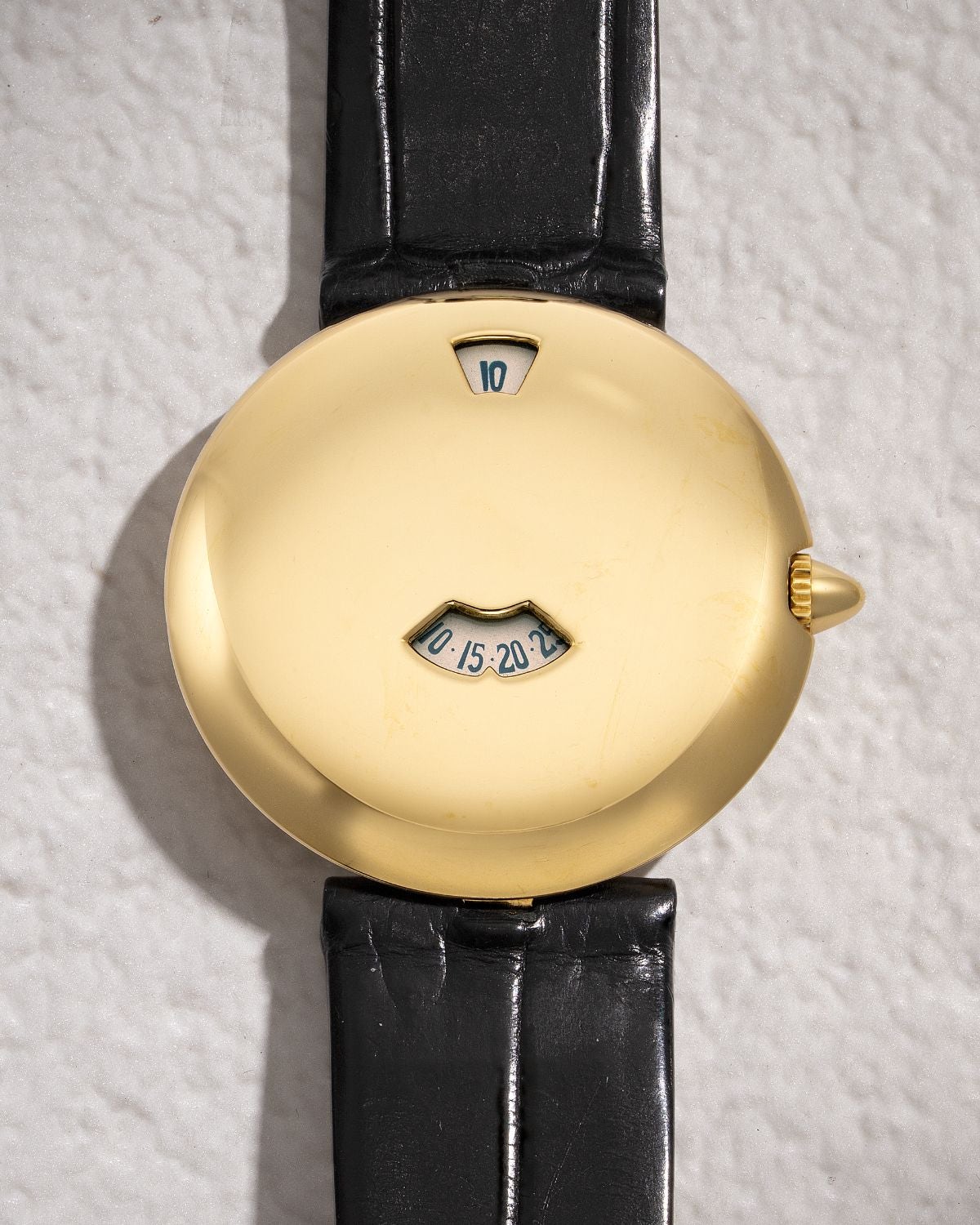
Lot 8009: A circa 1990s Chaumet Les Pléiades Ref. 11A in 18k yellow gold, included in the Phillips Hong Kong Sessions, Fall 2026. Estimate: HKD $15,000–30,000
The smaller 30mm Ref. 11A seen here is quartz, but it retains the collection's distinctive way of presenting time through apertures within its flying-saucer-like yellow gold case.
Time Doesn't Need a Single Center
The conventional watch asks its hour and minute hands to share an axis. Frank Jutzi's contribution to Goldpfeil's Seven Masters project sends them their separate ways.
Created in 2001, Seven Masters brought Goldpfeil together with seven members of the Académie Horlogère des Créateurs Indépendants (AHCI), each charged with producing a watch of his own design.
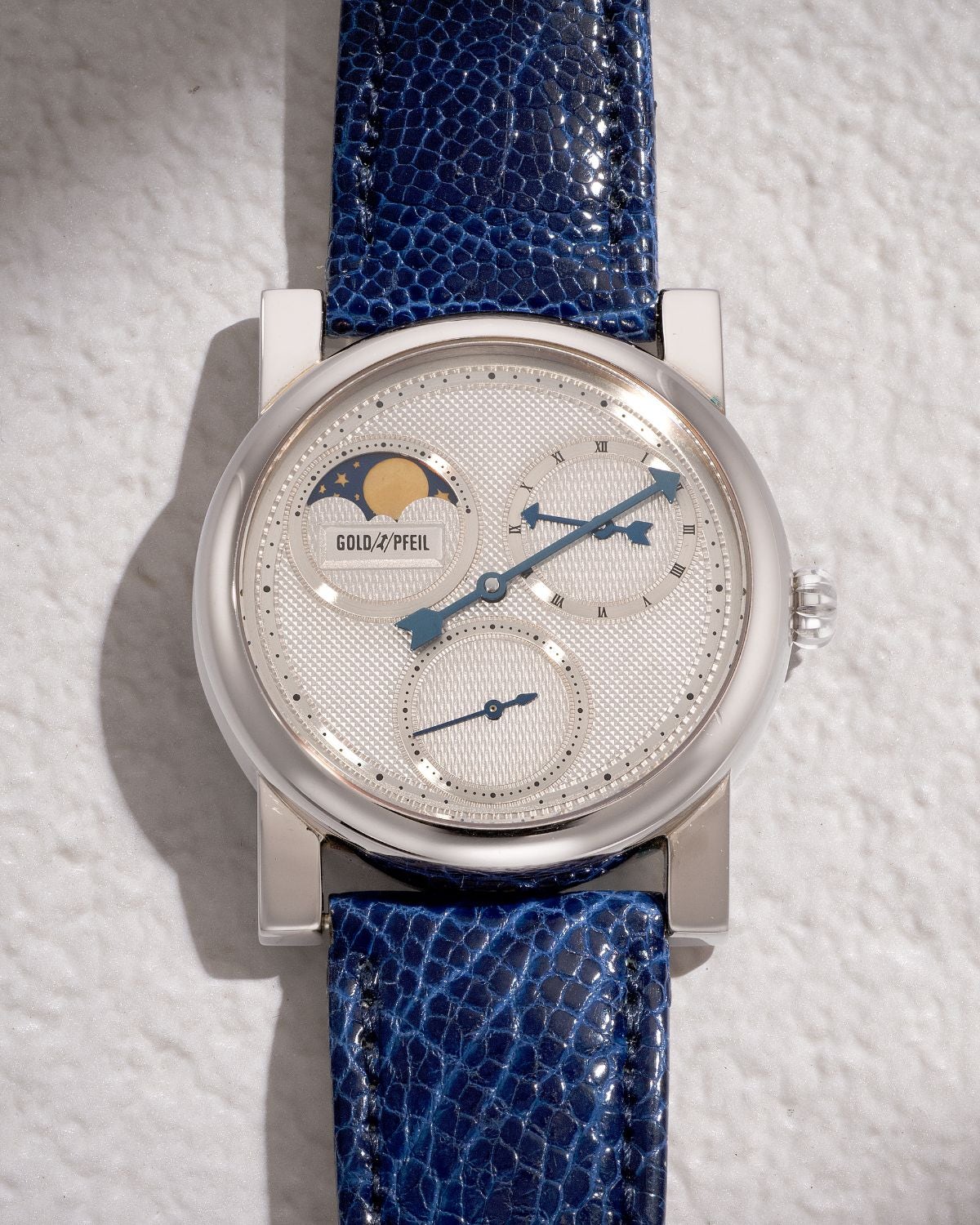
Lot 8119: A circa 2000s Goldpfeil Seven Masters Frank Jutzi Ref. GPFJ in 18k white gold, included in the Phillips Hong Kong Sessions, Fall 2026. Estimate: HKD $40,000–80,000
Jutzi opted for a regulator-style arrangement: the minutes occupy the main dial, the hours move to their own subsidiary dial, and running seconds sit at 6 o'clock, joined by a moonphase indication at 10 o’clock.
There is nothing new about the regulator principle itself – its roots stretch back to precision clocks from the 18th century in which separating the indications made them easier to read.
Jutzi uses that centuries-old arrangement to disrupt one of our most deeply ingrained habits: expecting the hour and minute hands to meet at the center of the dial.
The Dial Can Borrow From Other Machines
What does a rangefinder camera have in common with an 8mm turret camera? For Vianney Halter and Jiro Katayama, each offered a way of rethinking the architecture of a watch.
Halter's contribution to the Goldpfeil Seven Masters project takes the idea and runs with it. Inspired by vintage rangefinders, his rectangular white gold watch divides its indications between separate openings, with jumping hours at the upper left, moonphase at the upper right, and minutes below.
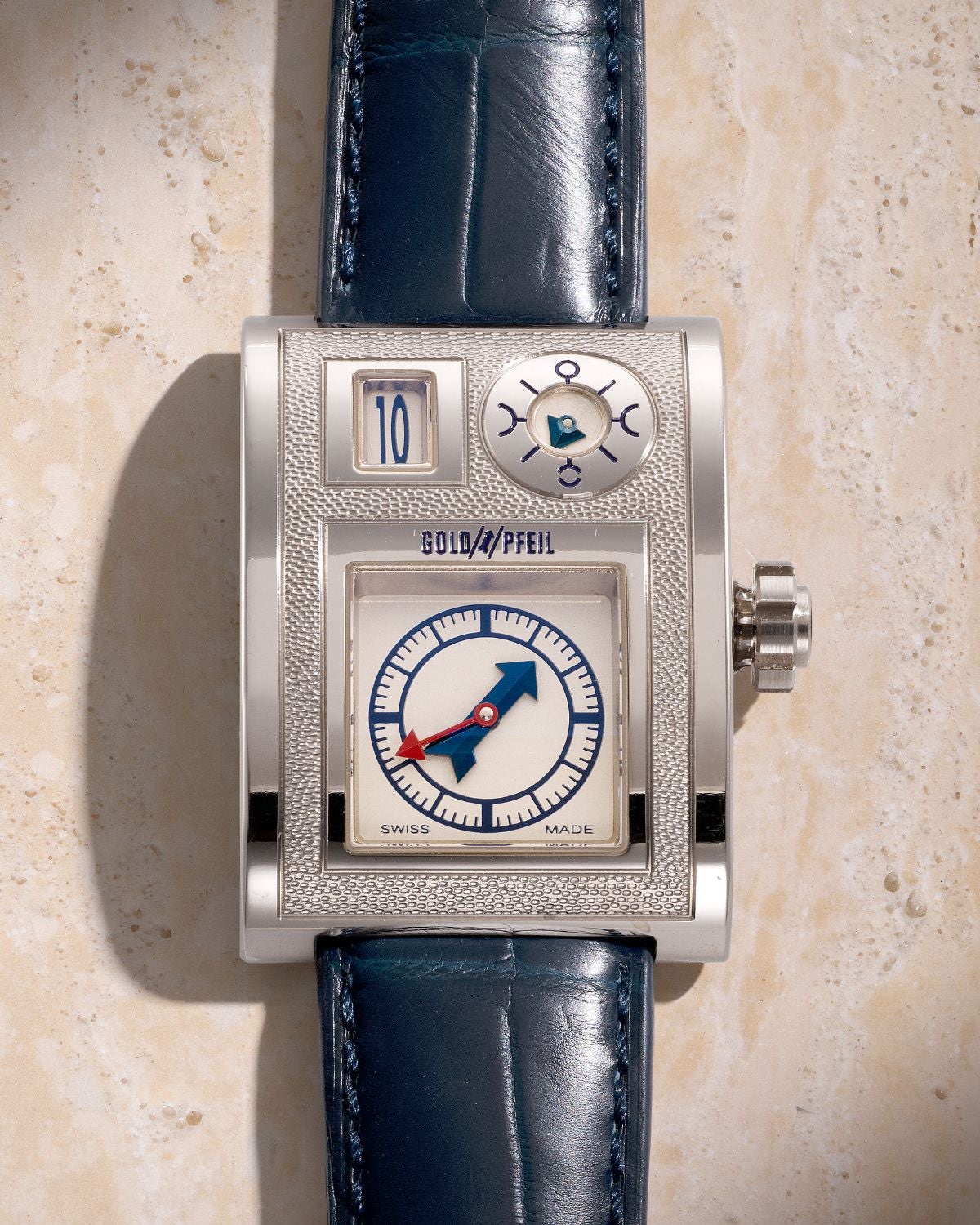
Lot 8118: A circa 2000s Goldpfeil Seven Masters Vianney Halter Ref. GPVH in 18k white gold, included in the Phillips Hong Kong Sessions, Fall 2026. Estimate: HKD $60,000–100,000
Hundreds of hand-hammered dimples mimic an old camera's leather covering, while the crown recalls a film-winding knob and the buckle takes further cues from camera hardware.
Two decades later, Katayama looked to vintage cinematography for Otsuka Lotec's Model No. 7.5. Its three circular displays recall the rotating lens turret of an 8mm movie camera, separating jumping hours, rotating minutes, and running seconds into their own apertures.
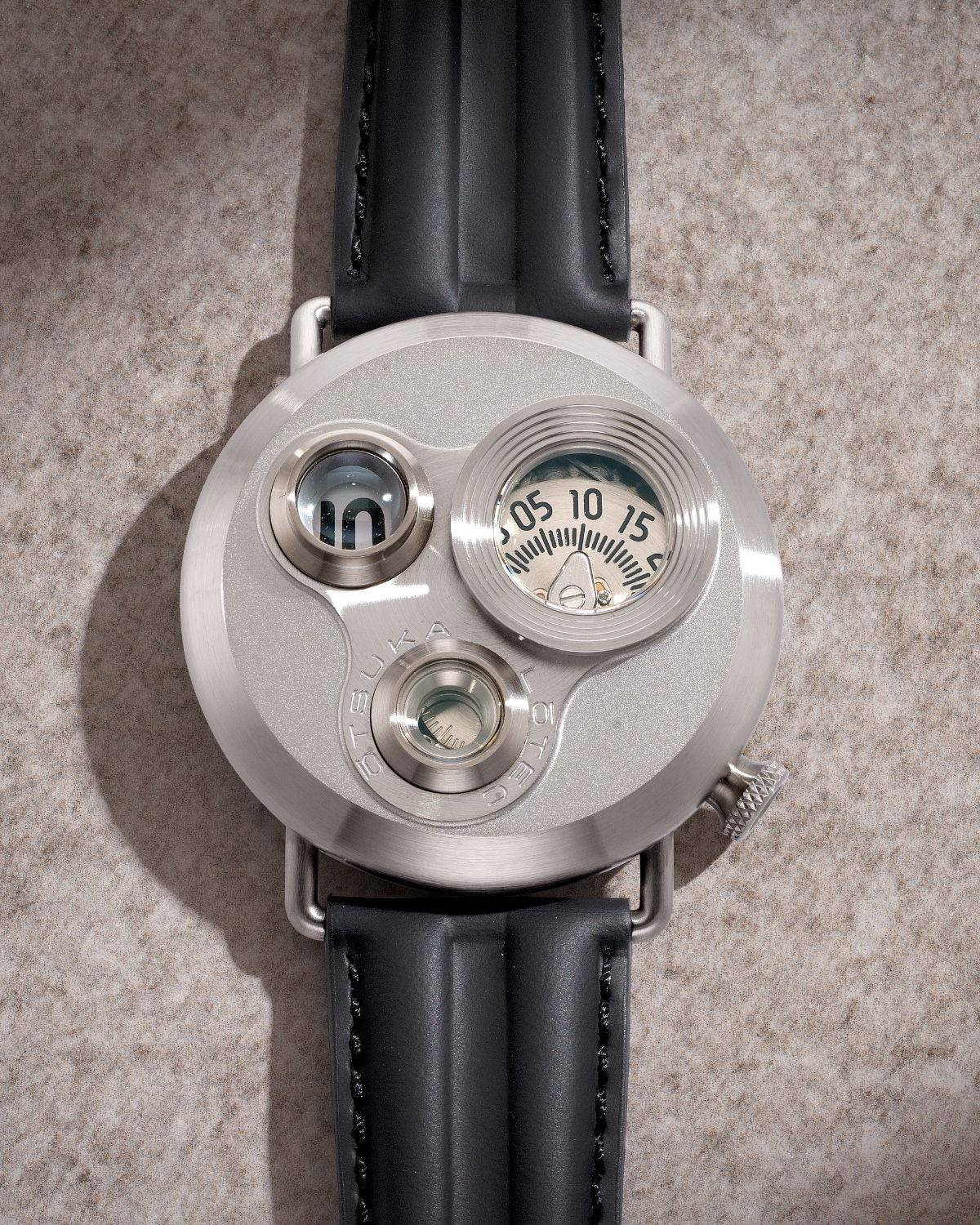
Lot 8154: A circa 2026 Otsuka Lotec Model No. 7.5 in stainless steel, included in the Phillips Hong Kong Sessions, Fall 2026. Estimate: HKD $30,000–50,000
The resemblance between the two watches is coincidental rather than genealogical. But what connects them is the idea behind them: sometimes the best way to rethink a watch dial is to stop looking at watches.
You can learn more, place a bid, and view the entire Hong Kong Sessions, Fall 2026, catalog here.