文章 | Minute Repeaters Different Approaches Chiming Watches Phillips Hong Kong Watch Auction Xxiii November 2026
Sound Judgment: Different Approaches to the Minute Repeater
Dial-side hammers, longer gongs, and a miniature soundboard: ten watches reveal the choices behind telling the time by ear.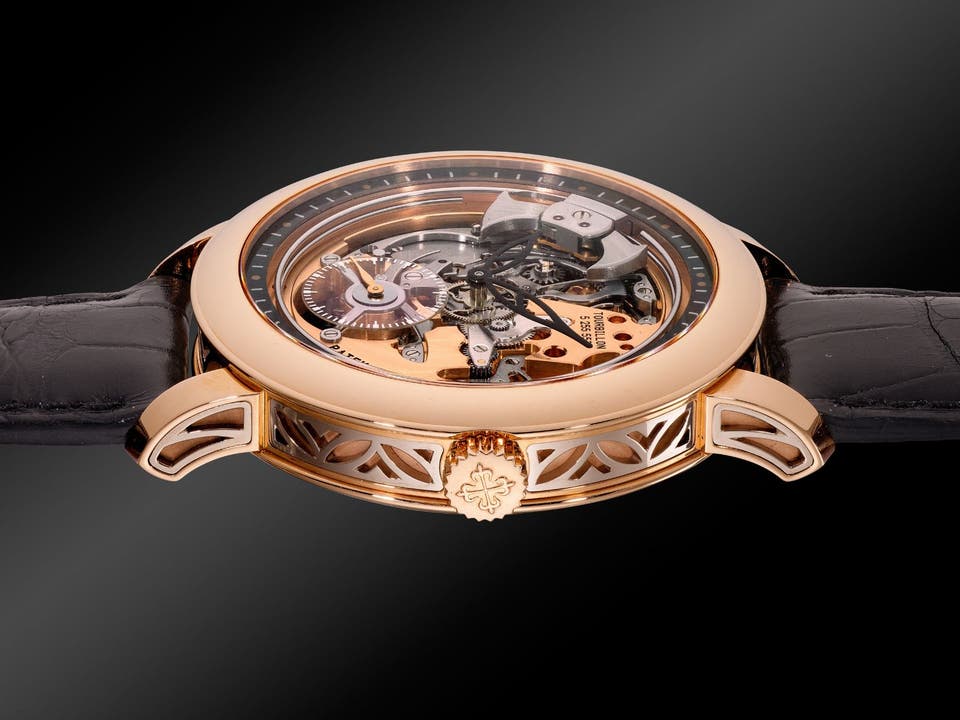
Phillips in Association with Bacs & Russo presents The Hong Kong Watch Auction: XXIII, a live auction taking place on 21–22 November 2026 at our West Kowloon headquarters. Featuring more than 320 exceptional luxury timepieces from makers such as Patek Philippe, Rolex, Audemars Piguet, Cartier, Vacheron Constantin, and F.P. Journe, the sale includes the ten minute repeaters explored in this story
For much of the pocket watch’s history, checking the time at night could mean fumbling for a candle. A repeater offered its owner another option: press a button or operate a slide, and listen to the watch sound the time. A useful solution, provided you could afford one.

Reading after dark by candlelight: Matthias Stom’s A Young Man Reading by Candlelight, circa 1630. Nationalmuseum, Stockholm. Image via Artvee (public domain)
Electric lighting has largely removed that necessity. The appeal of hearing tiny hammers strike the time has proved harder to extinguish. Ten minute repeaters in The Hong Kong Watch Auction: XXIII give us plenty to listen to, and several different ways of thinking about what makes these watches tick – and chime.
Time by Ear
Repeating pocket watches appeared around 1680. In England, Daniel Quare and Edward Barlow competed to develop them; Quare’s single-push-piece design secured a patent in 1687. Early examples struck small bells, which took up precious space inside the case. In 1783, Abraham-Louis Breguet introduced a steel gong spring, subsequently coiled around the movement, helping to make repeating watches thinner.
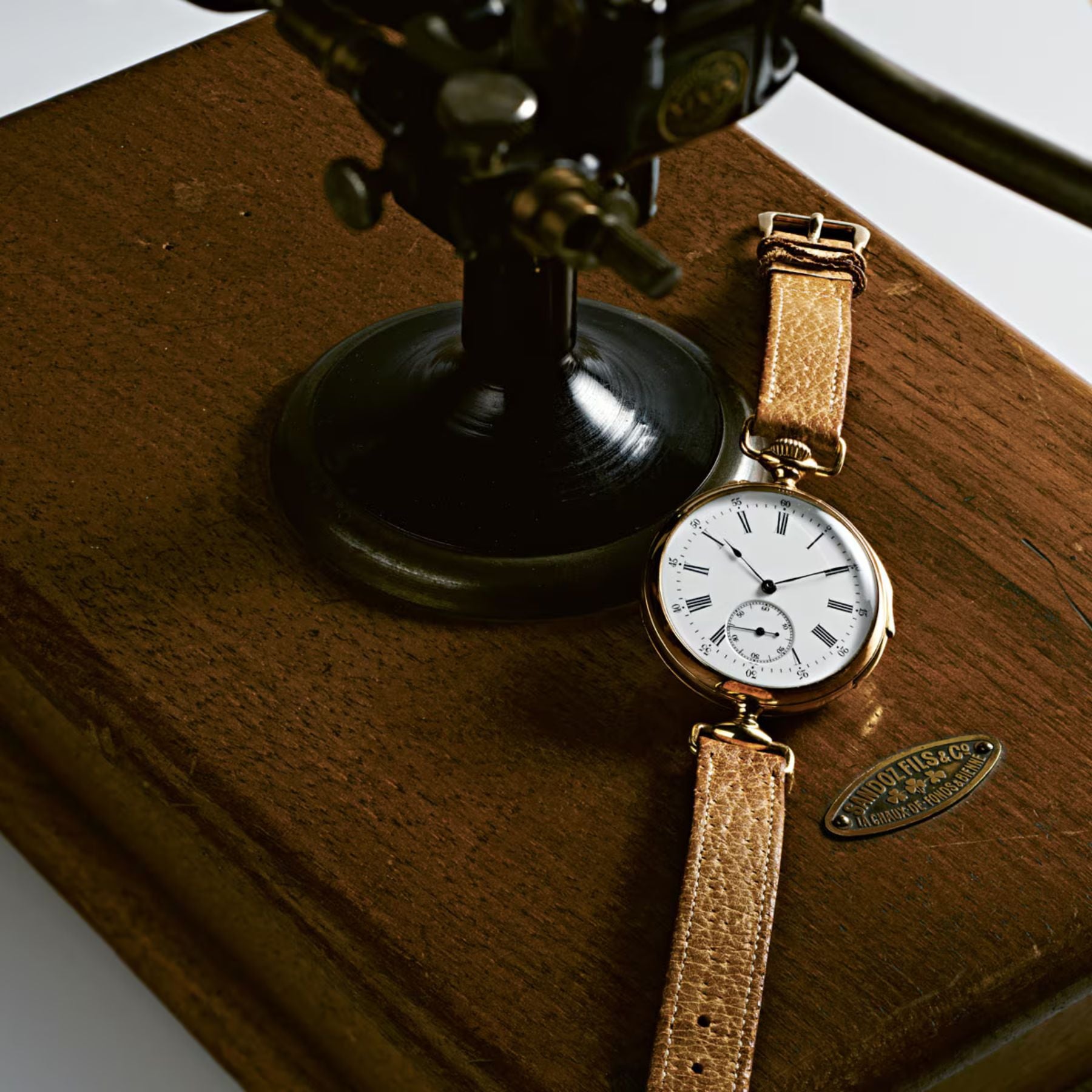
The 1892 minute-repeating wristwatch created by Louis Brandt & Frère, the future Omega, in collaboration with Audemars Piguet. Omega
By 1892, Audemars Piguet and Louis Brandt & Frère – the future Omega – had collaborated on a minute-repeating wristwatch. Moving the mechanism to the wrist brought another challenge: getting enough sound out of a smaller case.
Repeaters sound on demand, with different levels of detail. Quarter repeaters count hours and completed quarters; five-minute repeaters count hours and five-minute intervals. Minute repeaters give hours, quarters, and remaining minutes. Decimal repeaters substitute ten-minute intervals for quarters, then count the minutes left over.
Sonneries strike automatically. Both grande and petite sonneries strike the hours on the hour. At each quarter, a grande sonnerie repeats the hours before the quarters; a petite sonnerie sounds the quarters alone.
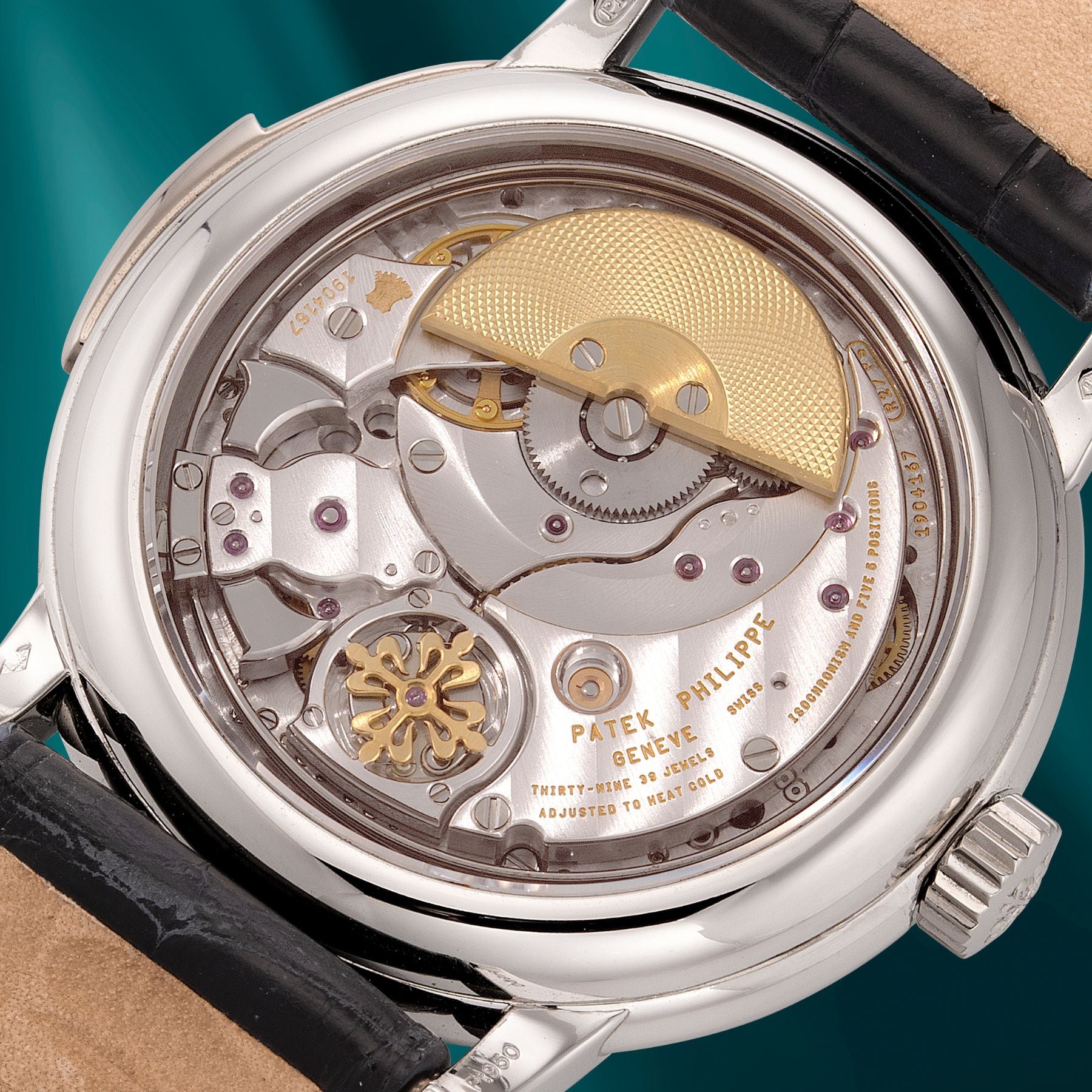
Movement of a circa 2006 Patek Philippe minute repeater Ref. 5078P-001 in platinum with a white enamel dial. Lot 883 in The Hong Kong Watch Auction XXIII. Estimate: HKD $2,000,000–4,000,000
All ten watches here are minute repeaters. Two small hammers strike two gongs – thin metal wires shaped around the movement – to produce a low note and a high note. The hours sound in low notes, each completed quarter gets a high-low pair, and the remaining minutes sound in high notes. At one o’clock, a single low strike suffices. At 12:59, the watch has its longest recital: twelve hour strikes, six strikes for the quarters, and fourteen for the minutes.
Operating the slide winds a separate spring, supplying the energy for striking without suddenly drawing it from the mechanism keeping time.
Inside, stepped “snail” cams encode the time. Levers read their positions and determine how many strikes follow. A regulator acts as a brake on the striking train, preventing the spring from running down too quickly. Otherwise, those carefully counted notes would arrive in an unhelpful hurry.
Hidden or Revealed
Patek Philippe’s Ref. 5078P-001, introduced in 2005, could pass for a time-only dress watch. White enamel, black Roman numerals, small seconds, and a 38mm platinum case give little away. But the slide on the left supplies the clue.
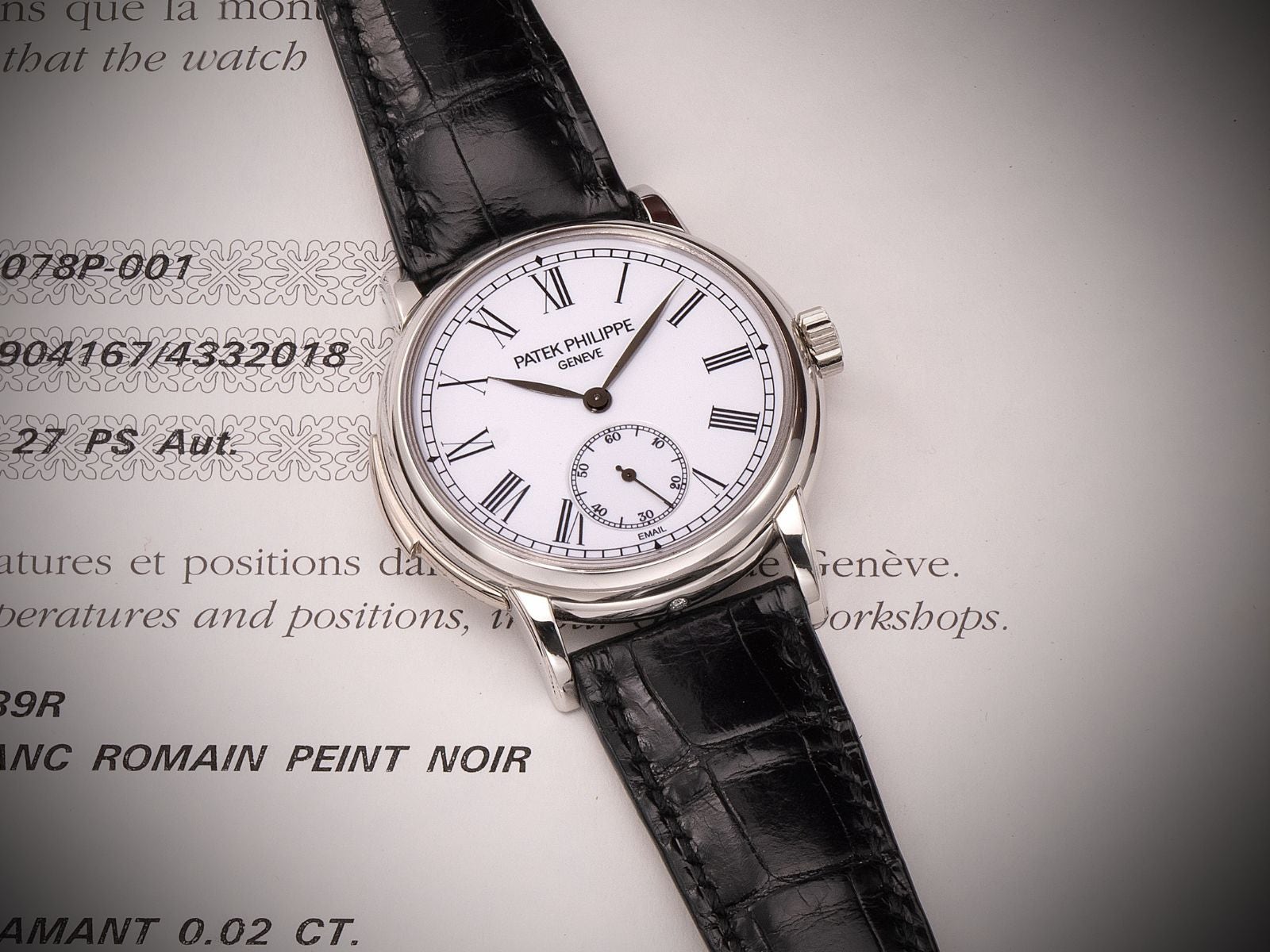
Lot 883: A circa 2006 Patek Philippe minute repeater Ref. 5078P-001 in platinum with a white enamel dial, included in The Hong Kong Watch Auction XXIII. Estimate: HKD $2,000,000–4,000,000
It is only when you turn it over that the hammers become visible. And the presence of a gold micro-rotor instead of a full-sized winding rotor means much of the movement is open to inspection, including the gongs around the circumference.
The Ref. 5539G-001, launched in 2013, conceals a tourbillon as well. Its black enamel dial, gold Breguet numerals, and spade-shaped hands are housed in a white gold case just 37mm across. The rotating carriage is visible through the back; its presence is so discreet that on the front Patek has written “Tourbillon” inside the small-seconds counter.
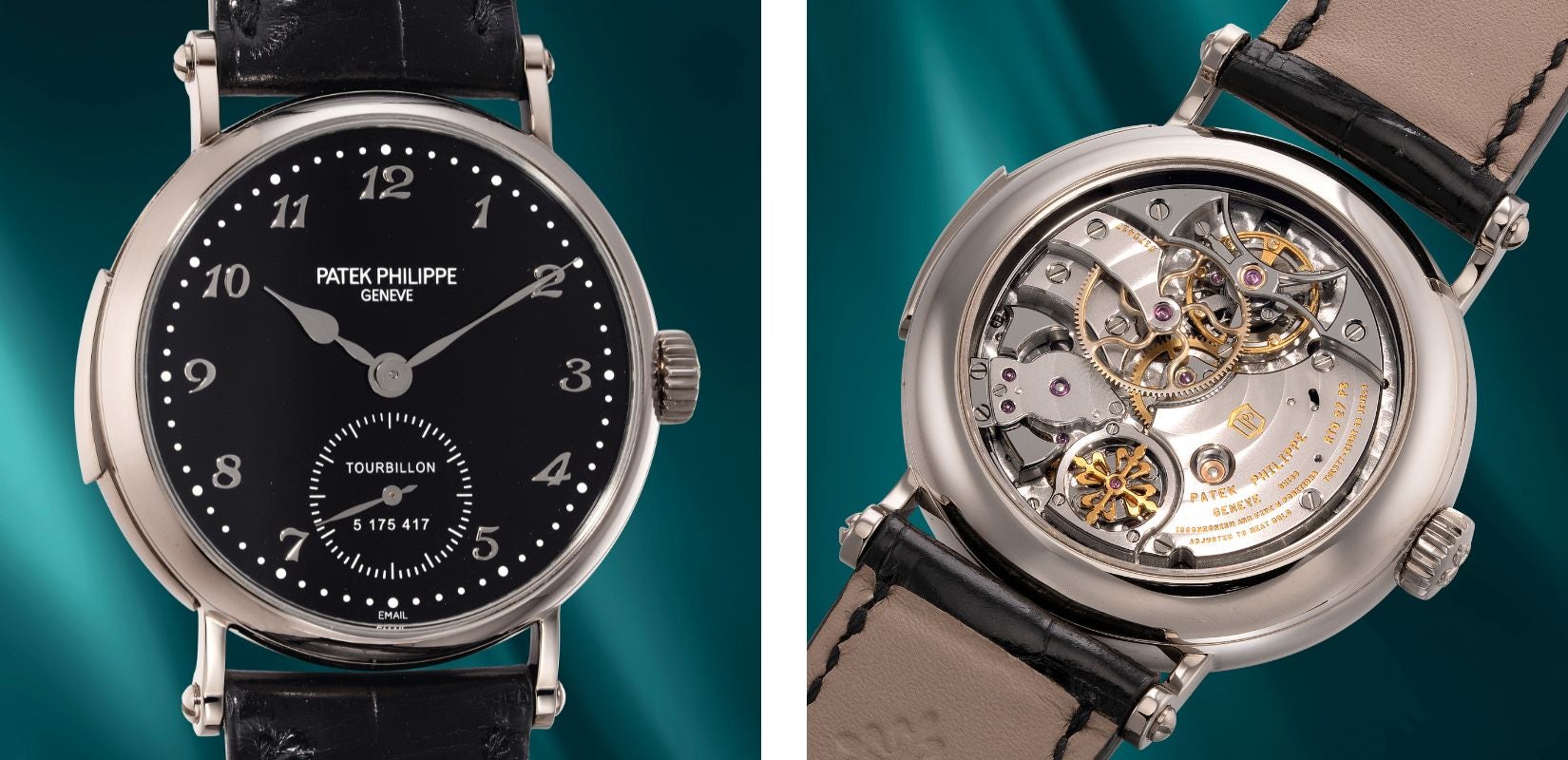
Lot 1024: A circa 2016 Patek Philippe minute repeater tourbillon Ref. 5539G-001 in 18k white gold with a black enamel dial, included in The Hong Kong Watch Auction XXIII. Estimate: HKD $2,000,000–4,000,000
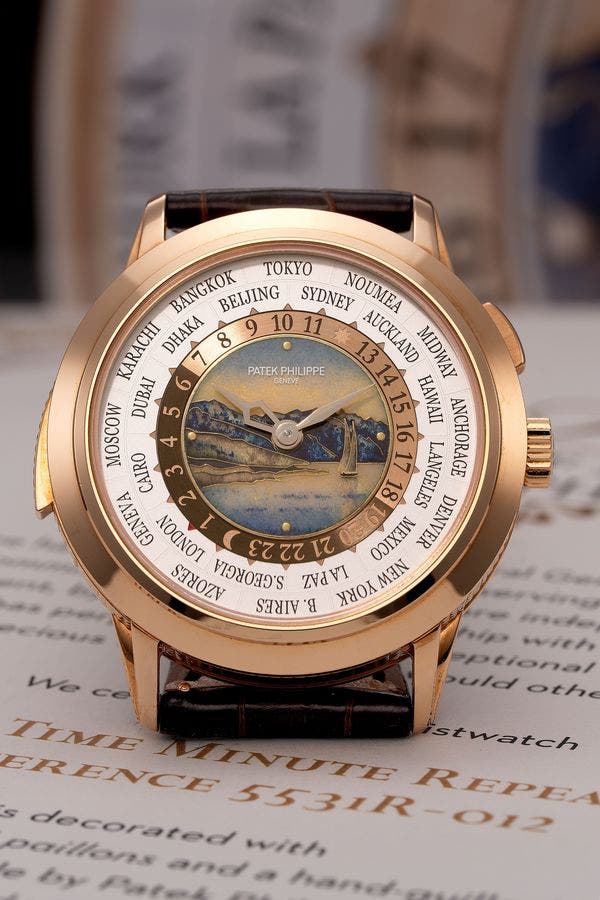
Patek changed the invitation with the pink gold Ref. 5303R-001. Here, the hammers and gongs are on the front, allowing the wearer to watch each strike.
That required reworking the hand-wound movement, opening up components and arranging the mechanism for inspection from the dial side. The 5539’s version of the R TO 27 PS caliber contains 336 components; the 5303’s has 356.
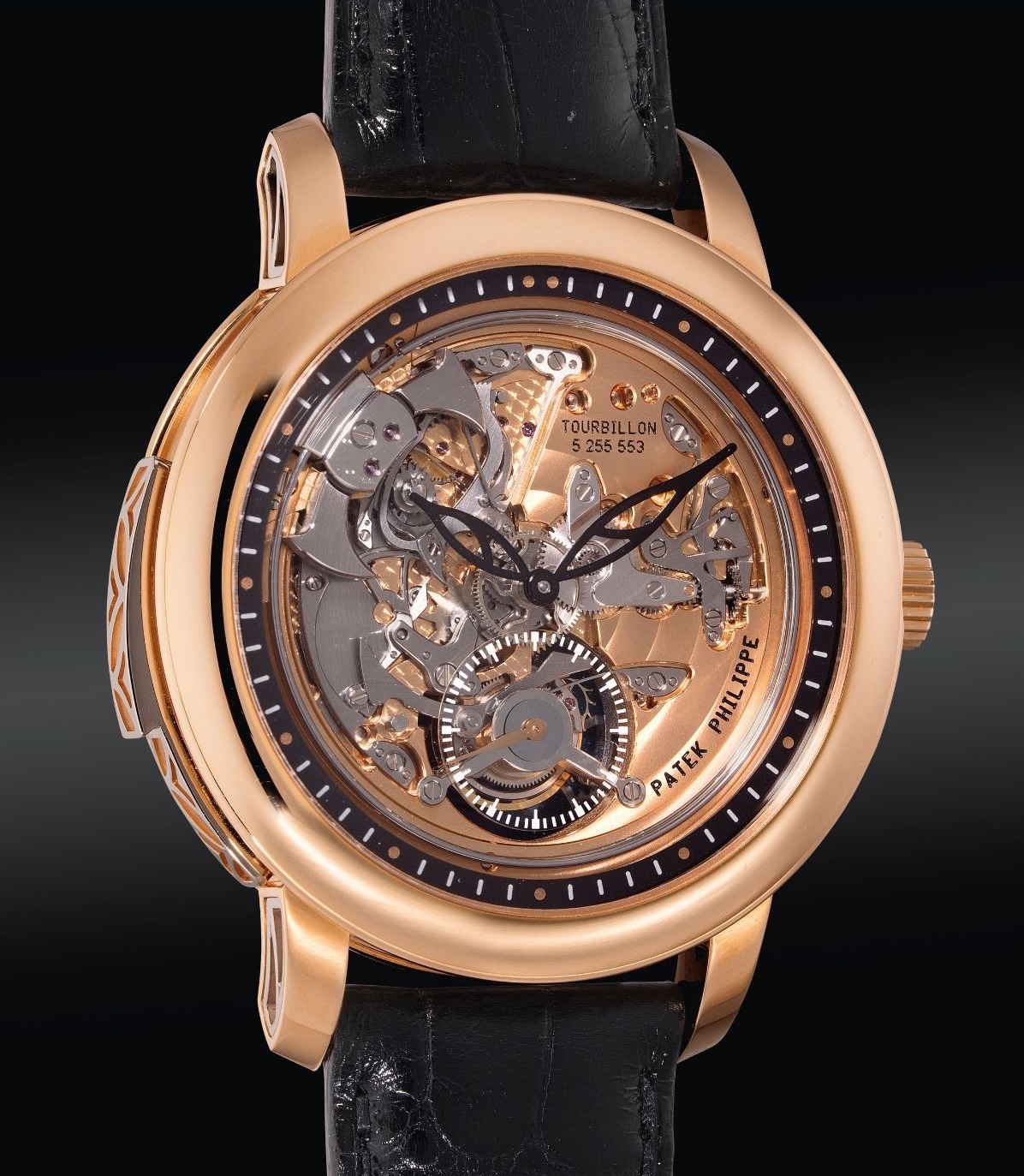
Lot 946: A circa 2021 Patek Philippe minute repeater tourbillon Ref. 5303R-001 in 18k pink gold with a dial-side striking mechanism, retailed by Tiffany & Co., included in The Hong Kong Watch Auction XXIII. Estimate: HKD $4,800,000–9,600,000
The Ref. 5303 debuted as the 12-piece Ref. 5303R-010 Singapore exhibition edition in 2019, before the Ref. 5303R-001 joined the regular collection in 2020. This circa 2021 example was retailed by Tiffany & Co.
A Longer Ring
Even inside a gold or platinum case, the sound commonly begins with hardened steel. Both hammers and gongs are often made from it, although modern watchmakers have experimented with other materials.
A slender wire, the gong is shaped around the movement and secured at one end. Its free portion vibrates when struck. Length, cross-section, alloy, and mounting all influence the sound; tuning can involve hand-filing away tiny amounts of metal to obtain the desired note. Remove too much and the watchmaker may have to start again.
Patek Philippe’s Ref. 5074 uses cathedral gongs that run for about one and three-quarter turns around the movement, rather than the roughly single circuit of conventional gongs. The extra length gives the notes a particularly long resonance.
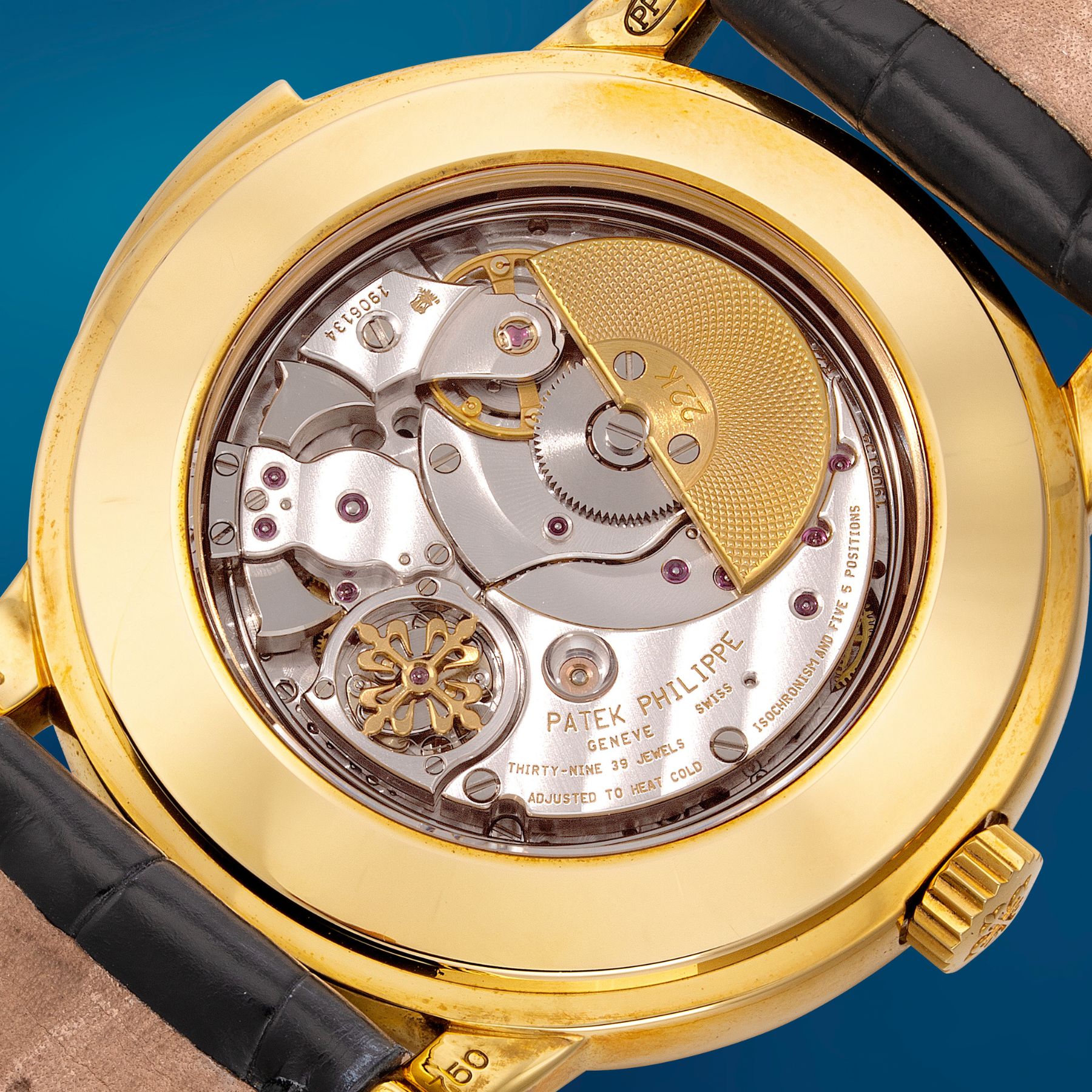
Movement of a circa 2002 Patek Philippe minute repeater and perpetual calendar Ref. 5074J in 18k yellow gold with cathedral gongs. Lot 1077 in The Hong Kong Watch Auction XXIII. Estimate: HKD $2,500,000–4,500,000
The coils must remain clear of each other, the movement, and the case. Any accidental contact can spoil the sound, with little room for error.
Introduced in yellow gold in 2001, the 5074 combines its cathedral-gong repeater with a self-winding perpetual calendar. The circa 2002 Ref. 5074J represents that early configuration. Platinum followed in 2009; the circa 2016 Ref. 5074P-021 adds emerald-set indexes to a silvered dial, a possibly unique configuration according to Phillips.
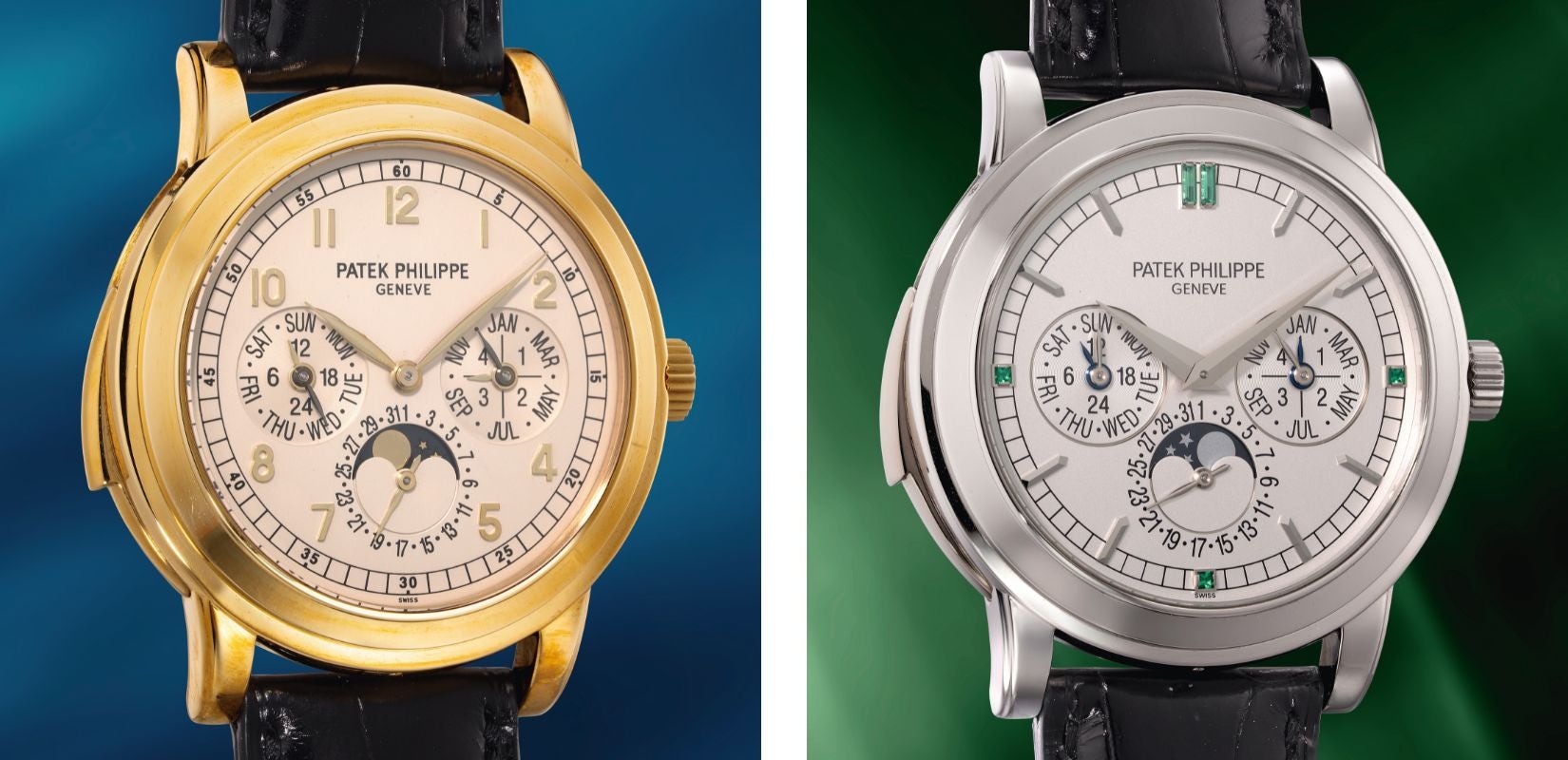
Two Patek Philippe Ref. 5074 minute repeaters: the circa 2002 Ref. 5074J in 18k yellow gold (Lot 1077) and the circa 2016 Ref. 5074P-021 in platinum with emerald-set indexes (Lot 881), included in The Hong Kong Watch Auction: XXIII.
Both house the R 27 Q caliber in a 42mm case. Through the back, a gold Calatrava-cross grille covers the centrifugal regulator controlling the sequence’s pace. While the gongs let a note linger, it is this regulator that determines when the next strike arrives.
Getting Sound Out
The gong’s mounting is another opportunity to change what reaches the ear. Audemars Piguet spent eight years developing Supersonnerie with the Swiss Federal Institute of Technology Lausanne and collaborators including musicians. One aim was to give a wristwatch the acoustic output of a much larger pocket watch.
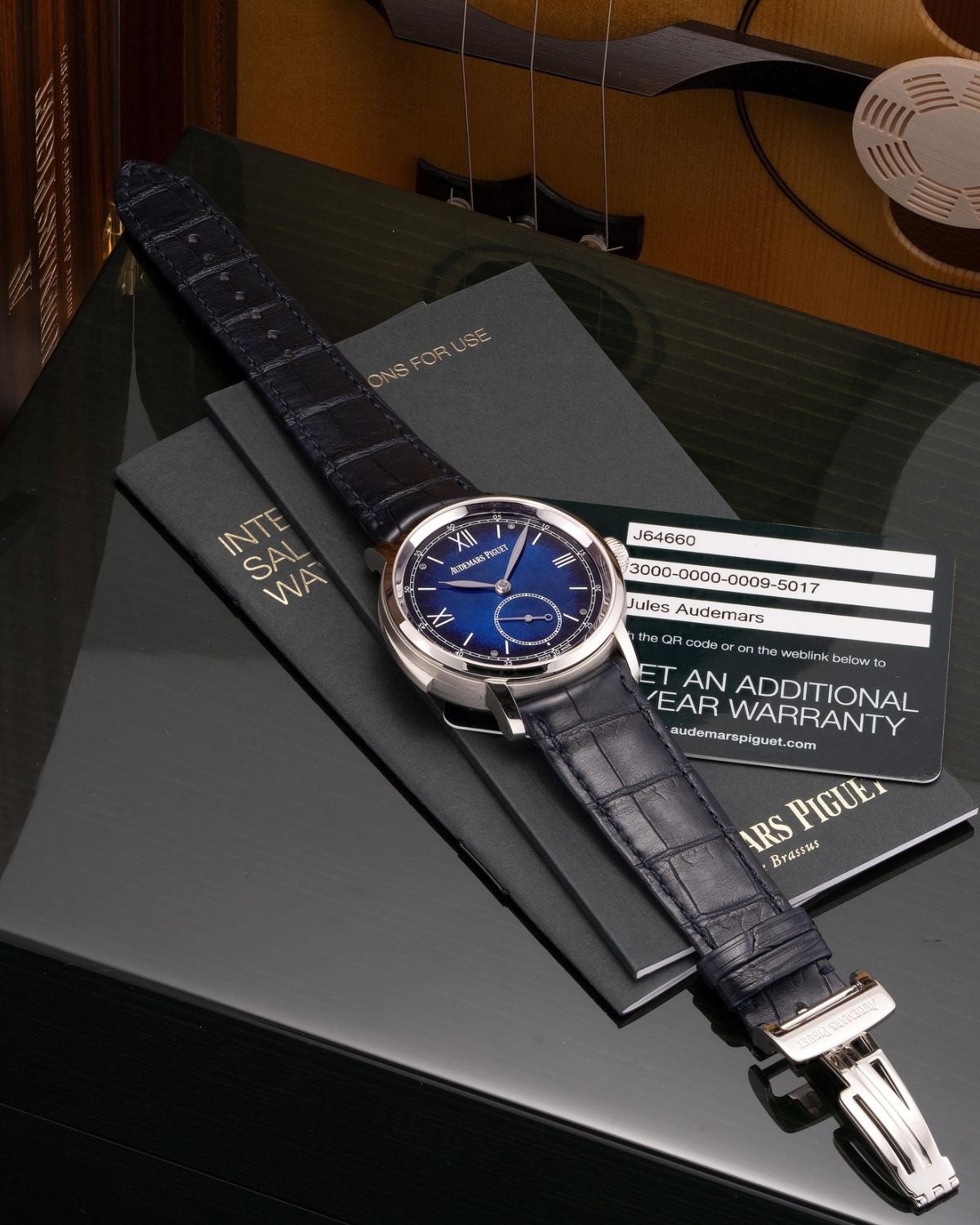
Lot 1118: A circa 2017 Audemars Piguet Jules Audemars Répétition Minutes Supersonnerie Ref. 26590PT.OO.D028CR.01 in platinum with a smoked blue enamel dial, included in The Hong Kong Watch Auction XXIII. Estimate: HKD $600,000–1,200,000
The system attaches the gongs to a thin copper-alloy membrane rather than the movement’s mainplate. This dedicated soundboard helps transmit and amplify their vibrations, much as the resonating body of a guitar carries the sound of its strings.
Openings around the outer caseback let sound escape even when the watch is pressed against the wrist.
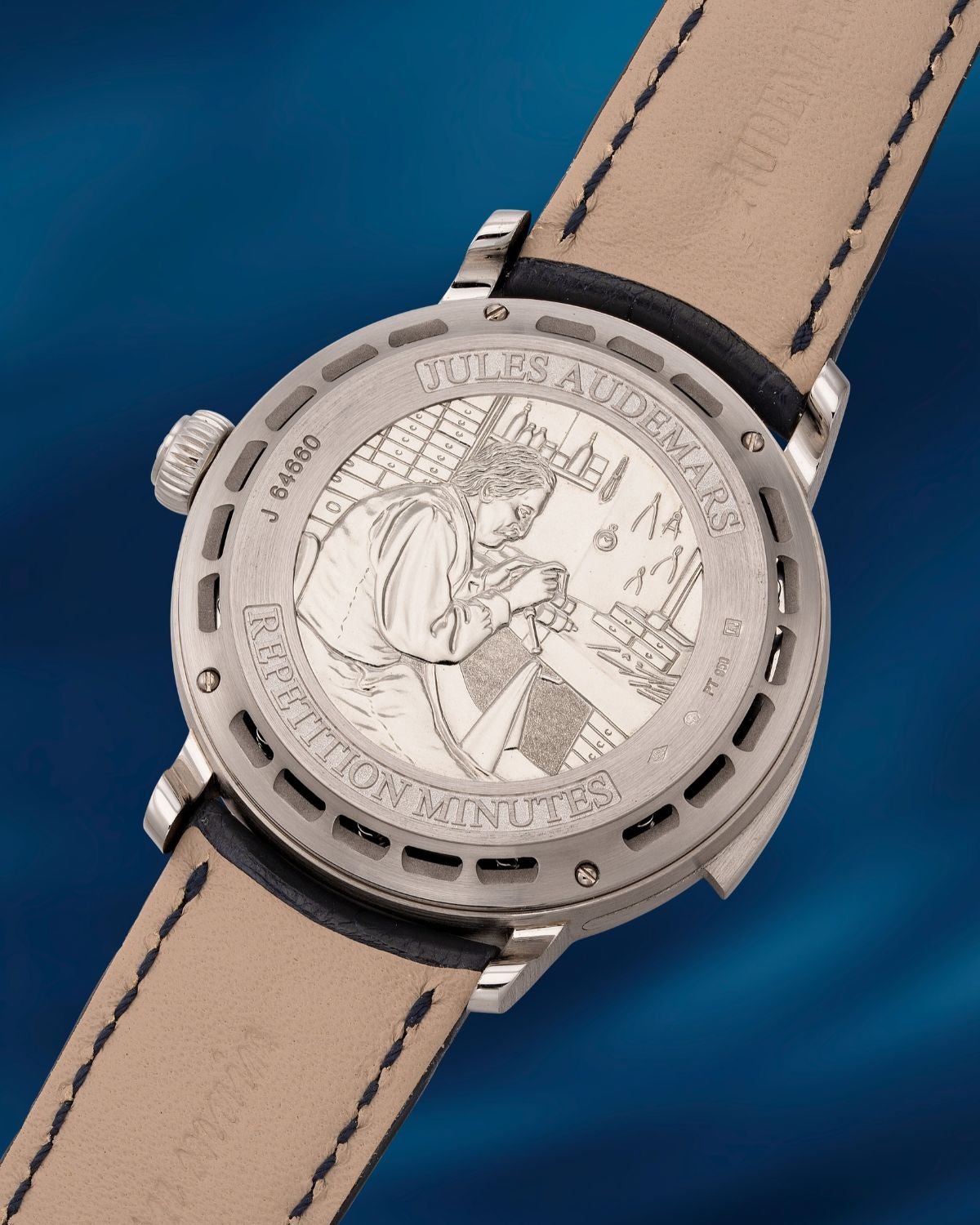
Lot 1118: A circa 2017 Audemars Piguet Jules Audemars Répétition Minutes Supersonnerie Ref. 26590PT.OO.D028CR.01 in platinum with a smoked blue enamel dial, included in The Hong Kong Watch Auction XXIII. Estimate: HKD $600,000–1,200,000
Then there is the mechanism’s own background noise. AP redesigned the striking regulator to reduce its mechanical chatter, letting the listener hear more of the chimes and less of the machinery controlling them.
The Jules Audemars Répétition Minutes Supersonnerie packages this engineering in a 43mm platinum case beneath a smoked blue enamel dial. Its white Roman numerals are enamel too, fused into the blue surface during firing. The two hands and small seconds give little hint of the acoustic construction behind them.
Making Room
For IWC, a repeater was part of an ambitious undertaking begun in 1985: combining a chronograph and perpetual calendar with a minute repeater in its first Grande Complication wristwatch.
The Ref. 3770 arrived in 1990 after five years of development. Kurt Klaus supplied the calendar expertise, while Dominique Renaud and Giulio Papi worked on the repeater. Beneath the additional mechanisms was a base derived from the Valjoux 7750 automatic chronograph.
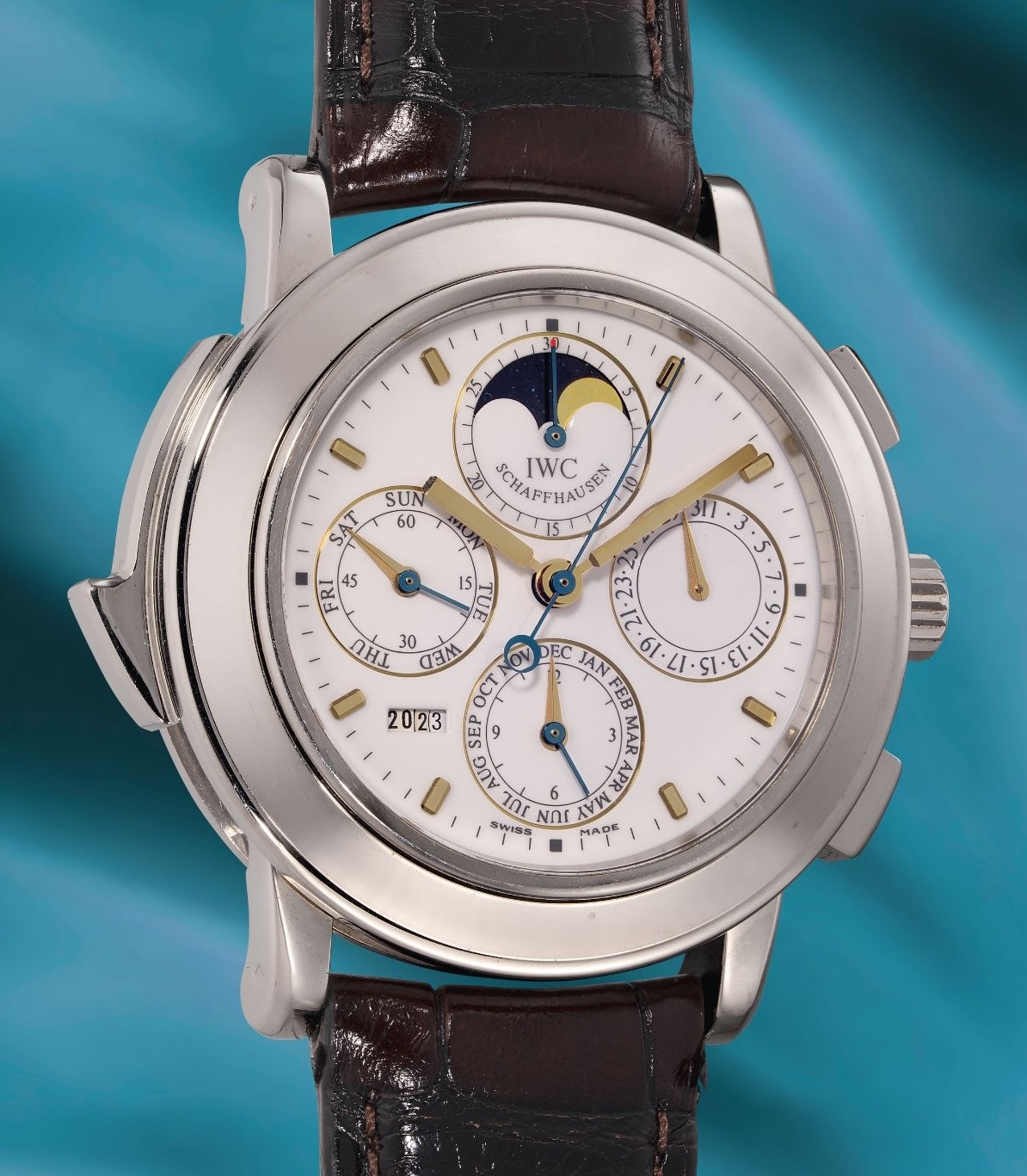
Lot 1059: An IWC Grande Complication Ref. 3770 in platinum with a minute repeater, perpetual calendar, and chronograph, dating from circa the 1990s, included in The Hong Kong Watch Auction XXIII. Estimate: HKD $400,000–800,000
This platinum example houses 568 movement components in a 42.5mm case. Its dial accommodates chronograph counters, calendar indications, and a four-digit year.
Vacheron Constantin found space by starting thin. Introduced in 1992, its caliber 1755 repeater base measured just 3.28mm thick. Of 200 movement blanks made, 77 received a perpetual calendar module. The circa 1994 Patrimony Ref. 30020/000P houses that combination in a 37mm platinum case with teardrop lugs recalling the vintage Ref. 4261.
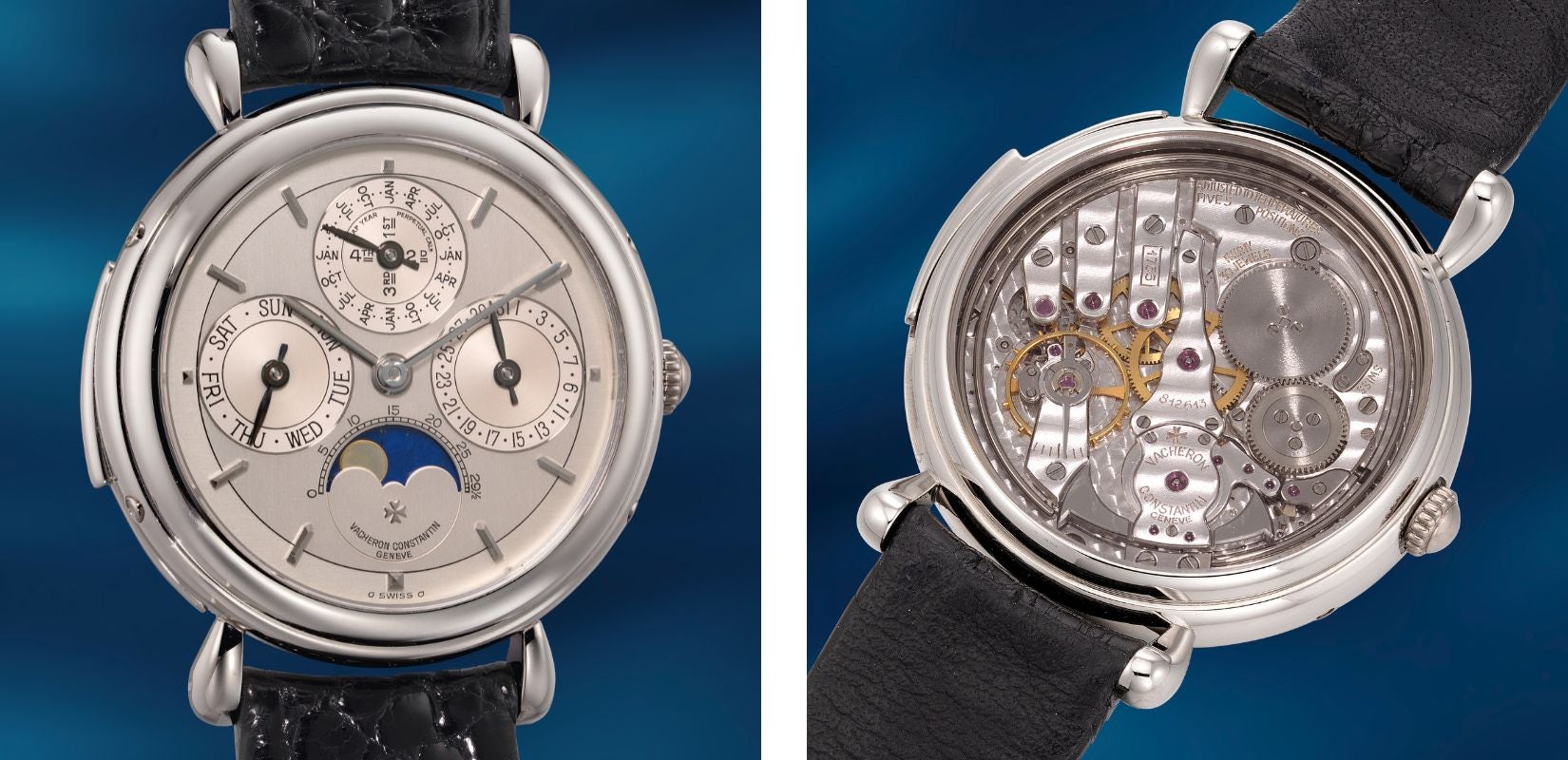
Lot 889: A circa 1994 Vacheron Constantin Patrimony minute repeater and perpetual calendar Ref. 30020/000P in platinum with teardrop lugs, included in The Hong Kong Watch Auction XXIII. Estimate: HKD $1,000,000–2,000,000
Roger Dubuis fitted a minute repeater and perpetual calendar inside the Sympathie S37’s white gold case, distinguished by its curves and projecting corners and measuring just 37mm across. Developed with Jean-Marc Wiederrecht, the bi-retrograde calendar sends separate day and date hands along arcs before returning them to their starting points.
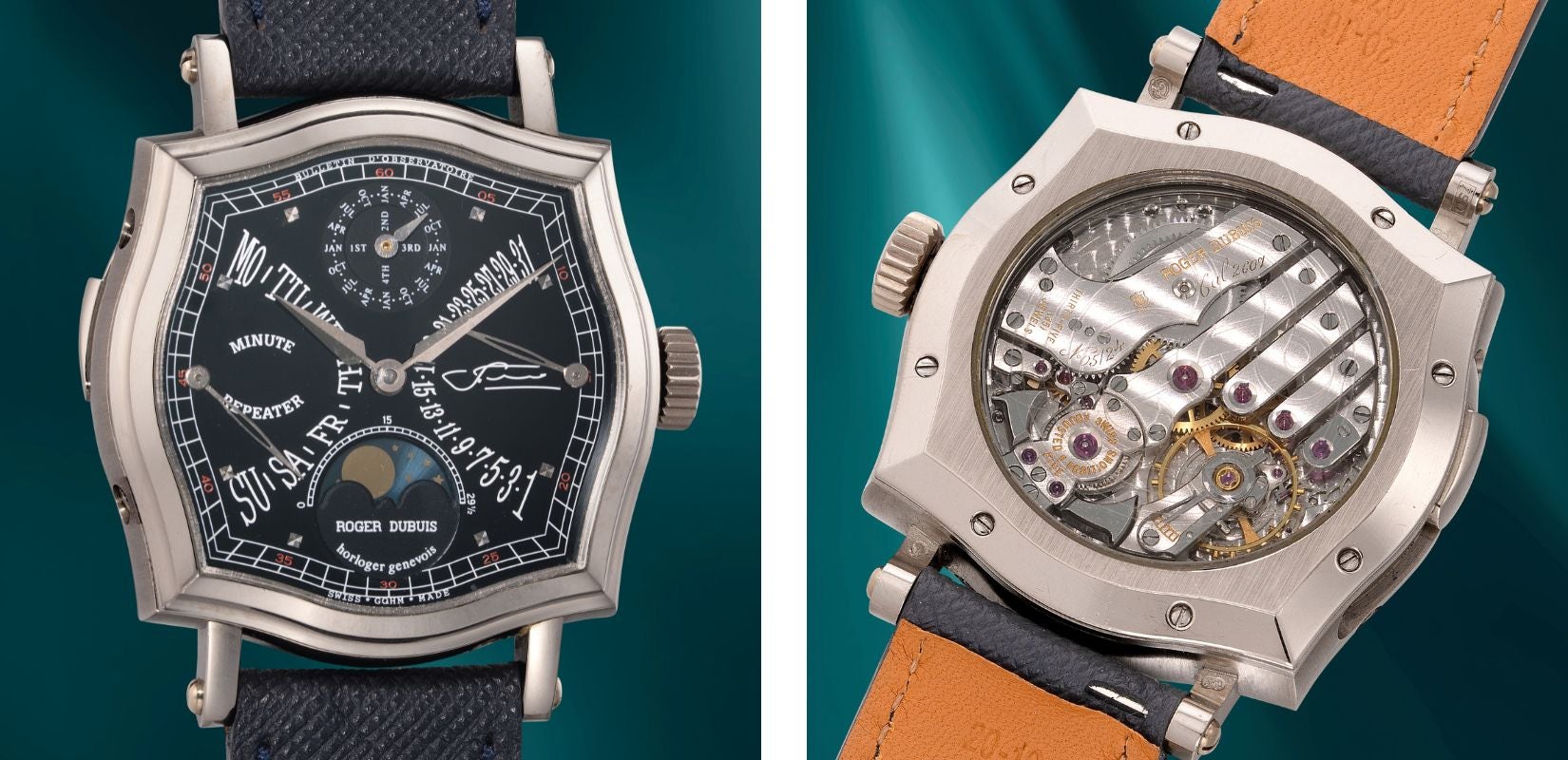
Lot 926: A Roger Dubuis Sympathie minute repeater and bi-retrograde perpetual calendar Ref. S37 in 18k white gold, dating from circa the 2000s, included in The Hong Kong Watch Auction XXIII. Estimate: HKD $320,000–640,000
Introduced in 2001, Patek Philippe’s Sky Moon Tourbillon Ref. 5002P-001 takes the packing exercise further. This circa 2008 Ref. 5002P-001 accommodates twelve complications and 694 movement components inside a 43mm platinum case.
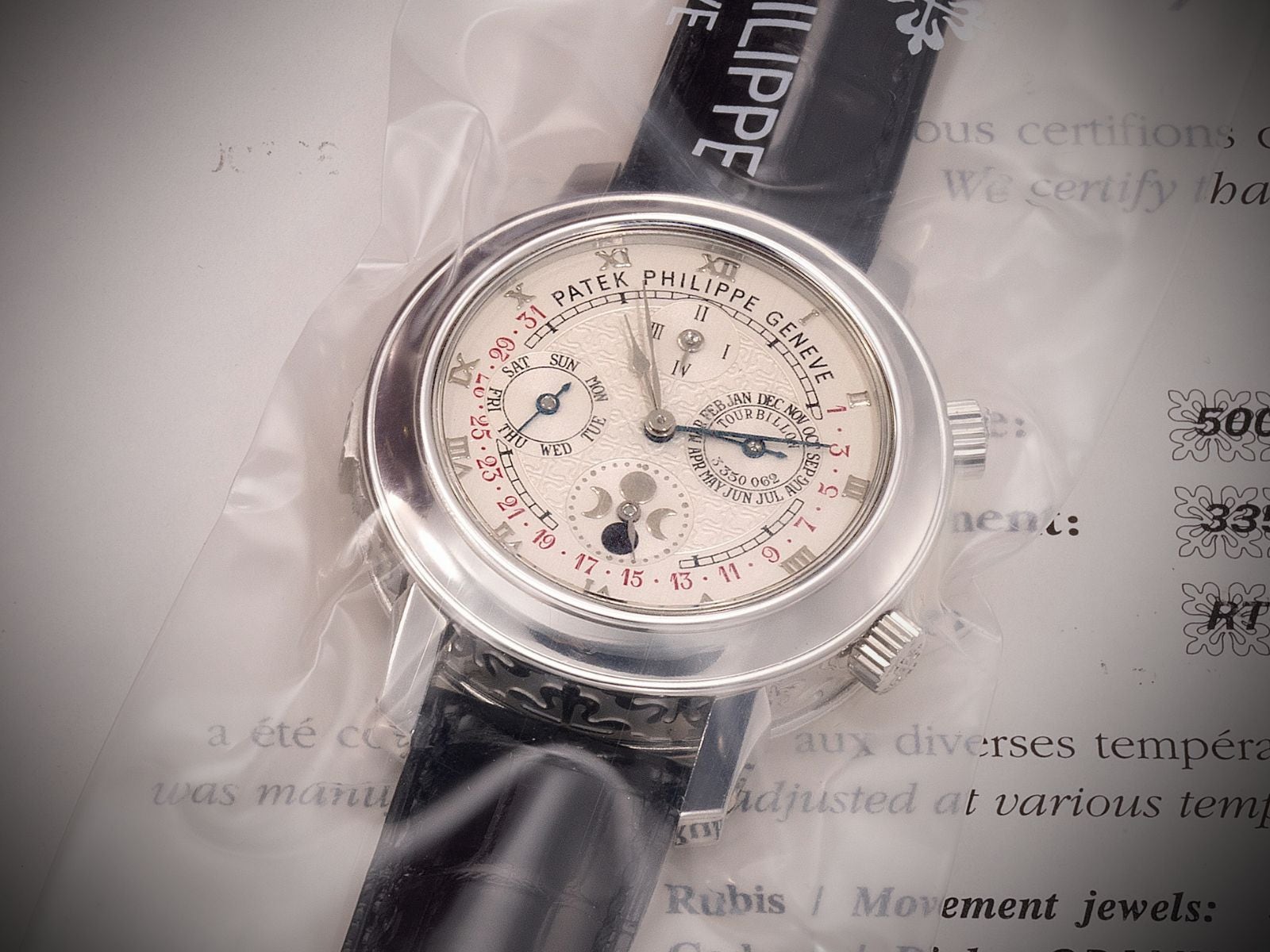
Lot 868: A circa 2008 Patek Philippe Sky Moon Tourbillon Ref. 5002P-001 in platinum with twelve complications, including a cathedral-gong minute repeater, included in The Hong Kong Watch Auction XXIII. Estimate: In excess of HKD $8,000,000
The front carries a perpetual calendar with retrograde date; the reverse displays a rotating northern sky chart and astronomical indications. A tourbillon and cathedral-gong minute repeater make accommodating all these mechanisms within a wristwatch more challenging still.
You can learn more, place a bid, and view the entire Hong Kong Watch Auction: XXIII catalog here.