9
Salvador Dalí
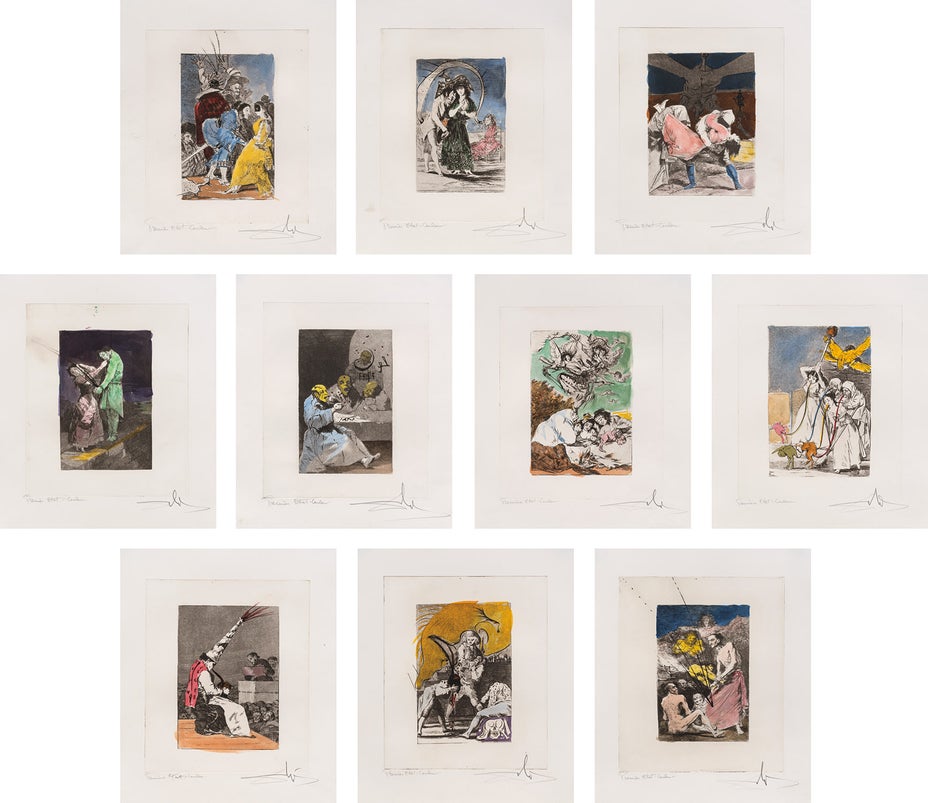
Les Caprices de Goya de Dali (Dali's 'Caprichos' by Goya): 10 plates (M. & L. 853-855; 859-860; 866-867; 870; 880; 916)
all S. 17 1/2 x 12 3/8 in. (44.5 x 31.4 cm)
Full-Cataloguing
In this large-scale project, Dalí reinterpreted Goya's famous series by introducing his own surrealist elements and satirical interpretation to the issues Goya presented in his etchings: vices, abuses of power and the relationship between men and women. For the published edition, the reworked plates were then re-titled by Dalí below the image with repartee to Goya's titles.
One can easily see Dali's keen interest in Goya's imagery and thoughts, and a base for his re-interpretation: "Goya was preoccupied with dreams, dreamlike states, and nightmares - the varying states of consciousness that allowed him to explore allusive subjects...The Caprichos provide the earliest concentrated evidence of Goya's interest in dreams..."Truth to life" is the essence of what Goya achieved through his graphic work. His prints and drawings quietly observe, confront, dissect, and reflect the many facets of what it means to be human. This truth to life has fueled the works' relevance over the course of two centuries, as they continue to provoke audiences to engage with Goya's profound insights". Mark McDonald, Goya's Graphic Imagination, The Metropolitan Museum of Art, 2021
Salvador Dalí
Spanish | B. 1904 D. 1989Salvador Dalí was perhaps the most broadly known member of the Surrealist movement of the early twentieth century. Heavily influenced by Sigmund Freud, the avant-garde style explored consciousness and dream-like states through exaggerated landscapes and bizarre or grotesque imagery. Using the means of painting, sculpture, printmaking, film and literature, Dalí explored these ideas with a meticulous hand and inventive wit.
Although known for his role in Surrealism, Dalí was also a seminal example of celebrity showmanship and the cult of personality, a phenomenon that dominates popular culture today. Always a colorful and flamboyant presence with his signature cape, wide-eyed expression and trademark upturned waxed mustache, Dalí was a master of self-promotion and spectacle.