11
Richard Prince
Untitled (de Kooning)
Full-Cataloguing
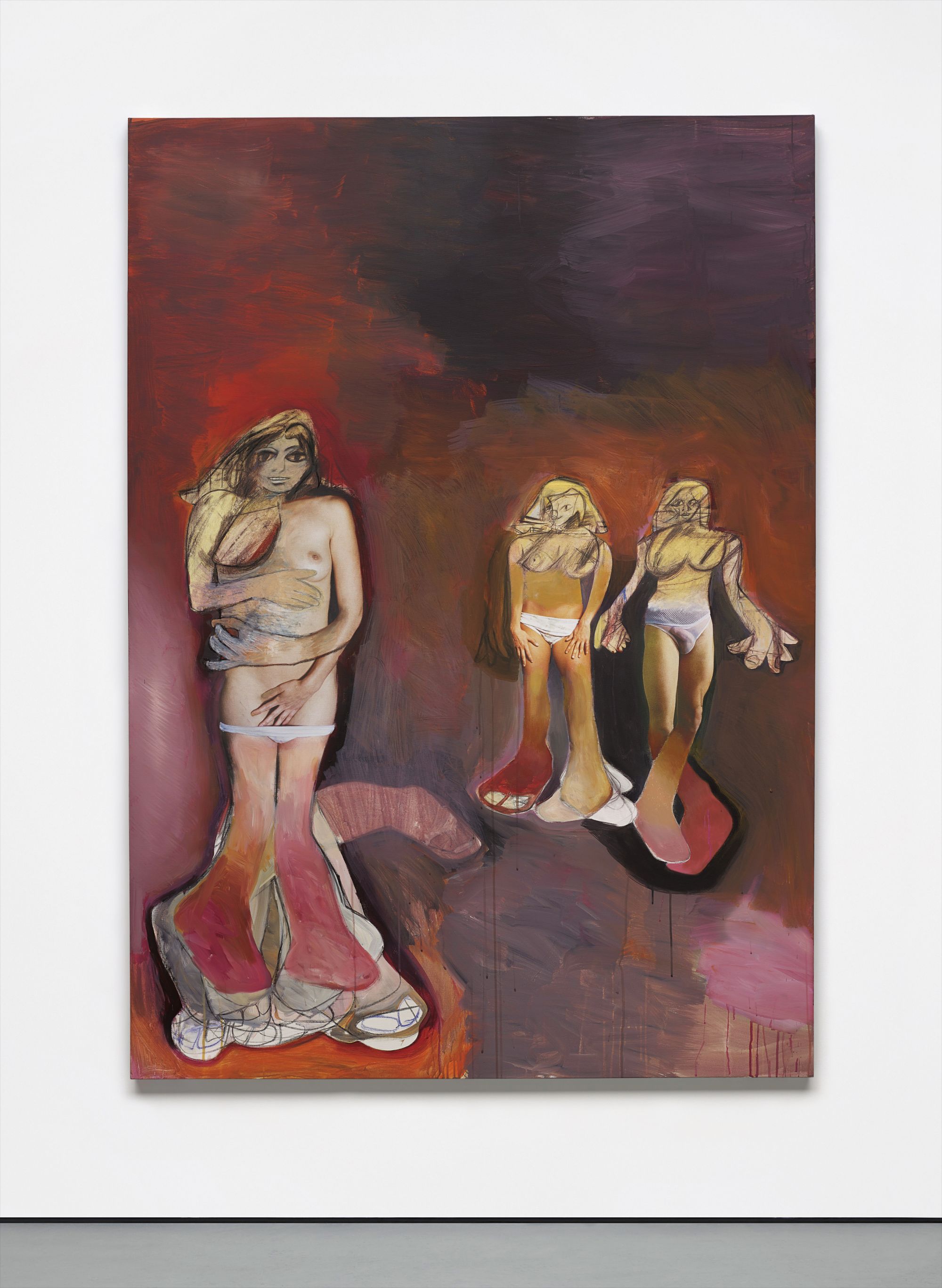
In Untitled (de Kooning), Prince has laboriously re-worked a painting by de Kooning: the 1953 Woman and Bicycle from his well-known Woman series. The genesis for this series grew organically as the artist was paging through a catalogue raisonné of the Abstract Expressionist’s works. Blurring the lines between homage and desecration, Prince’s de Kooning series uses a range of methods to explore the human form. His technique is complex, combining drawing, collage, digital reproduction and painting into a single, unified and cohesive work.
In the creation of the present lot, Prince began by sketching over the catalogue’s colour reproductions, sometimes following the outlines of the sensuous female form, sometimes sketching the figure of a man over the female figure. After then ripping these altered images from the catalogue raisonné, Prince further explored anatomy, figure and form, collating male and female fragments from vintage pornographic magazines and making additions in graphite. The artist then scanned these collages, printing them first as large-scale inkjet prints on canvas before reworking the final painting with paint and oil crayon. The immensely intricate surface shows evidence of the artist’s Freudian explorations: shadows of pentimenti linger, revealed in the many hands and feet of the painting’s figures.
Prince’s double portrait of de Kooning’s Woman and Bicycle is both intellectually and visually provocative. It simultaneously acts as a tribute to de Kooning and as an act of vandalism. In the present lot, the artist blurs the lines between the vulgarity of mass culture and the sanctity of modern art, between digital reproduction and painterly virtuosity and between male and female. The hermaphroditic figure on the right reveals an almost oedipal struggle within the artist’s psyche; the figures are at once twins and lovers. In de Kooning’s own exploration of the female form, the artist admitted: ‘The women had to do with the female painted through all the ages, all those idols, and maybe I was stuck to a certain extent; I couldn’t go on… I felt myself almost getting flustered. I never could complete it and when I think of it now, it wasn’t such a bright idea.’
Although Prince’s approach has often been regarded as controversial, questioning mainstream notions of artistic practice that celebrate individuality and ‘artistic genius,’ the artist owes much to the old-fashioned Academy system. Following in the tradition of the Academy, in which young students were instructed to copy from the ‘Masters’ that hung on hallowed museum walls, Richard Prince pays tribute to de Kooning’s ouevre. Untitled (de Kooning) shows Prince as both disciple and ‘agent provocateur,’ building upon the original work as well as on the entire history of the female nude. This lot is Prince at his best—questioning our fevered hold on the concept of originality.
Richard Prince
American | 1947For more than three decades, Prince's universally celebrated practice has pursued the subversive strategy of appropriating commonplace imagery and themes – such as photographs of quintessential Western cowboys and "biker chicks," the front covers of nurse romance novellas, and jokes and cartoons – to deconstruct singular notions of authorship, authenticity and identity.
Starting his career as a member of the Pictures Generation in the 1970s alongside such contemporaries as Cindy Sherman, Robert Longo and Sherrie Levine, Prince is widely acknowledged as having expanded the accepted parameters of art-making with his so-called "re-photography" technique – a revolutionary appropriation strategy of photographing pre-existing images from magazine ads and presenting them as his own. Prince's practice of appropriating familiar subject matter exposes the inner mechanics of desire and power pervading the media and our cultural consciousness at large, particularly as they relate to identity and gender constructs.