290
William Eggleston
Untitled
Overall 45 x 64 7/8 x 2 1/4 in. (114.3 x 164.8 x 5.7 cm)
Full-Cataloguing
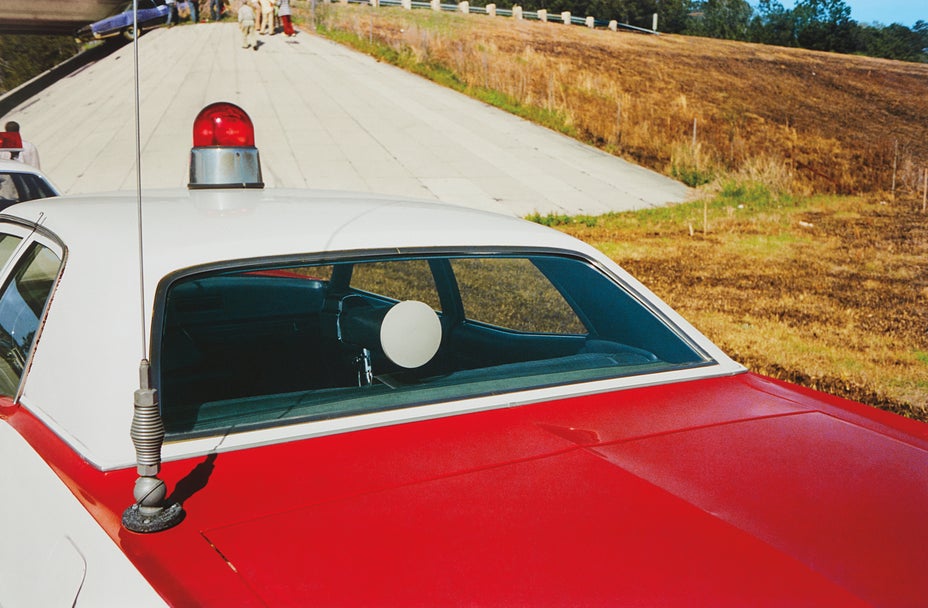
Eggleston shows us that there is nothing more elaborate or beautiful than the rich, material complexity of the unassuming everyday built environment. In Untitled, 1971-1974, bold colors, shapes, and planes intersect and repeat, forming a dynamic, almost Kandinsky-like Modernist composition from the not uncommon scene on the American highway system—police and bystanders congregated around a minor car accident. Rather than taking a photo-journalistic stance, Eggleston stands away from the scene on the distant overpass, eschewing any details that might provide circumstantial context, creating instead, a vivid study of color and form. In the present lot’s striking, large-scale presentation, we experience the full force and brilliance of Eggleston’s arresting composition.
Like many of Eggleston's photographs, the present lot is both semi-dislocated in time and space, providing the viewer with little hints to the specifics of the moment or location where the image was taken. Untitled, 1971-1974 comes from Eggleston's expansive series, Los Alamos. Named after the nuclear testing site in New Mexico, Los Alamos consists of images taken between 1966-1974 across the southern United States, from New Orleans to Santa Monica. A specific and evocative title for a sweeping series composed of distinctive places, people and moments, Los Alamos, like much of the American landscape, is a site for creation and destruction, and for William Eggleston, a place for endless experimentation and study.
William Eggleston
American | 1939William Eggleston's highly saturated, vivid images, predominantly capturing the American South, highlight the beauty and lush diversity in the unassuming everyday. Although influenced by legends of street photography Robert Frank and Henri Cartier-Bresson, Eggleston broke away from traditional black and white photography and started experimenting with color in the late 1960s.
At the time, color photography was widely associated with the commercial rather than fine art — something that Eggleston sought to change. His 1976 exhibition at the Museum of Modern Art, Color Photographs, fundamentally shifted how color photography was viewed within an art context, ushering in institutional acceptance and helping to ensure Eggleston's significant legacy in the history of photography.