12Ο
Takashi Murakami
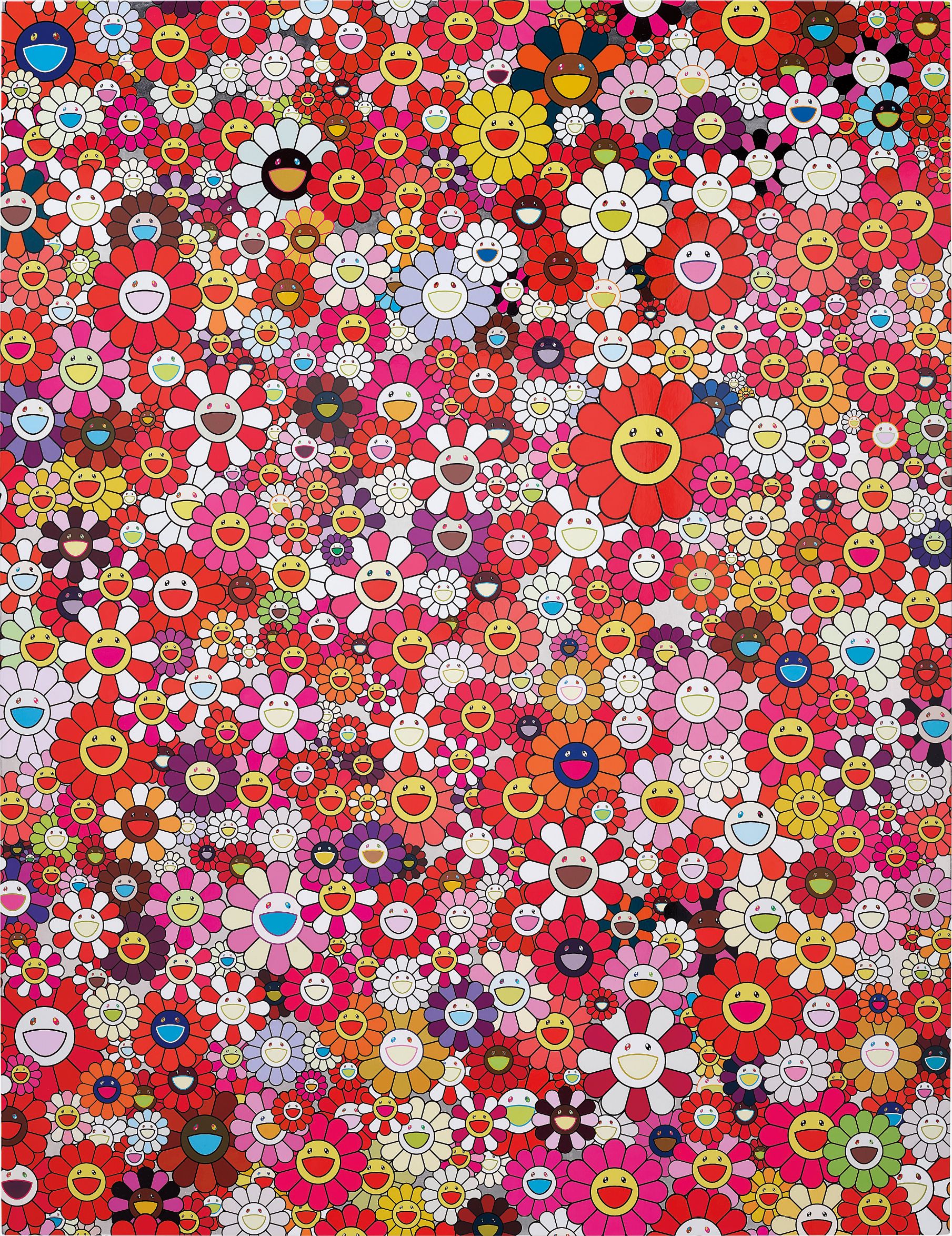
An Homage to Monopink, 1960 E
Full-Cataloguing
An Homage to Monopink, 1960 E is a pre-eminent example of Murakami’s flower series, which he has explored through variations across a wide range of media including sculptures, video installations and clothing. The swirling patterns vividly embody the bold, bright and kawaii (cute) idiosyncrasies of Japanese pop culture and function within the parameters of the Superflat movement coined and developed by the artist. Murakami explicitly sought to reverse the pervasive post-war sense of national cultural inferiority and simultaneously to establish an international platform for Japanese contemporary art. He therefore created a pictorial language overtly adopted from the style of anime and manga, often referencing controversial subcultures. The defining principles of Superflat are flatness and two-dimensionality, a technique which ensures that creative elements exist simultaneously in the present. This in turn serves to blur the traditional boundaries between high and low, ancient and modern, and Eastern and Western art. The consistent innovation inherent in Murakami’s work has cemented his position as one of the most influential artists of the Post-Pop and Post-Dadaist generation, alongside Jeff Koons and Damien Hirst. ‘Jeff Koons, Damien Hirst and myself, we were trying to link art, which fundamentally has no value, with capitalism and to show how it can be seen as valuable’ (Takashi Murakami interviewed by David Pilling, Financial Times Life and Arts 19 June 2015).
This mesmerising and enthralling painting offers an insight into the seminal series of Murakami’s career, one which can be seen to evolve and infiltrate every level of society. The artist’s hyper-conceptual iconographies and highly stylised techniques, such as the smiling flowers depicted in An Homage to Monopink, 1960 E, have redefined the contemporary art world by extending its parameters beyond traditional media. From collaborating with fashion houses such as Louis Vuitton to introducing Japanese kitsch into the Palace of Versailles, Murakami continues to cast an enduring revolutionary spell over audiences worldwide.
Takashi Murakami
Japanese | 1962Takashi Murakami is best known for his contemporary combination of fine art and pop culture. He uses recognizable iconography like Mickey Mouse and cartoonish flowers and infuses it with Japanese culture. The result is a boldly colorful body of work that takes the shape of paintings, sculptures and animations.
In the 1990s, Murakami founded the Superflat movement in an attempt to expose the "shallow emptiness of Japanese consumer culture." The artist plays on the familiar aesthetic of mangas, Japanese-language comics, to render works that appear democratic and accessible, all the while denouncing the universality and unspecificity of consumer goods. True to form, Murakami has done collaborations with numerous brands and celebrities including Kanye West, Louis Vuitton, Pharrell Williams and Google.