58
Rolex
Ref. 1665
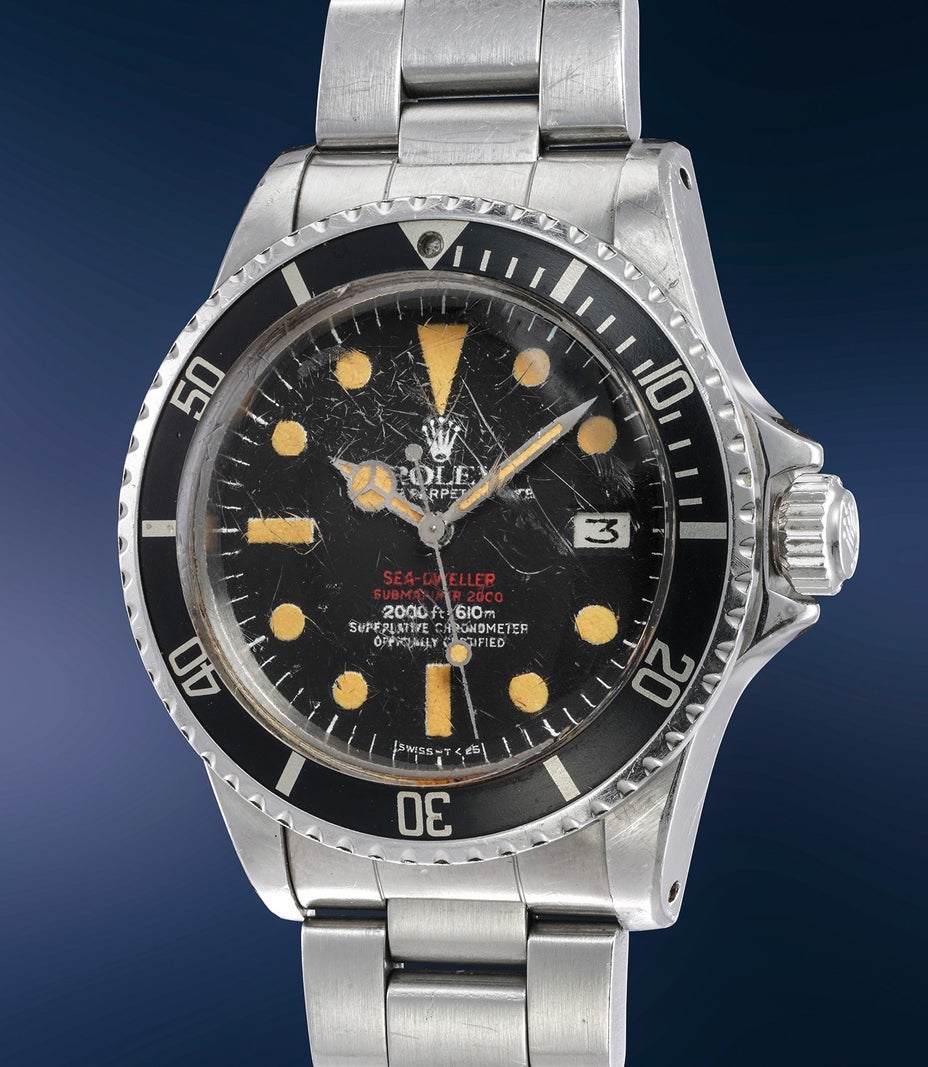
"Double Red" Sea-Dweller
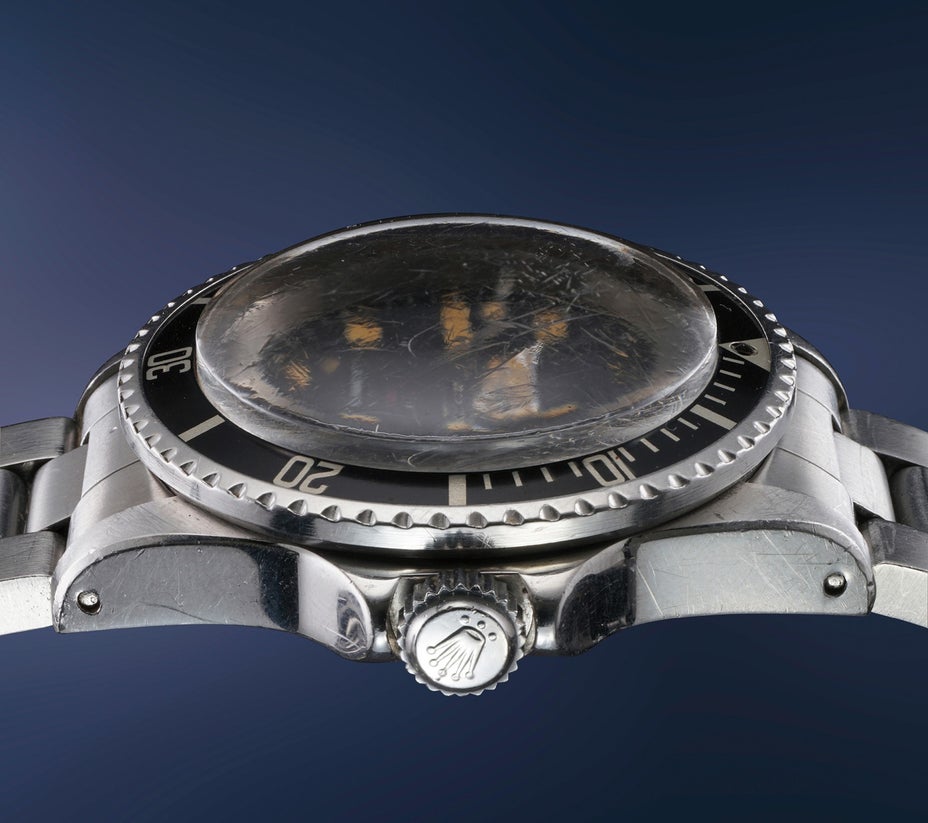
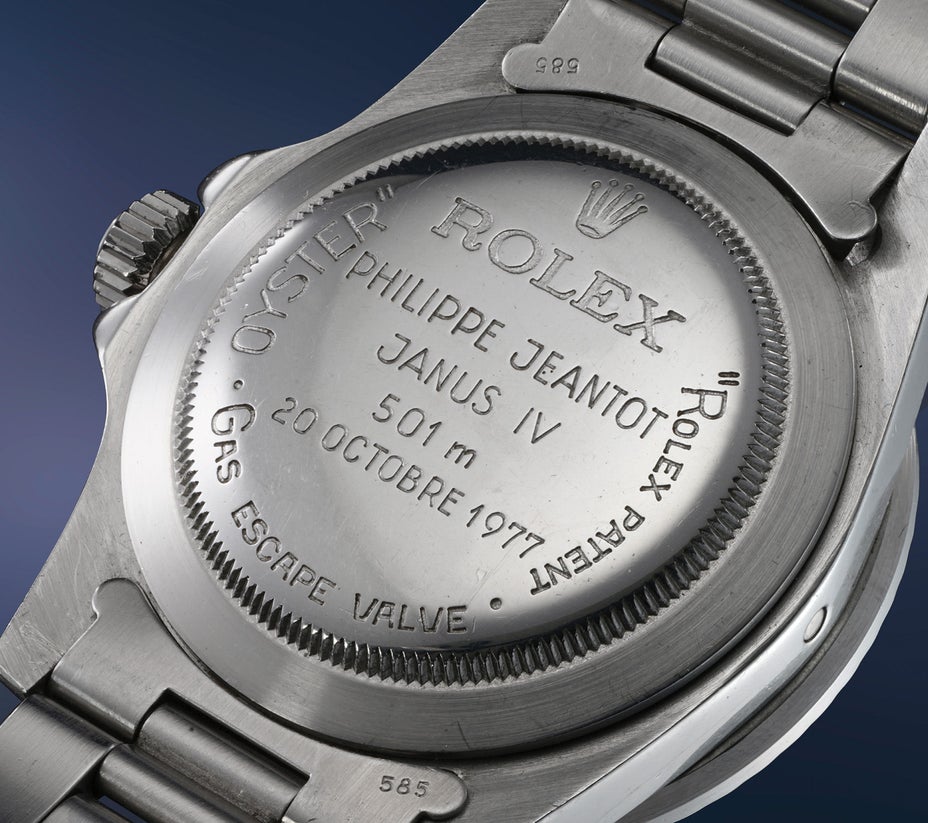
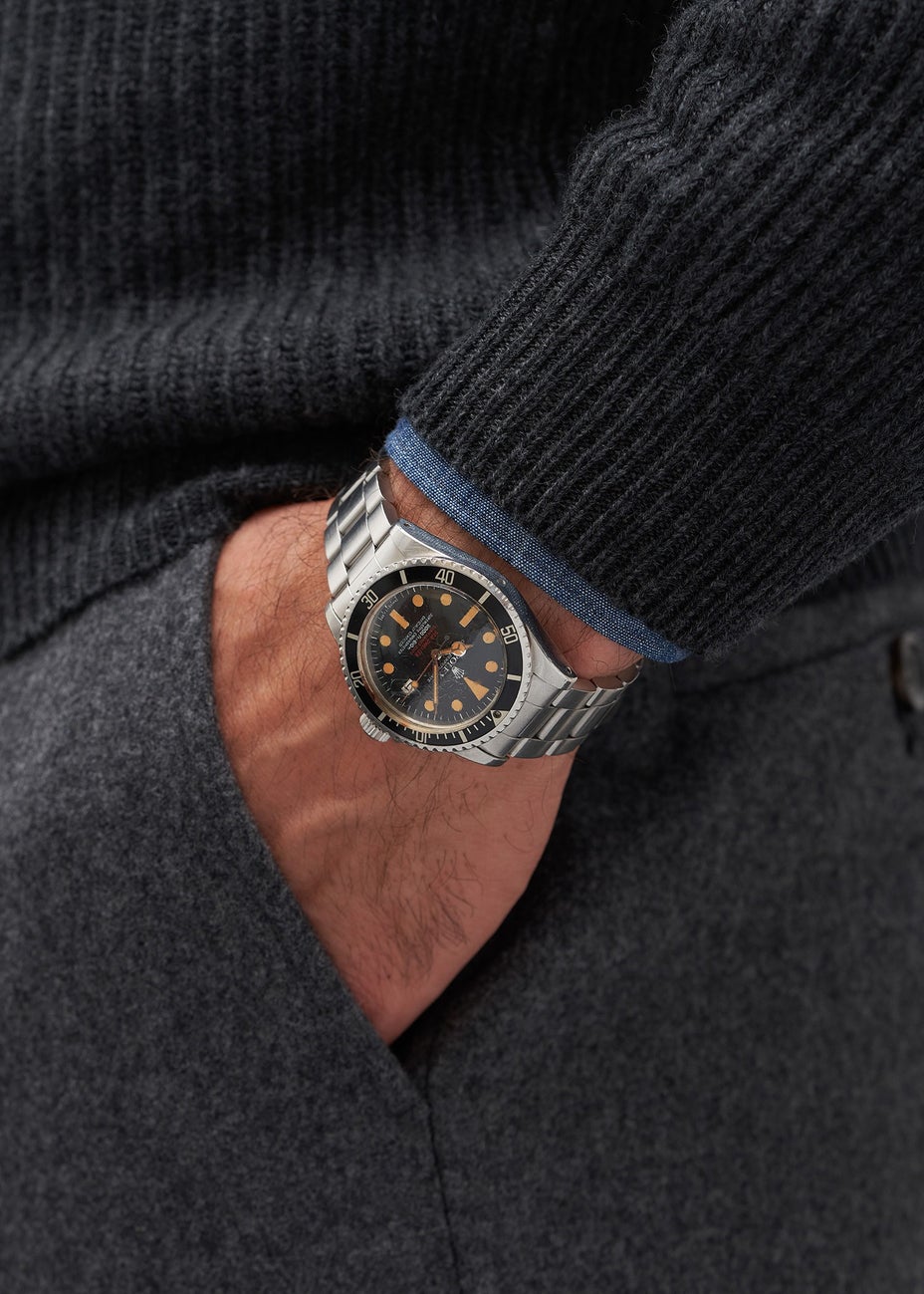
A very well preserved and uncommon stainless steel diver's wristwatch with center seconds, date, "Double Red" dial, engraved back and bracelet, made for Philippe Jeantot of the Janus IV experimental dive
Full-Cataloguing
It is obvious how such a technical piece was truly necessary only to a handful of individuals on the planet, highlighting the ethos of Rolex at the time.
While in the end Rolex released the Sea-Dweller to the general public, the present example, in the rare and extremely appealing “Double Red” configuration nonetheless, is in fact one of the few specimens that have been used to the full extent of their capabilities. As proudly engraved (by Rolex) on its back, it originally belonged to Philippe Jeantot, one of the 6 members of the Janus IV - Phase B (Phase A took place the previous year, reaching a max simulated depth of 480 meters) expedition. The Janus project, made by Comex in conjunction with Rolex, consisted in a series of dives made between 1968 and 1977 with increasing depth starting at 150 meters (Janus I). Janus IV will eventually reach a depth of 501 meters below sea level, marking a world record for scuba diving that lasts to this day and will most probably never be beaten. Not only the improved depth resistance was necessary for such a feat, but also the Helium Escape Valve: in order to reach such an enormous depth, the divers had to live for several days before the attempt in a hyperbaric chamber which was slowly pressurized with a mixture of helium, oxygen and nitrogen (Trimix Helium) to a pressure equivalent to 430 meters below sea level. Furthermore, during the descent the pressure was further increased to the equivalent of 490 meters (and from that point the dive to 501 meters took place). Without an escape valve, there is no way the watch would have come out of decompression intact.
A true piece of history, a tool watch exploited out of necessity in all of its capabilities and a witness to a nearly superhuman feat which is likely to rest unchallenged for the foreseeable future, it is without a doubt that they present watch is one of the most important Sea-Dweller watches - nay! All professional watches - to ever appear on the market, and the “human” counterpart to the Deepsea Special (lot 248): where the latter reached the lowest depth achieved by a manned vehicle, this watch was present when humankind marked the lowest depth for an “unshielded” dive.
Rolex
Swiss | 1905Founded in 1905 England by Hans Wilsdorf and Alfred Davis as Wilsdorf & Davis, it soon became known as the Rolex Watch Company in 1915, moving its headquarters to Geneva in 1919. Like no other company, the success of the wristwatch can be attributed to many of Rolex's innovations that made them one of the most respected and well-known of all luxury brands. These innovations include their famous "Oyster" case — the world's first water resistant and dustproof watch case, invented in 1926 — and their "Perpetual" — the first reliable self-winding movement for wristwatches launched in 1933. They would form the foundation for Rolex's Datejust and Day-Date, respectively introduced in 1945 and 1956, but also importantly for their sports watches, such as the Explorer, Submariner and GMT-Master launched in the mid-1950s.
One of its most famous models is the Cosmograph Daytona. Launched in 1963, these chronographs are without any doubt amongst the most iconic and coveted of all collectible wristwatches. Other key collectible models include their most complicated vintage watches, including references 8171 and 6062 with triple calendar and moon phase, "Jean Claude Killy" triple date chronograph models and the Submariner, including early "big-crown" models and military-issued variants.