948Σ︎
Patek Philippe
Ref. 2481
“Tropics”
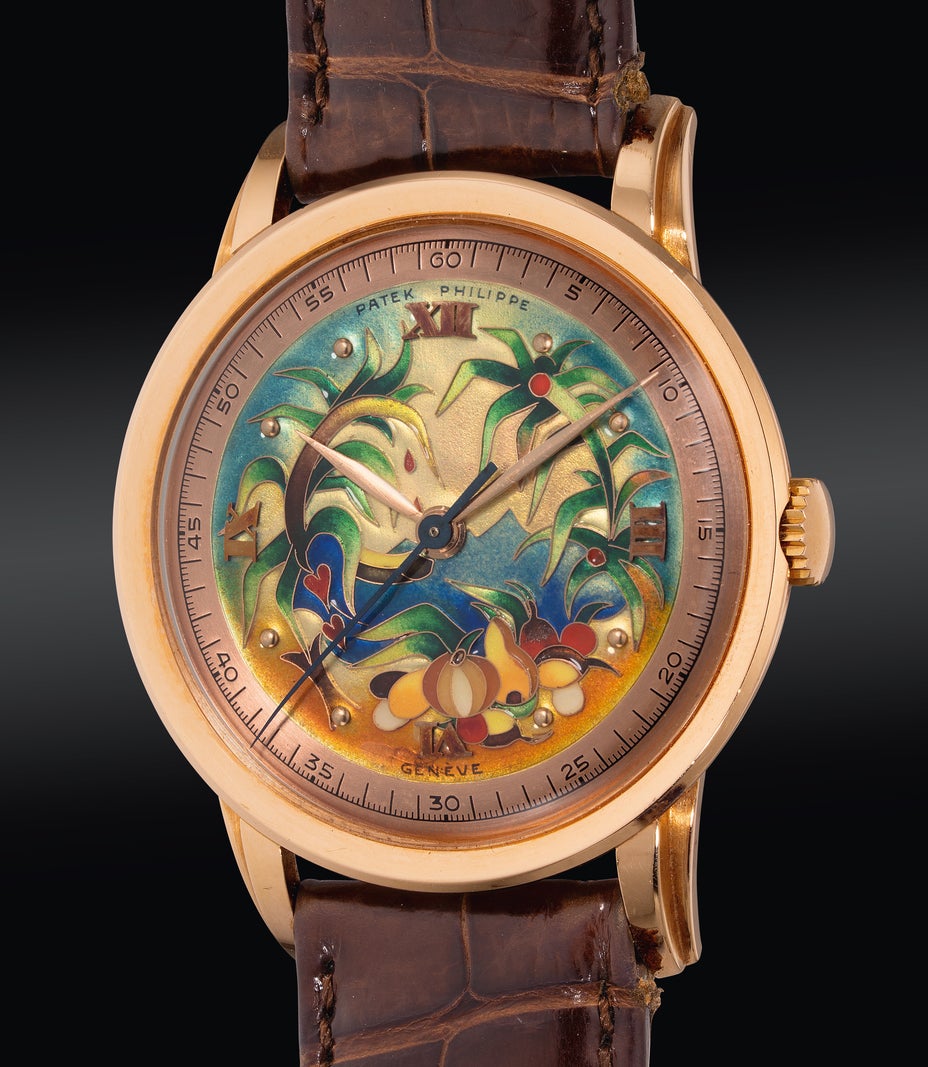
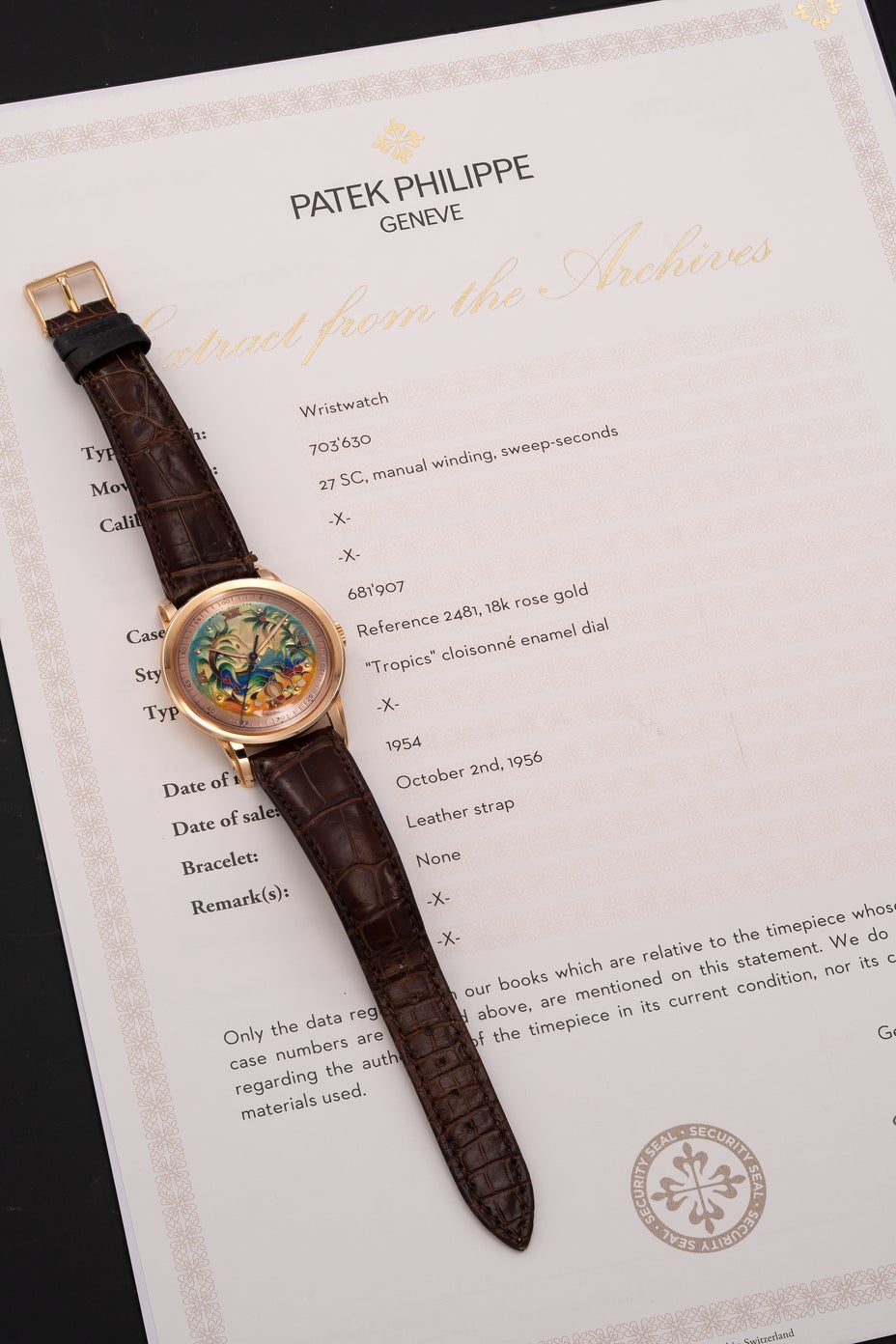
An exceptional, important and extremely rare pink gold wristwatch with “Tropics” cloisonné enamel dial, center seconds and Extract from the Archives
Full-Cataloguing
- One of 6 Tropical Landscape dials known in pink gold
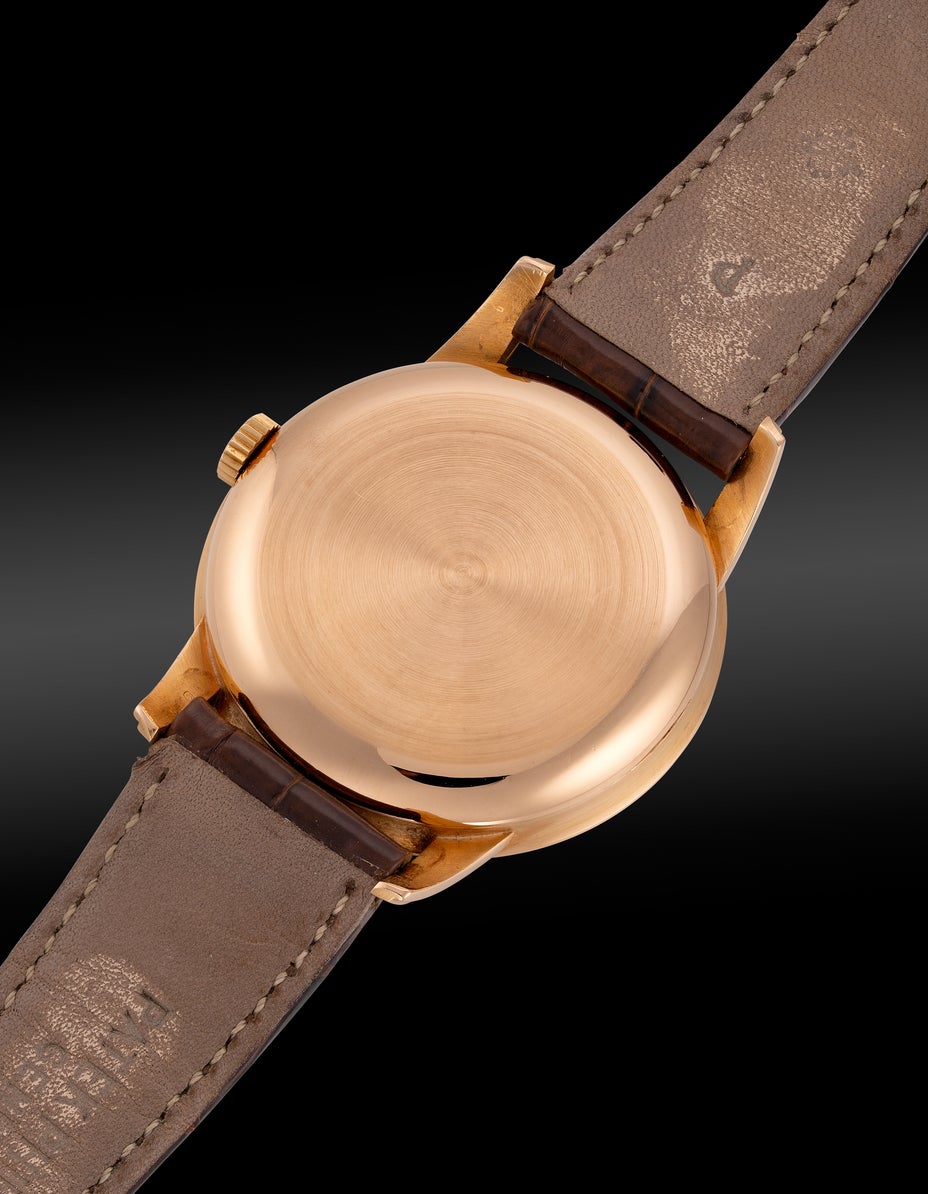
- Case is remarkably strong with 2 very crisp hallmarks
- Colors on the dial are exceptionally vibrant and well-preserved
Certain creations, by virtue of their mechanical audacity, rarity and enduring aesthetic, transcend the boundaries of watchmaking and step into the realm of legendary artisanship. Timepieces that every discerning connoisseur dreams of acquiring and that, once secured, bestow a subtle yet profound sense of fulfillment. These are the masterworks that dictate taste, redefine horological milestones and command pride of place within the world’s most private vaults. Owning a piece such as the present watch marks a quiet entry into an exclusive circle of collectors whose passion is unyielding and whose standards remain absolute.
Reference 2481
Patek Philippe’s reference 2481 is one of the manufacture's most iconic time-only watches of the mid-20th century. At 36.5mm in diameter, it is affectionately known by collectors as the “King Size”, and when introduced to the market in 1950, it was one of the largest wristwatches ever made by the brand. The dial is spacious enough to serve as the perfect canvas for enamellists to create their masterworks. The reference 2481 is powered by the legendary calibre 27SC, considered among the very best center seconds wristwatch movements of its era.
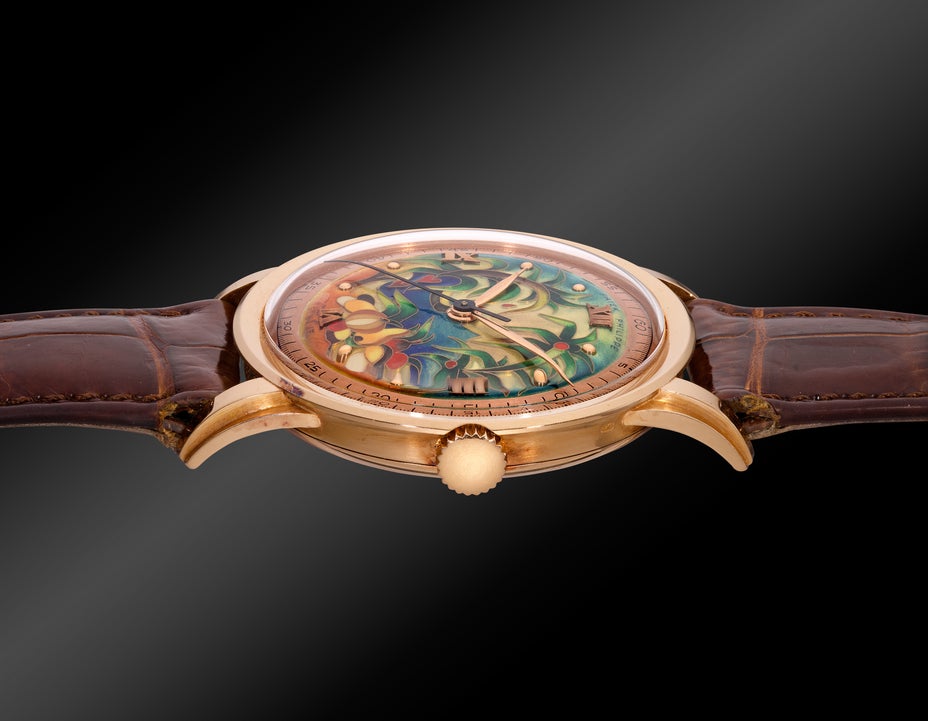
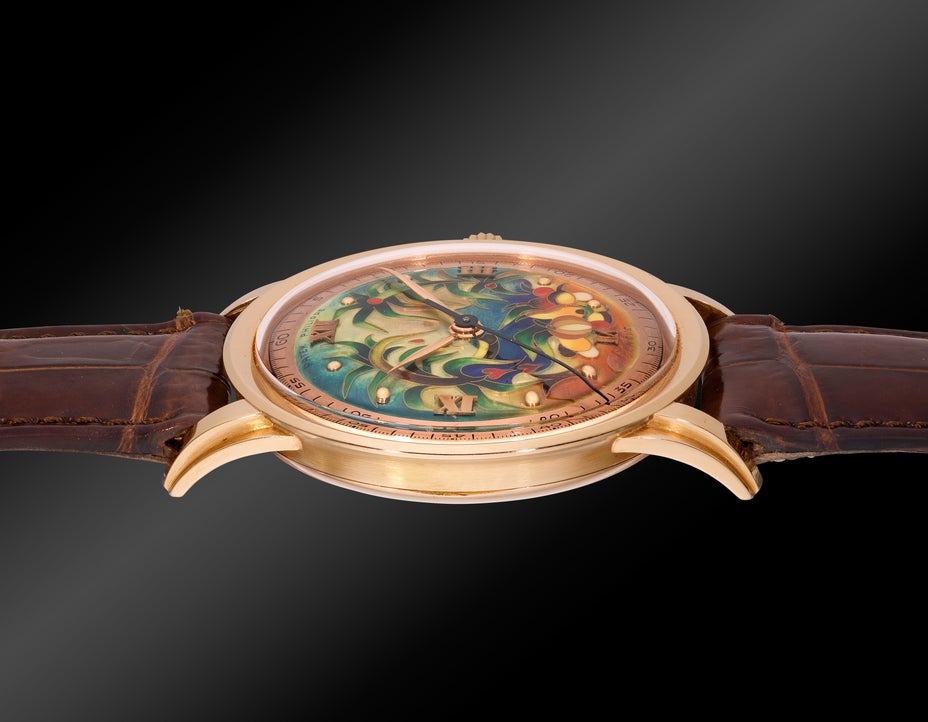
The reference is instantly recognizable due to its case design, which features a distinctive "V"-shaped profile. It is also one of very few cases crafted by Le Locle master casemaker Bernard Dubois, confirmed by the head hammer key number 171 and the letter “L” (Le Locle) within the Helvetia hallmark. Featuring elongated claw lugs and a concave bezel, it delivers a remarkable presence on the wrist, a modernist departure from the reserved, classic proportions of traditional Calatrava models.
Cloisonné enamel dial
The reference was available with the standard silvered dial, but also, on extremely rare occasions, with cloisonné enamel dials depicting various motifs such as landscapes (like the present watch), maps and even portraits of renowned figures.
Cloisonné enamel is considered one of the finest and most complex dial fabrication techniques in haute horlogerie. Fine gold wires are first arranged on a metal base to outline the subject. Then, the compartments created by the wire are then filled with powdered enamel colored by metal oxides and fired, solidifying the enamel into a beautiful work of art.
Compared with modern enamel, vintage enamel dials feature colors that are exceptionally deep, glossy and translucent as the skilled artisans who created these scenes worked with mercury, lead and cyanide. These were the substances whose dangerous health effects were not fully recognized in the 1940s and 50s, but were subsequently banned. Due to the high production costs and the limited number of artisans capable of such work, cloisonné enamel dials were made in extremely small numbers, and very few were sold during the mid-20th century.
Ref. 2481 in pink gold with tropical landscape cloisonné enamel known to the market:
Movement No. 700’260, Case No. 660’758, 1950
Movement No. 701'298, Case No. 668'427, 1951
Movement No. 703’043, Case No. 678’621, Circa 1953
Movement No. 703’613, Case No. 681’906, Circa 1953
Movement No. 703’630, Case No. 681’907, 1954 (Present example)
Movement No. 708’178, Case No. 2’600’048, Circa 1959
According to our research, there are 12 known examples across yellow gold and pink gold, the present watch is believed to be one of only 6 known pink gold examples featuring this dial type. All dials differ slightly as some feature raindrops, while others depict various fruits in their lower portions, or distinct mountain, sea or skyscapes.
“Tropics” Dial
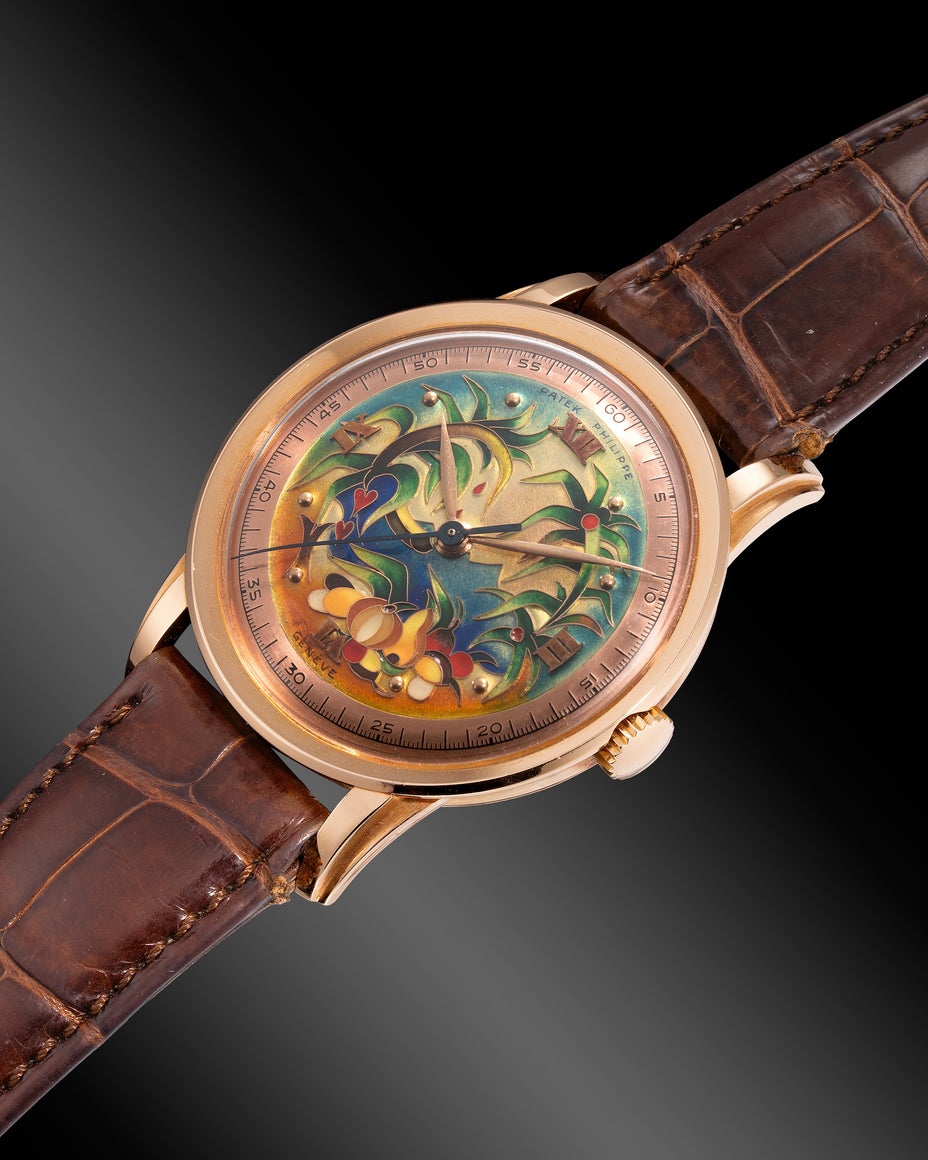
This type of "tropical rainforest" dial was inspired by 19th-century French artists Paul Gauguin and Henri Rousseau’s depictions of tropical landscapes, and is one of the most sought-after Patek Philippe cloisonné dials. The rich variety of shapes and multiple color combinations render it one of the most beautiful decorative dials ever produced.
The dial was crafted by dial maker Stern Frères by one of their most celebrated artists, Marguerite Koch. The production of such dials was extremely costly as each had to be individually executed. Koch created the outline of the motif by shaping thin gold wires on the dial, ensuring no two dials were identical down to the smallest detail.
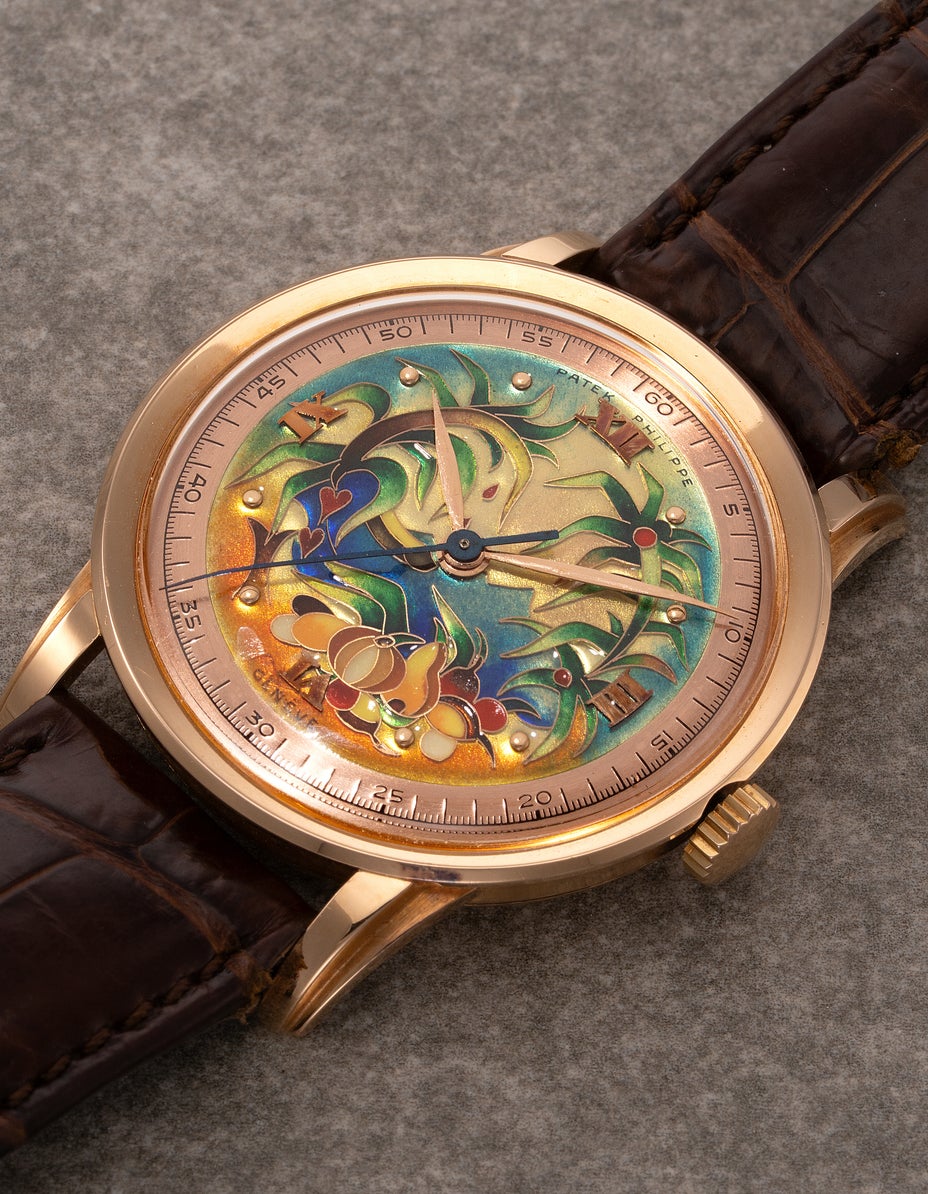
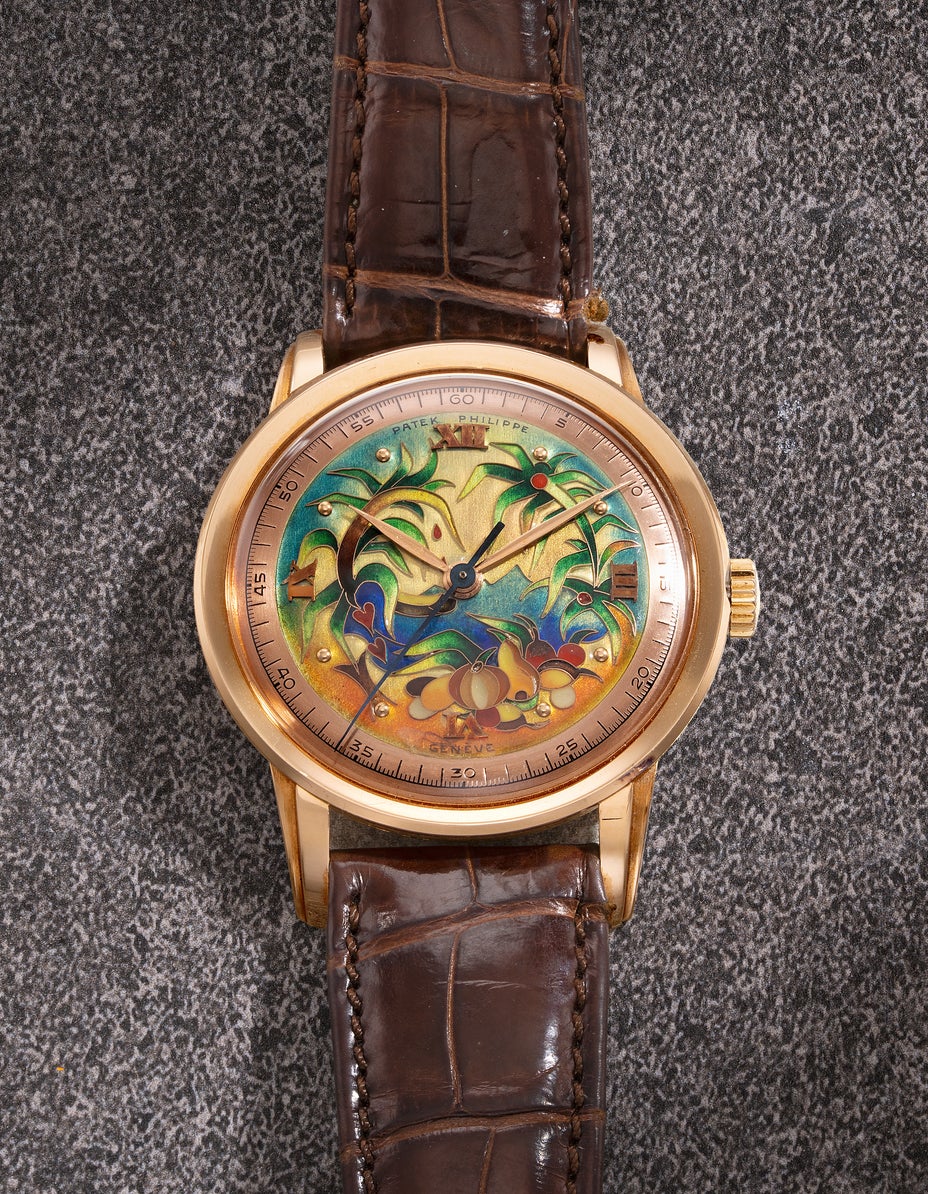
Confirmed by its Extract from the Archives, the “Tropics” cloisonné dial depicts a lush tropical setting with palm trees and fruits. Its colors, ranging from a deep cobalt blue to an intense yellow, are stunning and iridescent—enhanced by its excellent state of preservation. Sparing no expense, all dial graphics, including the outer minute track, are executed in raised hard enamel. Whilst applied gold Roman numerals, dot hour markers, gold feuille hands and a blued steel seconds hand complete this elegant and timeless aesthetic.
Condition
The case is preserved in outstanding condition, with incredibly crisp steps on the lugs and two strong hallmarks present on the caseband and behind the lugs. The original proportions of the claw-shaped lugs remain remarkably preserved.
The colors on the dial are exceptionally vibrant and well-preserved, which is a remarkable feat for a watch over 70 years old. The transition of green shades on the palm leaves and brown on the trunk is executed perfectly alongside the various blue hues across the dial. Naturally, vintage dials age and may show subtle restoration over their lifespan. The dial is immaculately preserved, aside from light hairline traces near 6 o’clock.
Provenance
1954 – Date of manufacture
1956 – First sold
2002 – First time in auction
2002 – Second time in auction
2009 – Third time in auction
2026 – Phillips Hong Kong
This timepiece previously appeared at auction 3 times, twice in 2002 and most recently in 2009. Tucked away in private hands since its last public appearance 17 years ago, the watch remains in the same condition as when it was last offered.
The importance of this model is well recognized by Patek Philippe themselves as two similar 18K yellow gold examples with the “Tropical Landscape” dial motif are housed in the Patek Philippe Museum. The present watch was also the cover lot for the June 2002 auction, further underscoring the historical significance of mid-century cloisonné enamel dials.
Since its previous appearance in 2009, a cloisonné enamel reference 2481 in pink gold has appeared at an international auction on only two occasions. Phillips is honored to present this breathtaking and historically important wristwatch to the market once again, offering a truly rare opportunity for the discerning connoisseur.
Patek Philippe
Swiss | 1839Since its founding in 1839, this famous Geneva-based firm has been surprising its clientele with superbly crafted timepieces fitted with watchmaking's most prestigious complications. Traditional and conservative designs are found across Patek Philippe's watches made throughout their history — the utmost in understated elegance.
Well-known for the Graves Supercomplication — a highly complicated pocket watch that was the world’s most complicated watch for 50 years — this family-owned brand has earned a reputation of excellence around the world. Patek's complicated vintage watches hold the highest number of world records for results achieved at auction compared with any other brand. For collectors, key models include the reference 1518, the world's first serially produced perpetual calendar chronograph, and its successor, the reference 2499. Other famous models include perpetual calendars such as the ref. 1526, ref. 3448 and 3450, chronographs such as the reference 130, 530 and 1463, as well as reference 1436 and 1563 split seconds chronographs. Patek is also well-known for their classically styled, time-only "Calatrava" dress watches, and the "Nautilus," an iconic luxury sports watch first introduced in 1976 as the reference 3700 that is still in production today.