821
Patek Philippe
Ref. 866/48
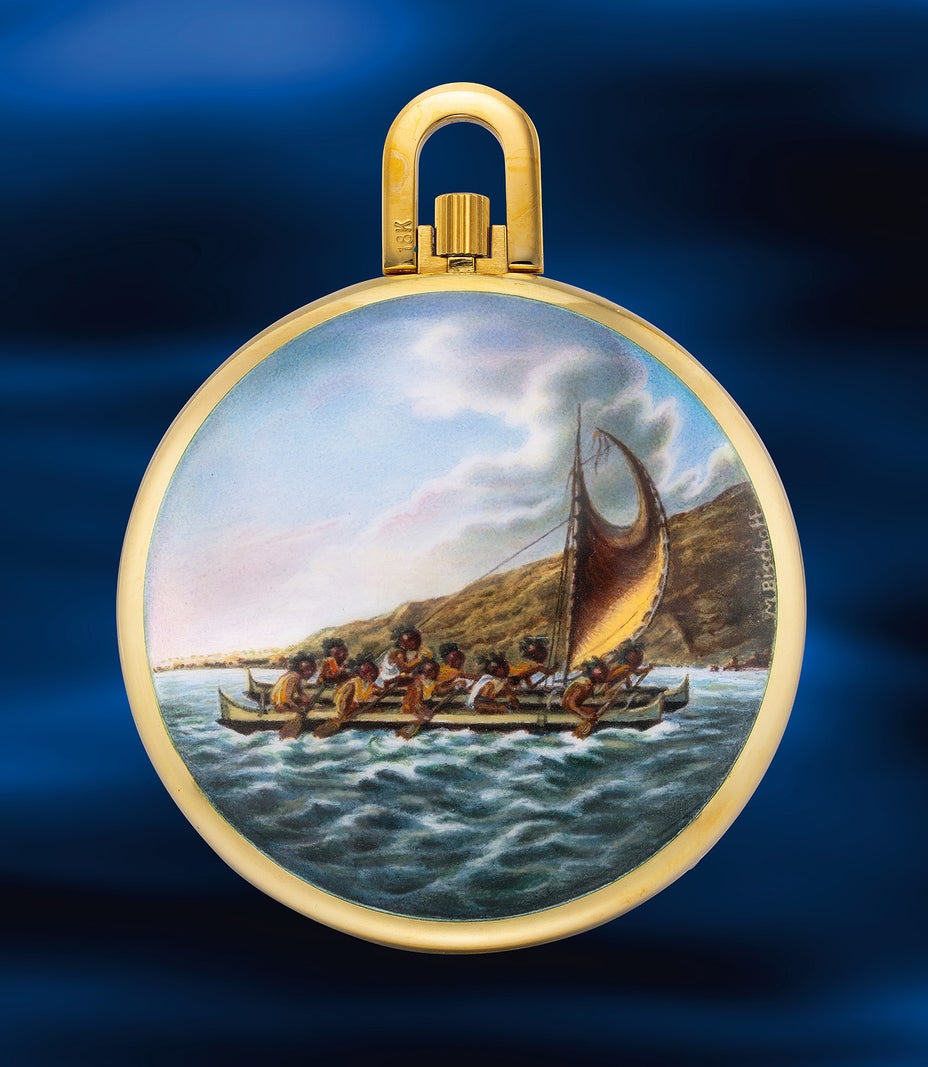
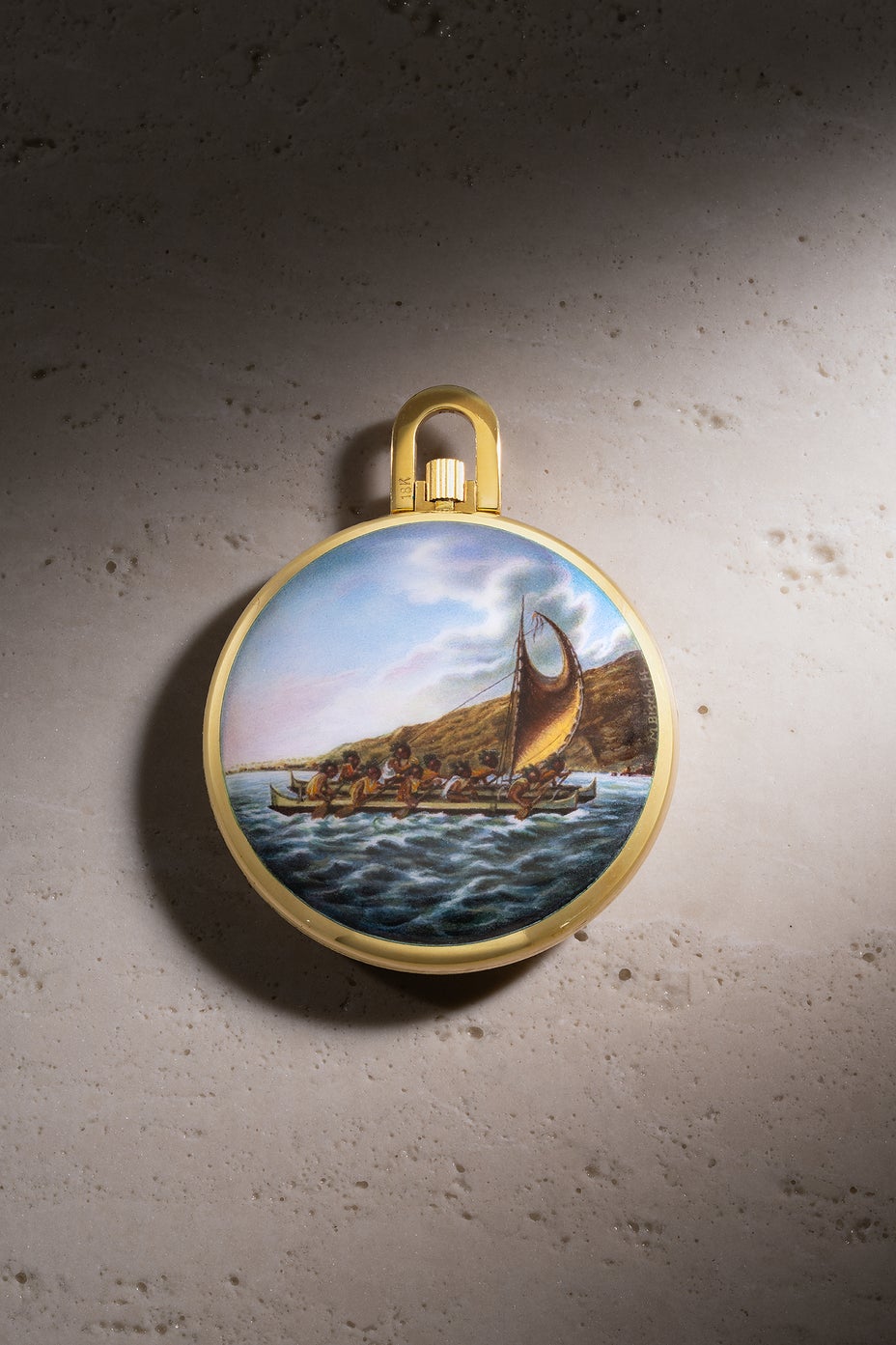
“Guerriers Hawaiiens”
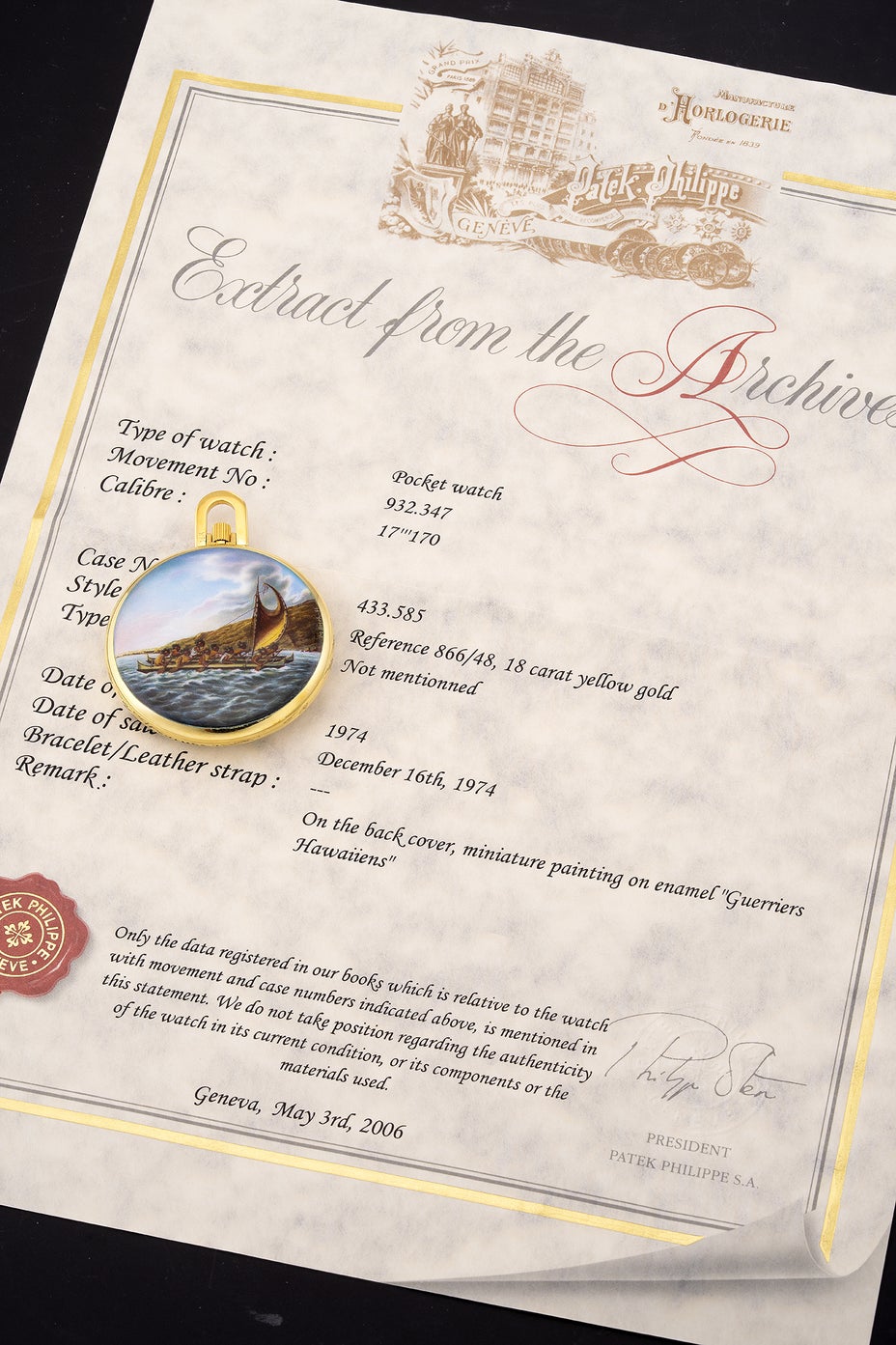
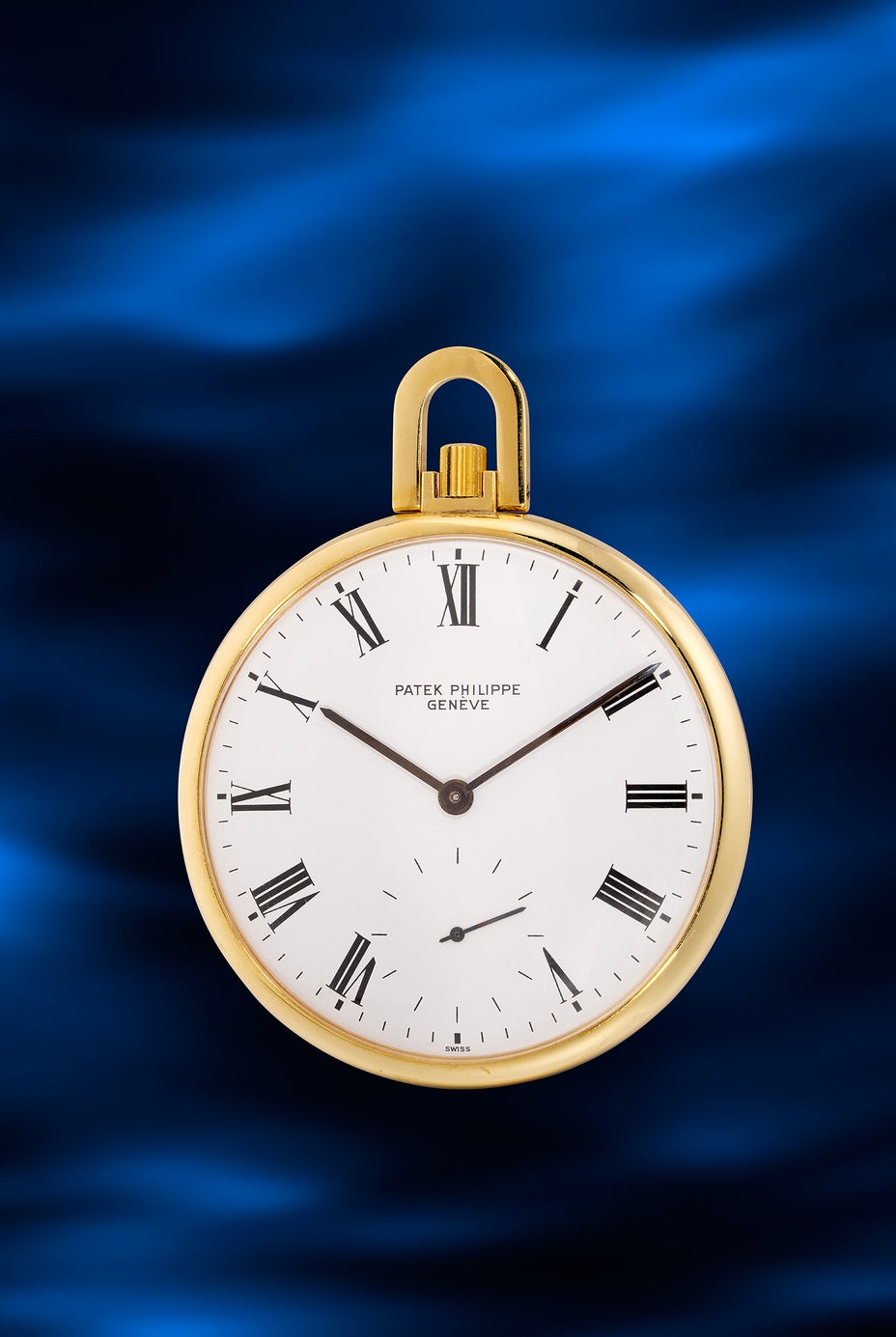
A unique, exceptional and well-preserved yellow gold openface pocket watch with enamel miniature painted by M. Bischoff reproducing a 1784 painting “Guerriers Hawaiiens” by John Webber and Extract from the Archives
Full-Cataloguing
“A Canoe of the Sandwich Islands, the Rowers Masked”, John Webber, circa 1784
The inspiration for this miniature enamel comes from an 18th century drawing by John Webber (1752-1793). Webber was the official artist on British explorer Captain James Cook’s third and final voyage to the Pacific from 1776 to 1780. Born in London, England, in 1751, he was trained as an artist and tasked with creating illustrations of the places and people encountered during the voyage. His sketches were later used to produce engravings for the official account of the journey, published after Cook's death. Webber aimed to provide a more vivid representation than could be conveyed through written descriptions.
During Cook’s third voyage, he sought to discover the Northwest Passage between the Atlantic Ocean and the Pacific coast of North America. The present enamel miniature captures Webber’s depiction of a scene from his time in the "Sandwich Islands", the European name for the Hawaiian Islands, which Cook named in 1778 in honor of John Montagu, the 4th Earl of Sandwich. The name was widely used by foreigners in the 19th century, although the native name, Hawaiʻi, has since been restored.
The enamel illustrates a notable image of ten Hawaiian rowers transporting a priest carrying a feather-covered representation of Kukailimoku, the Hawaiian god of war. The priests and paddlers are all adorned with gold masks as they navigate a double-hulled canoe with an upright sail. These double-hulled or single-hulled outrigger canoes were the primary mode of transport in Polynesian Hawaii. The smaller canoes, like the one depicted here, were carved from a single great Hawaiian Koa log harvested from the rainforest, then shaped and brought down to the coast.
The craftsmanship is magnificent, beautifully capturing the scenery of this remarkable expedition, with the sky, ocean, and clouds enhancing the canoe's presence. Well-preserved since its auction debut in 2006, it has remained in a safe without further intervention. The present “Guerriers Hawaiiens” is a true culmination of watchmaking and fine art, showcasing Patek Philippe's preeminence in the field.
Patek Philippe
Swiss | 1839Since its founding in 1839, this famous Geneva-based firm has been surprising its clientele with superbly crafted timepieces fitted with watchmaking's most prestigious complications. Traditional and conservative designs are found across Patek Philippe's watches made throughout their history — the utmost in understated elegance.
Well-known for the Graves Supercomplication — a highly complicated pocket watch that was the world’s most complicated watch for 50 years — this family-owned brand has earned a reputation of excellence around the world. Patek's complicated vintage watches hold the highest number of world records for results achieved at auction compared with any other brand. For collectors, key models include the reference 1518, the world's first serially produced perpetual calendar chronograph, and its successor, the reference 2499. Other famous models include perpetual calendars such as the ref. 1526, ref. 3448 and 3450, chronographs such as the reference 130, 530 and 1463, as well as reference 1436 and 1563 split seconds chronographs. Patek is also well-known for their classically styled, time-only "Calatrava" dress watches, and the "Nautilus," an iconic luxury sports watch first introduced in 1976 as the reference 3700 that is still in production today.