90
Northern Goldsmiths Company
"Tourbillon with Guillaume Balance"
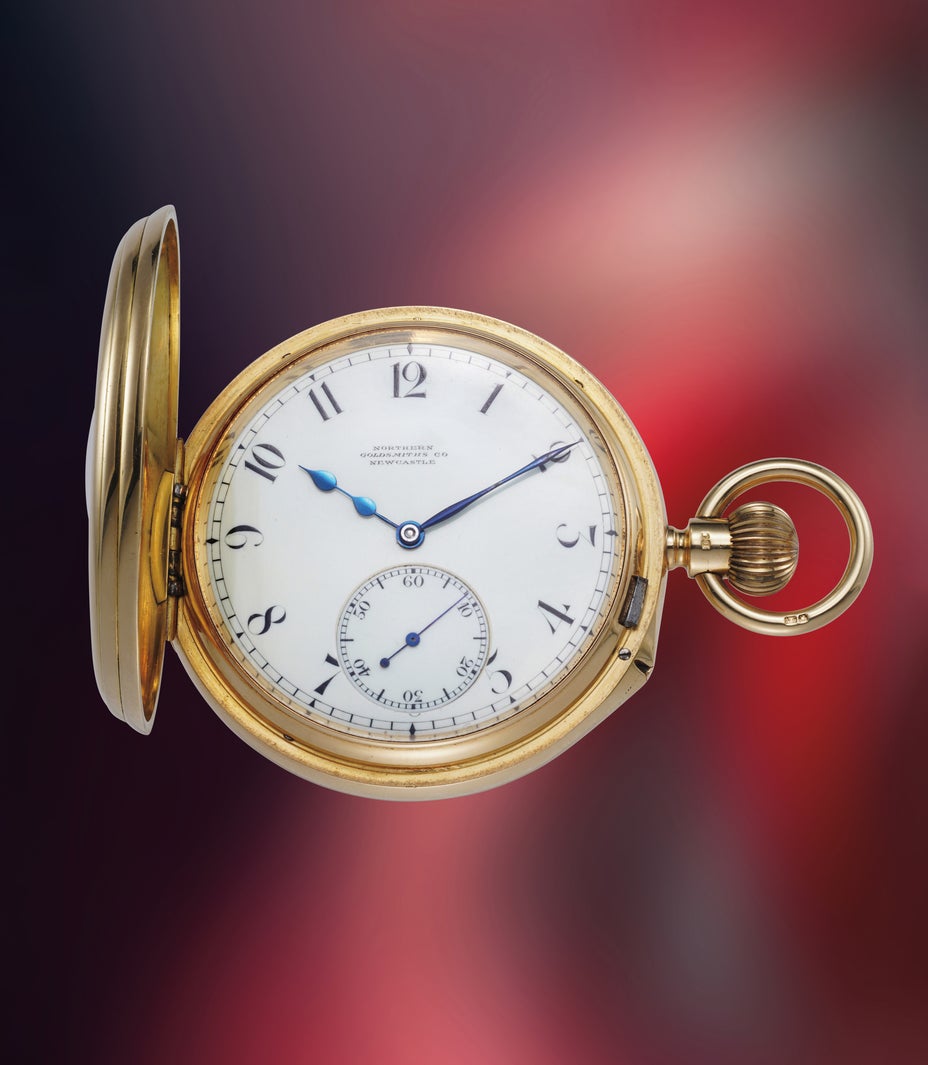
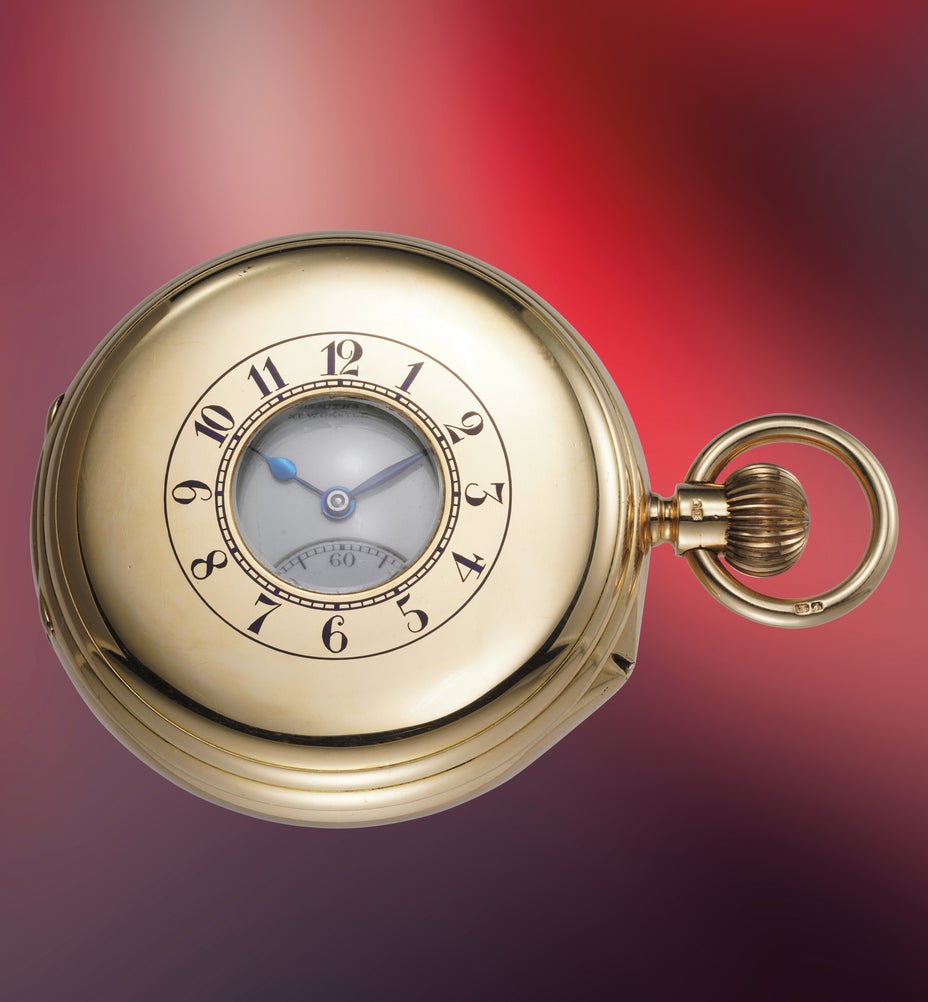
An extremely rare and important yellow gold half hunter case tourbillon pocket watch with Guillaume balance and Class A "Especially Good" rating Certificate
Estimate
CHF30,000–60,000
€32,100–64,200
$36,100–72,200
Manufacturer
Northern Goldsmiths Company
Year
Circa 1925
Movement No
2100
Case No
2100
Model Name
"Tourbillon with Guillaume Balance"
Material
18k yellow gold
Calibre
Manual
Dimensions
55.5mm diameter
Signed
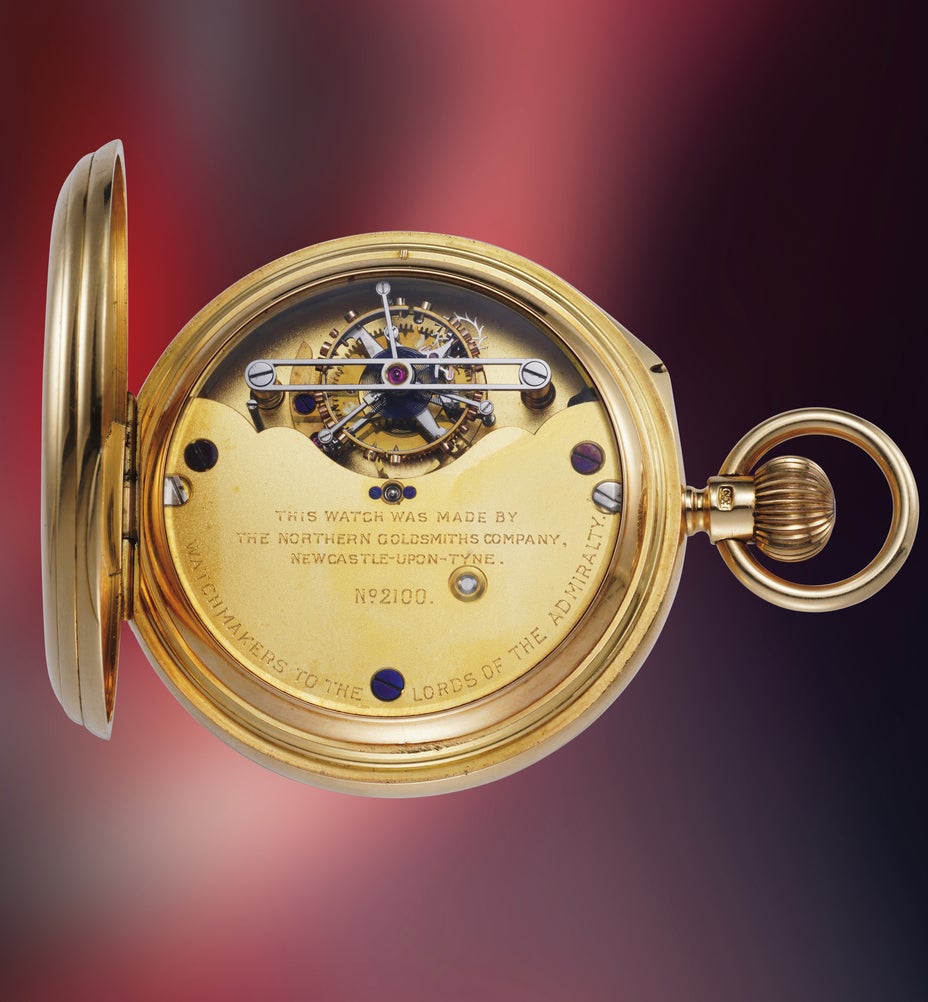
Dial and movement signed, movement, front and back cuvettes numbered, case further stamped NG Co (Northern Goldsmiths Company) and date letter for 1925
Accessories
Accompanied by Class A “Especially Good” National Physics Laboratory Certificate dated May/June 1920.
Full-Cataloguing
Good To Know:
- Tourbillon
- One of only 8 known
- Kew Observatory tested between 15 May and 28 June 1920 where the watch achieved 90.8 points, “especially good”.
The Northern Goldsmiths Company was founded in 1892 by Thomas Cooke in Newcastle upon Tyne. It transitioned from a high-end watch and chronometer maker into a prominent retailer, famously becoming the UK's very first official retailer of Rolex watches in 1919
Featured in multiple historically important horological tomes including George Daniels and Cecil Clutton’s Watches, and Reinhard Meis’, Das Tourbillon, the Northern Goldsmiths series of eccentric tourbillon pocket watches are widely considered as some of the finest and most accurate British watches made during the early 20th century.
One of only eight known examples of a possible 15 produced between 1917 and 1922, the present watch was sent to the Kew Observatory for testing between 15 May and 28 June 1920 where the watch achieved 90.8 points, “especially good”. Sidney Better made all the eight tourbillon watches sold by Northern Goldsmiths between 1917-1922, when he was at his peak. To have achieved 90.8 points “especially good” rating at Kew is an achievement indeed but in 1922 he went on to achieve 94.2 points with his No. 2134 which has scarcely been bettered by any maker.
Housed within an extremely high-quality 18 karat yellow gold hunter case with 5-knuckle joints and a raised push piece, the frosted gilt three-quarter plate movement exhibits finest quality, hand-made details, such as jewels housed in screwed-in gold chatons, mirror polished bridges and tourbillon cage, and beautifully beveled gear axles.
The tourbillon escapement, of course is the star of the show. The polished steel double-arm bridge, referred to in scholarship as the “Better 1” design attributed to Sidney Better, and houses a “Better type-2” carriage with offset arms. Free-sprung and fitted with a blued steel balance wheel with terminal curve, the entire design was made for maximum timekeeping accuracy – and its Especially Good rating at Kew proves it. Beautifully preserved with its mesmerizing, eccentric tourbillon cage immediately captivating to the eye, it is an exceptional opportunity for the discerning collector.
- Tourbillon
- One of only 8 known
- Kew Observatory tested between 15 May and 28 June 1920 where the watch achieved 90.8 points, “especially good”.
The Northern Goldsmiths Company was founded in 1892 by Thomas Cooke in Newcastle upon Tyne. It transitioned from a high-end watch and chronometer maker into a prominent retailer, famously becoming the UK's very first official retailer of Rolex watches in 1919
Featured in multiple historically important horological tomes including George Daniels and Cecil Clutton’s Watches, and Reinhard Meis’, Das Tourbillon, the Northern Goldsmiths series of eccentric tourbillon pocket watches are widely considered as some of the finest and most accurate British watches made during the early 20th century.
One of only eight known examples of a possible 15 produced between 1917 and 1922, the present watch was sent to the Kew Observatory for testing between 15 May and 28 June 1920 where the watch achieved 90.8 points, “especially good”. Sidney Better made all the eight tourbillon watches sold by Northern Goldsmiths between 1917-1922, when he was at his peak. To have achieved 90.8 points “especially good” rating at Kew is an achievement indeed but in 1922 he went on to achieve 94.2 points with his No. 2134 which has scarcely been bettered by any maker.
Housed within an extremely high-quality 18 karat yellow gold hunter case with 5-knuckle joints and a raised push piece, the frosted gilt three-quarter plate movement exhibits finest quality, hand-made details, such as jewels housed in screwed-in gold chatons, mirror polished bridges and tourbillon cage, and beautifully beveled gear axles.
The tourbillon escapement, of course is the star of the show. The polished steel double-arm bridge, referred to in scholarship as the “Better 1” design attributed to Sidney Better, and houses a “Better type-2” carriage with offset arms. Free-sprung and fitted with a blued steel balance wheel with terminal curve, the entire design was made for maximum timekeeping accuracy – and its Especially Good rating at Kew proves it. Beautifully preserved with its mesmerizing, eccentric tourbillon cage immediately captivating to the eye, it is an exceptional opportunity for the discerning collector.