1
KAWS
Man's Best Friend
portfolio 36 3/4 x 24 5/8 in. (93.3 x 62.5 cm.)
Full-Cataloguing
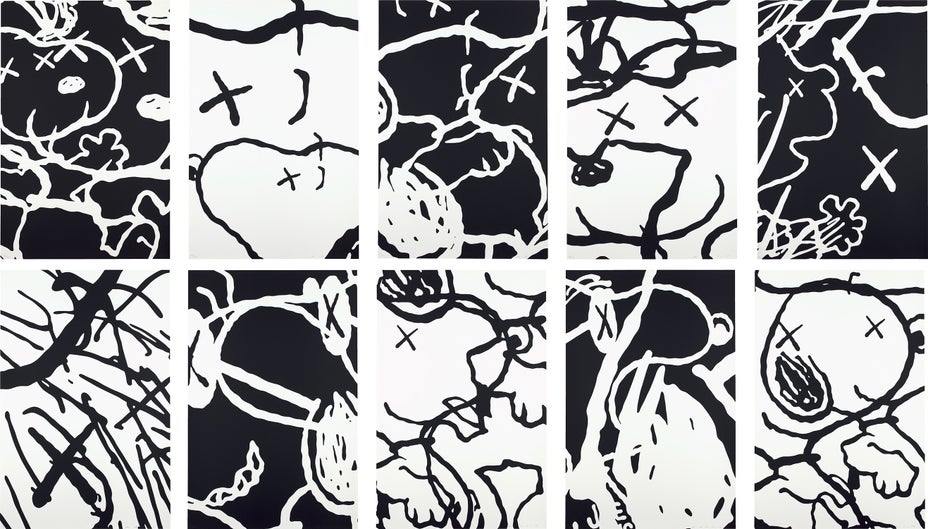
By extracting minimalist, detailed crops of Charlie Brown, KAWS has left just a hint of the persona being portrayed, yet even with just a dissociated portion the viewer is able to immediately recognize this iconic canine. As the artist comments, “[I] found it weird how infused a cartoon could become in people's lives; the impact it could have, compared to regular politics” (KAWS in Healy & Murray, "Graffiti Artist Turned Gallery Artist Turned Art Toy Maker, KAWS," Pop, February 2007, pp. 260-265). KAWS’ simplistic yet bold images playfully and inventively rework quintessential cartoon imagery while touching on the viewer’s personal, childhood relationship to the ensemble of friendly cartoon faces.
KAWS
American | 1974To understand the work of KAWS is to understand his roots in the skateboard and graffiti crews of New York City. Brian Donnelly chose KAWS as his moniker to tag city streets beginning in the 1990s, and quickly became a celebrated standout in the scene. Having swapped spray paint for explorations in fine art spanning sculpture, painting and collage, KAWS has maintained a fascination with classic cartoons, including Garfield, SpongeBob SquarePants and The Simpsons, and reconfigured familiar subjects into a world of fantasy.
Perhaps he is most known for his larger-than-life fiberglass sculptures that supplant the body of Mickey Mouse onto KAWS' own imagined creatures, often with 'x'-ed out eyes or ultra-animated features. However, KAWS also works frequently in neon and vivid paint, adding animation and depth to contemporary paintings filled with approachable imagination. There is mass appeal to KAWS, who exhibits globally and most frequently in Asia, Europe and the United States.