113
Joaquín Torres-García
Untitled
Full-Cataloguing
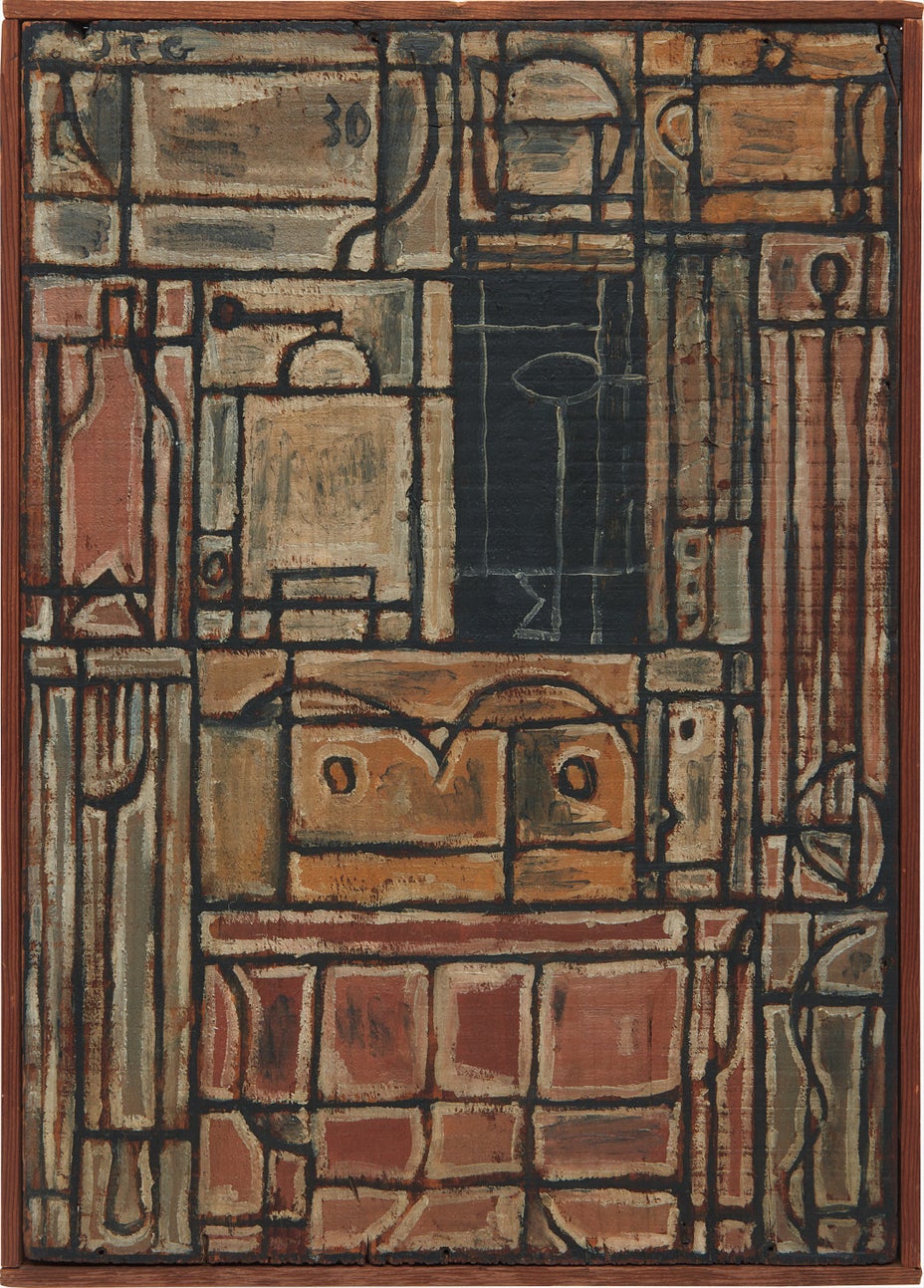
The present lot, Untitled, 1930, introduces the structures of thick, black orthogonal lines creating a Neo-Plastic grid that organizes Torres-García’s compositions into geometric compartments, reminiscent of Piet Mondrian. Inside these windowed façades, Torres-García includes quotidian symbols—bottles, a pot, an abstract figure and a key—to depict a schematic urban scene from his own imagination. At the same time, the perfectly balanced geometrical plane and earth-toned palette are inspired by Pre-Columbian art, which he considered to be “the perfect synthesis of structure and figuration” (Luis Pérez-Oramas, Joaquín Torres-García: The Arcadian Modern, New York, 2015, p. 108). The jarring and vibrant chromatic field of pink, gray, yellow and orange, reflects Torres-García’s first experiments with colors that he observed in Peruvian Nazca ceramics. Although seemingly simple, this composition is quite radical as it combines “the European modern-art-practices such as abstraction, to an indigenous artistic legacy, with the aim of creating a sense of timelessness and universality” (Luis Pérez-Oramas, Joaquín Torres-García: The Arcadian Modern, New York, 2015, p. 108). Untitled, 1930 is thus an emblematic painting that delineates the principles behind Joaquín Torres-García’s Constructive Universalism vision, reminding us of the pivotal contributions that the artist made to modernism, most recently reflected in his 2015 retrospective at the Museum of Modern Art in New York, Joaquín Torres-García: The Arcadian Modern.
Joaquín Torres-García
Uruguayan | B. 1874 D. 1949Joaquín Torres-García was born in Montevideo and moved to Barcelona with his family, studying at the Escuela Oficial de Bellas Artes. The Catalan Noucentismo movement provided the foundation for his artistic development. His work was also influenced by Neo-Plasticism, Cubism and Vibrationism, which fused Cubism and Futurism with urban imagery.
Torres-García returned to Uruguay after a 43-year absence. While at home, he continued to develop his iconic style of Constructive Universalism, a chief contribution to modernism that affected many younger generations of Uruguayan artists. This style aspired to establish a universal structural unity through synthetic abstraction. In order to accomplish this, Torres-García synthesized rather than analyzed the quotidian elements and urban scenes from reality. While remaining in the world of figuration, he integrated abstraction's structural grids within the composition, also incorporating pre-Columbian aesthetics.