152Ο︎
Jean-Michel Basquiat
Untitled (Standing Male Figure)
Full-Cataloguing
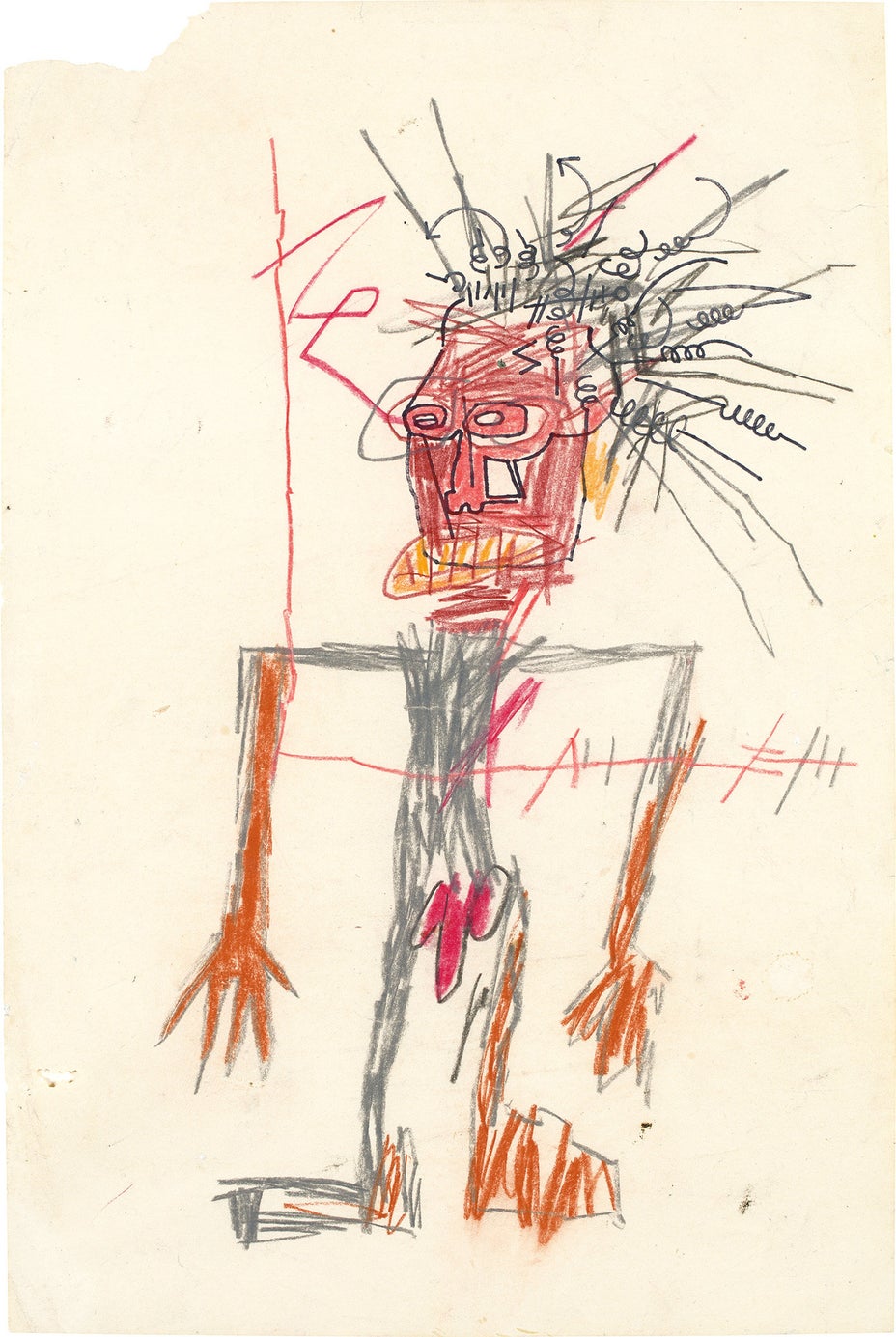
It was above all Basquiat’s re-introduction of the human figure into contemporary art that garnered him widespread acclaim. “Basquiat's canon,” as Kellie Jones has indeed noted, “revolves around single heroic figures: athletes, prophets, warriors, cops, musicians, kings and the artist himself” (Kellie Jones, “Lost in Translation: Jean-Michel in the (Re)Mix”, in Basquiat, exh. cat., Brooklyn Museum, New York, 2005, p. 43). Untitled (Standing Male Figure) presents us with such a single heroic figure, here rendered with dreadlocks that suggest it may in fact be a self-portrait of the artist. While the stick-like figure points to his fascination with comic books, it also points to the wealth of inspiration Basquiat found in ancient pictographs.
Works such as the present one demonstrate the incredibly mature pictorial idiom of Basquiat’s breakthrough work, one that built upon his lifelong fixation with drawing. For Basquiat, drawing was akin to a performative act – it was not simply the means of working out pictorial solutions to be integrated into a painting, rather, each drawing presented a discrete work in of itself. The present work pulsates with the unbridled immediacy that the act of drawing provided him: the expressive lines evidence the swift and sure movements with which Basquiat would feverishly move his hand across the paper. It is in works such as Untitled (Standing Male Figure) that we recognize how, as Dieter Buchhart argued, “Basquiat’s works [in 1983] achieved their greatest complexity, in terms of both subject matter and artistic strategies” (Dieter Buchhart, “Against All Odds”, Now’s The Time, exh. cat., Guggenheim Museum Bilbao, Bilbao, 2015, p. 20).
Jean-Michel Basquiat
American | B. 1960 D. 1988One of the most famous American artists of all time, Jean-Michel Basquiat first gained notoriety as a subversive graffiti-artist and street poet in the late 1970s. Operating under the pseudonym SAMO, he emblazoned the abandoned walls of the city with his unique blend of enigmatic symbols, icons and aphorisms. A voracious autodidact, by 1980, at 22-years of age, Basquiat began to direct his extraordinary talent towards painting and drawing. His powerful works brilliantly captured the zeitgeist of the 1980s New York underground scene and catapulted Basquiat on a dizzying meteoric ascent to international stardom that would only be put to a halt by his untimely death in 1988.
Basquiat's iconoclastic oeuvre revolves around the human figure. Exploiting the creative potential of free association and past experience, he created deeply personal, often autobiographical, images by drawing liberally from such disparate fields as urban street culture, music, poetry, Christian iconography, African-American and Aztec cultural histories and a broad range of art historical sources.