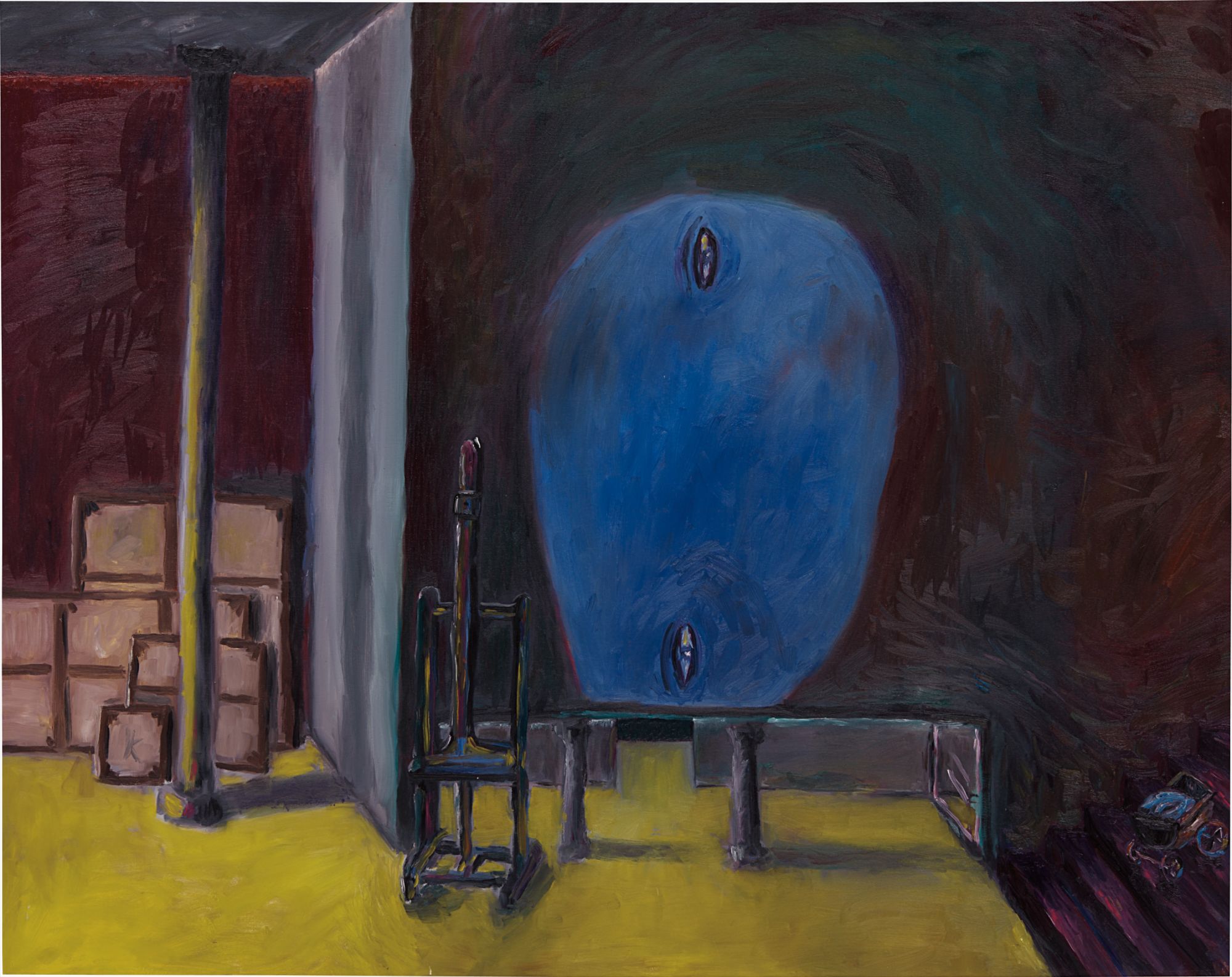
The present lot, Un taller para el jóven Kuitca (A Studio for Young Kuitca), belongs to a small group of early paintings that Kuitca made between his two most renowned series: Nadie olvida nada and El mar dulce. During this time he enrolled at the University of Buenos Aires and studied art history, eventually abandoning his studies to exhibit extensively. It was during this time that he became heavily involved with the theater, inspired by the work of the German choreographer Pina Bausch, who he visited in Wuppertal. Upon his return, he produced his first theater piece in 1982. Consequently, his paintings from this period reflect this theatrical influence, where the compositional drama takes place in interior spaces that look like stages, much like the scene in the present work. This painting is filled with a number of symbols that will haunt Kuitca’s later works, including the baby carriage rolling down a series of steep steps, which references the iconic Odessa steps scene in the 1925 silent film Battleship Potemkin. However, this painting also takes on a very personal subject, that of the artist in his studio surrounded by his tools and his work. Interestingly, most of Kuitca’s paintings are devoid of human forms, which he purposefully omits to allow the viewer to reflect on the psychological space. This is a recurring technique used by Kuitca that is also used by directors to make the drama of a film more intense. And even though there is no human figure, it does not lack the human presence, which one can readily perceive through the haunting pair of eyes in the middle of the stage staring at us. The fact that all of the stretched paintings depicted in the work face away from the viewer combined with this looming human presence creates a sense of isolation and loneliness. The complex spaces and imagery Kuitca unveils in this painting reveal a very personal narrative, making this work unique and more poignant than his later works that deal with more universal themes.