71
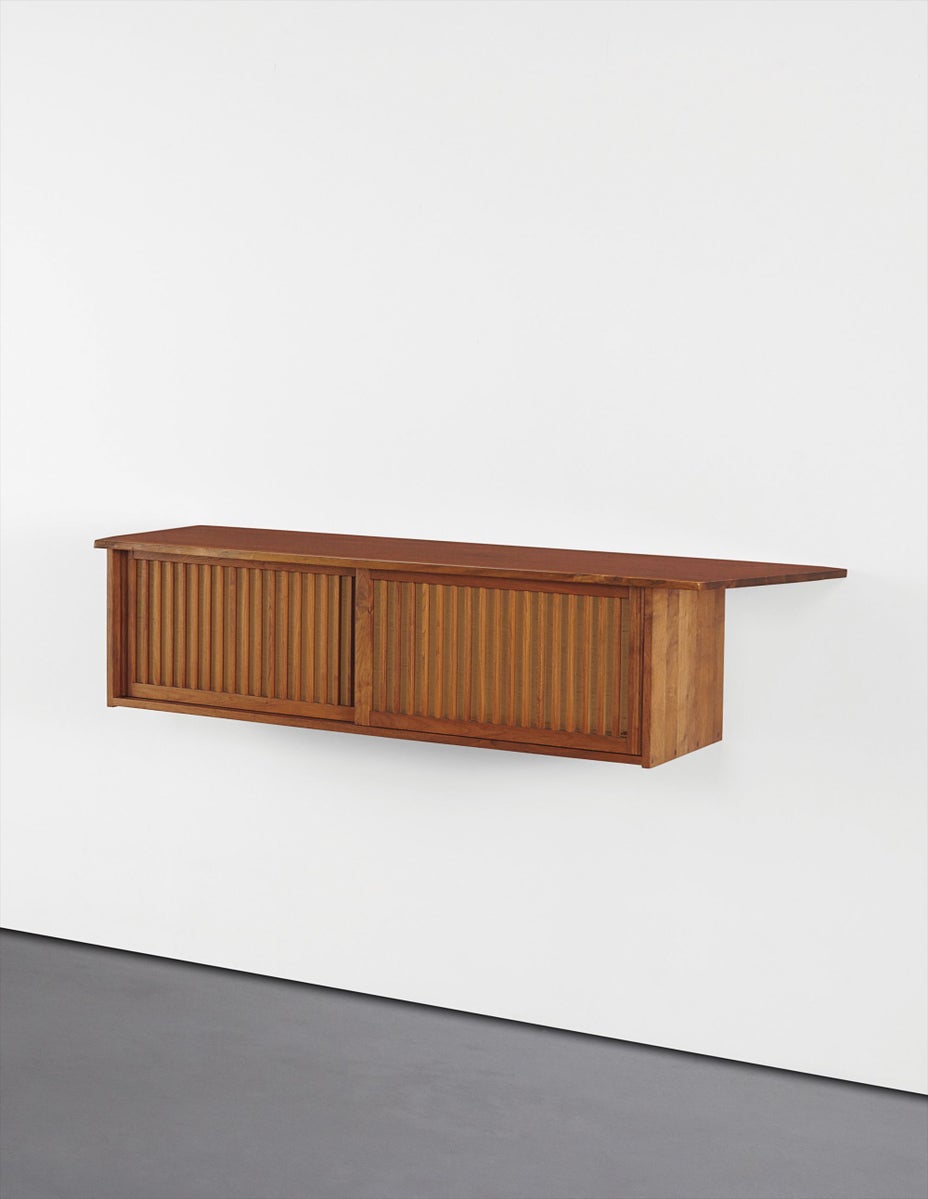
George Nakashima
Wall-mounted cabinet
Full-Cataloguing
The Ginsbergs were immediately attracted to the work of Jean Royère, whom they admired both for the elegance and the playfulness of his pieces. The dynamism of the “Ondulation” chandelier in the current selection is a perfect example of the characteristics that first enticed them and which led them to acquire more works by the designer. The amazing Serge Mouille “Vrillée” coffee table, circa 1962, was another example of Janet and Alan’s adventurous spirit. I clearly remember the day the table arrived at the gallery. I called Janet with the news, and within the hour she was admiring the table in person. Soon after we were loading it in the trunk of her car. I will never forget that magical moment.
Over the years, I was very happy to witness the Ginsbergs’s newfound love for the work of American masters like George Nakashima and Phillip and Kelvin LaVerne. The cabinet “La Femme,” by the latter two, which the Ginsbergs loaned me for my 2008 retrospective, is one of the best and most admired examples of the LaVernes's work.
It has been a privilege to help Janet and Alan develop their collection through the years, and I feel honored to call them my friends today.
—CRISTINA GRAJALES
George Nakashima
American | B. 1905 D. 1990Working out of his compound in rural New Hope, Pennsylvania, George Nakashima produced some of the most original and influential furniture designs of the post-war era. Nakashima aimed to give trees a second life, choosing solid wood over veneers and designing his furniture to highlight the inherent beauty of the wood, such as the form and grain. To this end, his tables often feature freeform edges, natural fissures and knot holes. Nakashima was an MIT-trained architect and traveled widely in his youth, gaining exposure to modernist design the world over.
The signature style he developed was the distillation of extraordinary, diverse experiences, which led to the establishment of his furniture-making business in 1946. In particular, his practice of Integral Yoga, which he studied while working under the architect Antonin Raymond on the construction of the Sri Aurobindo Ashram in Pondicherry, India, had a lasting impact on his philosophy as a designer.
After returning to the U.S. in 1940, Nakashima's family was interned in an American concentration camp, a horrible ordeal that nevertheless introduced him to traditional Japanese joinery by way of a Nisei woodworker he met in the camp. He incorporated these techniques and also drew on American vernacular forms, such as the Windsor chair. These diverse influences have resulted in immense crossover appeal in the world of twentieth-century design collecting.