53
Jesús Rafael Soto
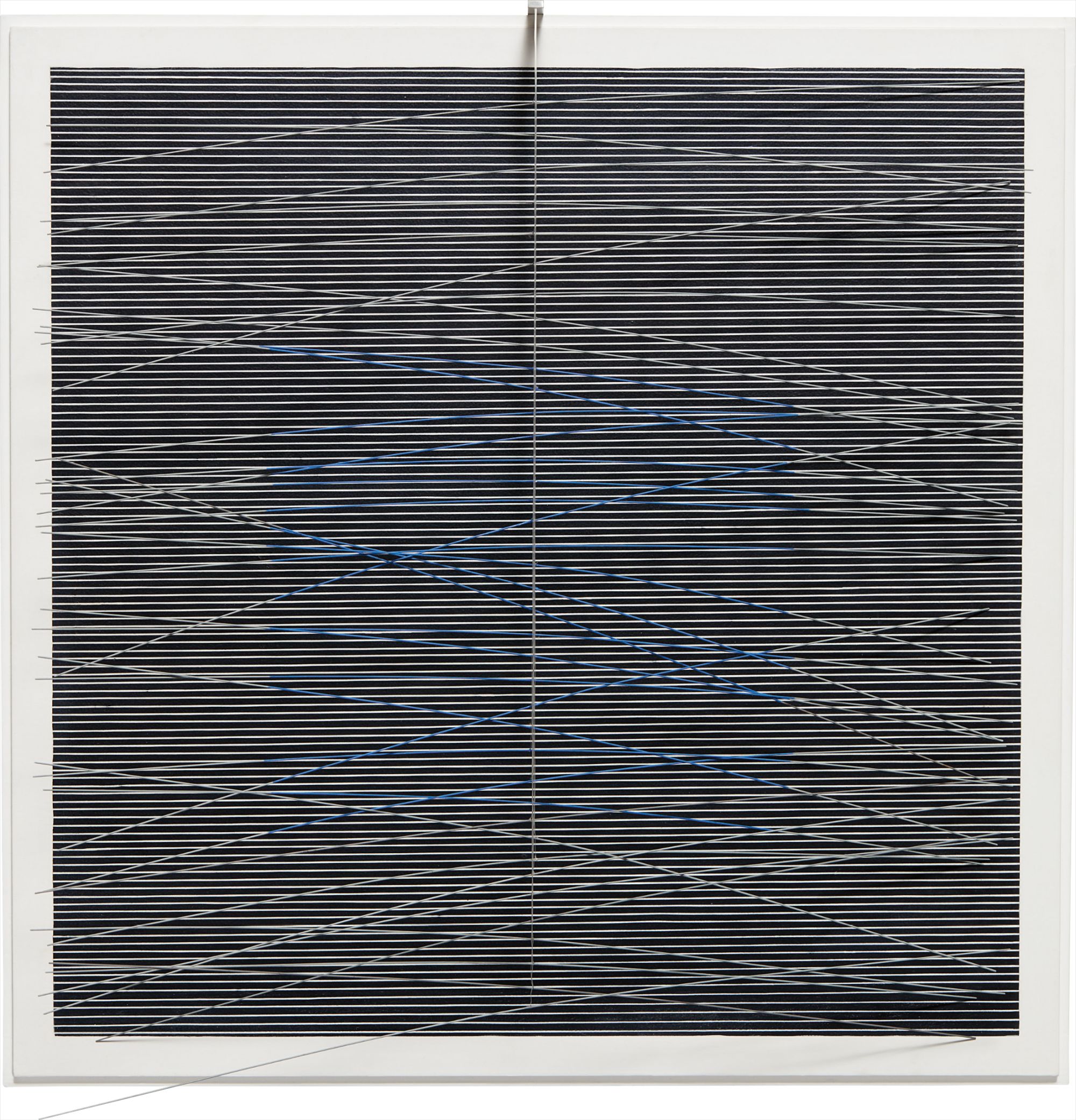
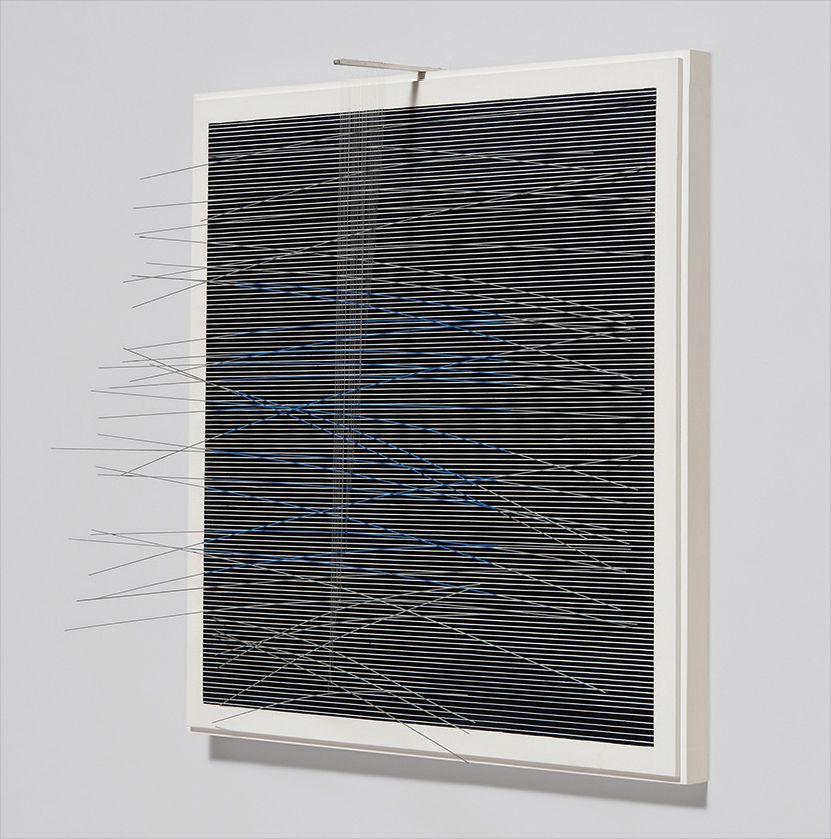
Cuadrado virtual azul, con gris
Full-Cataloguing
“Soto’s optical paintings keep the question of what is real and what is imaginary in perpetual suspension,” critic Guy Brett observed. “When he hangs a metal rod in front of a lined screen (his ‘sign’ reduced to its simplest terms) the optical interference of these two elements releases a third—the vibration—which is real to the eyes though it has no material existence. The rod is not exactly dissolved into vibrations, for then it would be absorbed into another medium and disappear altogether. The vibrations take the shape of the solid rod, tracing its movement in pulses, as if they were its shadow. But the situation is so finely balanced it could equally be that the solid rod is the ‘shadow’ of the energy pulses, which ‘really’ constitute the rod and everything else we see as solid stable objects in the world.”
From a single bar at the top of Cuadrado virtual azul, con gris, a stream of thin metal rods hangs from transparent nylon threads before a dark gray square, flickering in shifting patterns of light and shadow against the lined ground. As in Tríptico a cuadrados virtuales (1974), a “virtual” square emerges amid the shimmering optical surface, produced here by the vibrations of rods painted blue at their center. The slightest movement of the steel rods induces a wavy moiré effect, dematerializing the blue square in the dynamic temporal space activated between the static support and the viewer. “Soto’s achievement has been to give a luminous imaginative force to the idea of continuum,” Brett remarked. “Forms are not localizable, it’s not possible to say: there are the forms and this is the space that contains them. Forms and space are continually creating each other, changing into each other.” This flux of fugitive lines and color is perceptual and interactive, the optical vibrations conditioned by the surrounding space and the ambulant viewer. “It has always been part of the poetry of Soto’s work to be half in the world and half out of it,” Brett concluded. “The rods oscillate between the abstract world of relations and the world of things. Unpredictable currents from the world of things activate and bring to life the painting’s space.”
Abigail McEwen, PhD
Jesús Rafael Soto
Venezuelan | B. 1923 D. 2005Jesús Rafael Soto was born in Ciudad Bolívar and studied at the School of Visual and Applied Arts in Caracas. During this period he became acquainted with Los Disidentes, a group of artists that included Alejandro Otero and Carlos Cruz-Diez. In addition to his fellow compatriots, Soto’'s work was influenced by Kazimir Malevich and Piet Mondrian.
The main artistic tenets evinced in Soto's works are pure abstraction, vibrations, progressions and geometric rigor. They can be seen through the use of lines and superimposed squares in his sculptures, made with paint and a series of industrial and synthetic materials. He spent much time in Europe, becoming a key member of the Group Zero movement, which included such artists as Lucio Fontana, Gunther Uecker and Yves Klein. As a result, Soto's work also incorporates modernist concepts such as light, time, movement, color manipulation and space. All of these facets place him as an important figure within the Kinetic and Op Art movements.