277
Dawoud Bey
Amishi
Estimate
$10,000–15,000
Sold For
$20,000
1993
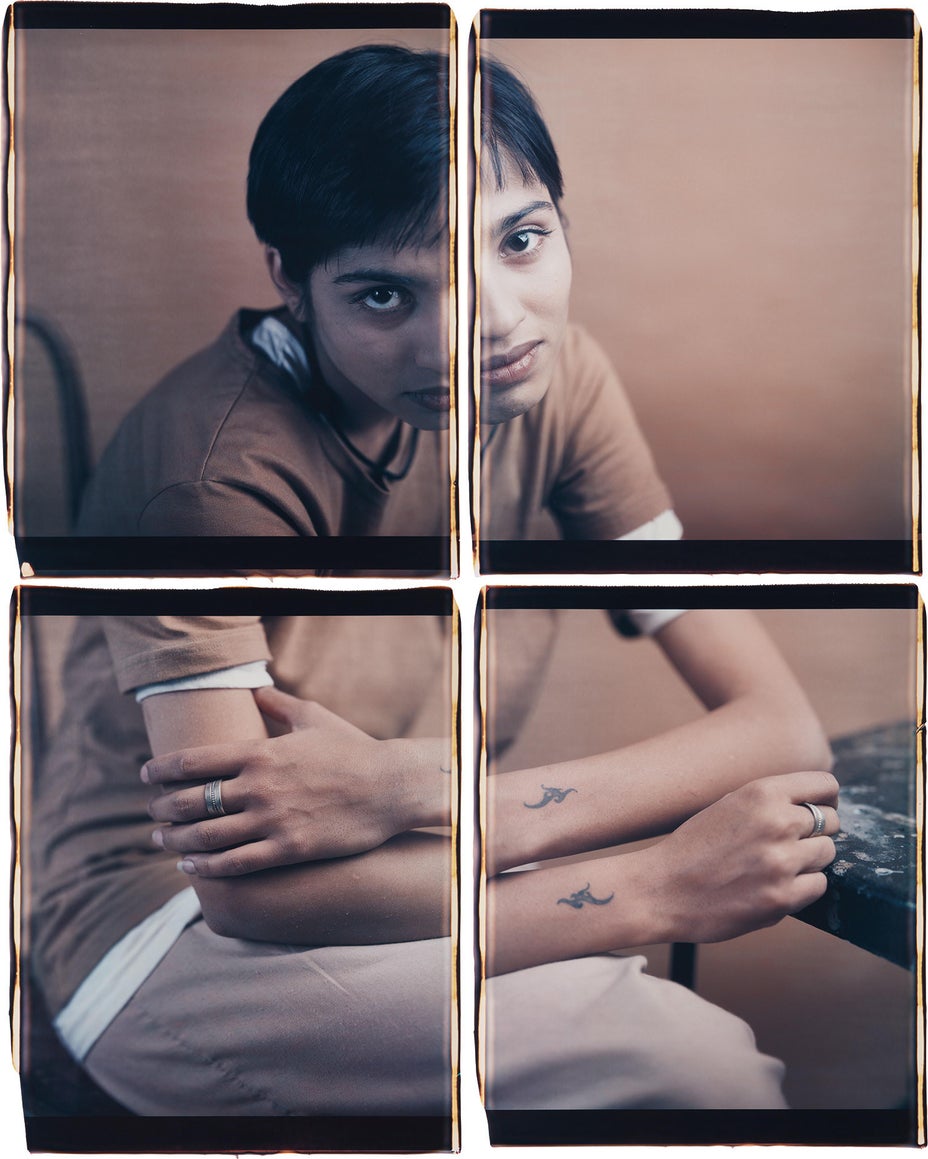
Four Polaroid prints.
Each 24 x 20 1/2 in. (61 x 52.1 cm)
Overall 63 1/4 x 47 in. (160.7 x 119.4 cm)
Overall 63 1/4 x 47 in. (160.7 x 119.4 cm)
Signed on a label accompanying the work. Typed title, date and number 3/3 on gallery labels affixed to the reverse of each frame.
Full-Cataloguing
Intertwining the conventions of 19th century portraiture with the scale and immediacy of the contemporary Polaroid, Dawoud Bey’s portraits carry an unwavering presence. The work on offer, Amishi, comprised of four 24 x 20 inch Polaroid prints, imbues a life-like scale to the commanding portrait. Bey “recognize[s] that there is a power in the gaze,… My photographs allow the subject to direct their unflinching gaze at the viewer, if only in facsimile.”
By capturing his subject in the studio in front of a large format camera, Bey strips the environmental data away, leaving his sitter to dominate the frame without any distractions. As A.D. Coleman noted in his essay in the book Dawoud Bey: Portraits 1975-1995 “…as in most early photographic portraiture—there is nothing casual about these pictures and nothing surreptitious; those who have chosen to accept Bey’s scrutiny, and ours, compose themselves willingly for these portraits, presenting themselves self-consciously to the light and the lens, returning the gaze.”
As the Polaroid is an inherently unique process, Bey’s edition is comprised of three variants of the subject, one of which is in the Collection of the Los Angeles County Museum of Art.
By capturing his subject in the studio in front of a large format camera, Bey strips the environmental data away, leaving his sitter to dominate the frame without any distractions. As A.D. Coleman noted in his essay in the book Dawoud Bey: Portraits 1975-1995 “…as in most early photographic portraiture—there is nothing casual about these pictures and nothing surreptitious; those who have chosen to accept Bey’s scrutiny, and ours, compose themselves willingly for these portraits, presenting themselves self-consciously to the light and the lens, returning the gaze.”
As the Polaroid is an inherently unique process, Bey’s edition is comprised of three variants of the subject, one of which is in the Collection of the Los Angeles County Museum of Art.