220
Cartier
Portico No. 4
A historically important and unique yellow gold, platinum, enamel, onyx, rock crystal, jade, mother-of-pearl and diamond-set Portico Mystery Clock with rock crystal dial and onyx and jade inlay
Full-Cataloguing
- Portico Mystery Clock No. 4
- Among the largest of all Portico clocks
- Features 18k yellow gold, platinum, enamel, rock crystal, mother of pearl, seed pearls, onyx, jade and diamonds
- The only one known with Hexagonal dial
In watch collecting, certain timepieces stand apart as the ultimate “grails” of their respective categories—the undisputed champions of their kind. Among the examples that immediately come to mind are Paul Newman’s Rolex reference 6239 “Paul Newman,” the stainless-steel Patek Philippe reference 1518, and F.P. Journe’s very first Tourbillon Souverain wristwatch. Yet, for many watch scholars and seasoned collectors, there exists a series of timepieces that is arguably even more magnificent, transcendent, and mesmerising—one that occupies a place at the very pinnacle of horological collecting: the Portico Mystery clock.
Among the most splendid, enigmatic, and captivating horological marvels of the 20th century, Cartier’s mystery clocks undoubtedly rank among the most extraordinary objects ever created. Few maisons have ever succeeded in producing timepieces of such magic, ingenuity, and sheer visual splendour as Cartier. The mystery clock provided Cartier with the ultimate canvas upon which to express its unfettered creativity—a union of two seemingly distinct disciplines: the creation of an intricately crafted work of art and the precision of horology. In these remarkable clocks, the boundaries between art and timekeeping dissolve, giving rise to objects that are as mesmerising in their mystery as they are extraordinary in their execution.
Cartier has always attracted the most exclusive clientele, and owners of its mystery clocks were no exception. From royalty, to aristocratic families and industry titans, Cartier's client book was nothing less than illustrious. Owners of mystery clocks include King Zog of Albania, King Farouk of Egypt, King and Queen of Spain...the list goes on. The very first Mystery Clock was notably sold to banker John Pierpont Morgan.
The Maison has created some of the most dazzling Mystery Clocks, with Maurice Coüet creating the movements and construction of the Model A in 1912. These clocks were unlike anything the market had seen at the time of their launch. So cloaked in mystery were these clocks that in the beginning, even the salespeople at the Cartier boutiques could not properly explain exactly how they worked. While it seems like the hands are floating and suspended, the system works on the basis of optical illusion. The hands are in fact attached by two translucent disks that are driven by a clock movement hidden within the base. The movement construction was based on the creation of French clockmaker and illusionist Jean Eugène Robert-Houdin in the 1830s. As a pioneer of modern illusionism, he paved the way for other watchmakers and illusionists, such as Maurice Coüet. Coüet came from a long line of watchmakers, whose father and grandfather worked for Breguet. He later moved to Paris to set up his own business, and exclusively created table clocks for Cartier.
Yet, within this hallowed category, there are 6 clocks that are unequivocally the largest, most prestigious, technically complex and impressive of all mystery timepieces: The Portico Clock. Made with Coüet and created between 1923 and 1925, the Portico clocks were suspended from the frame in a manner reminiscent of a Chinese gong. The frame was designed to resemble the columns of a temple gate. The overall effect was that of a freestanding Oriental Archway, giving way to the name “Portico”. The main difference between a classic Mystery Clock and the Portico is that the movements are housed above the dial, rather than the base of the timepiece.
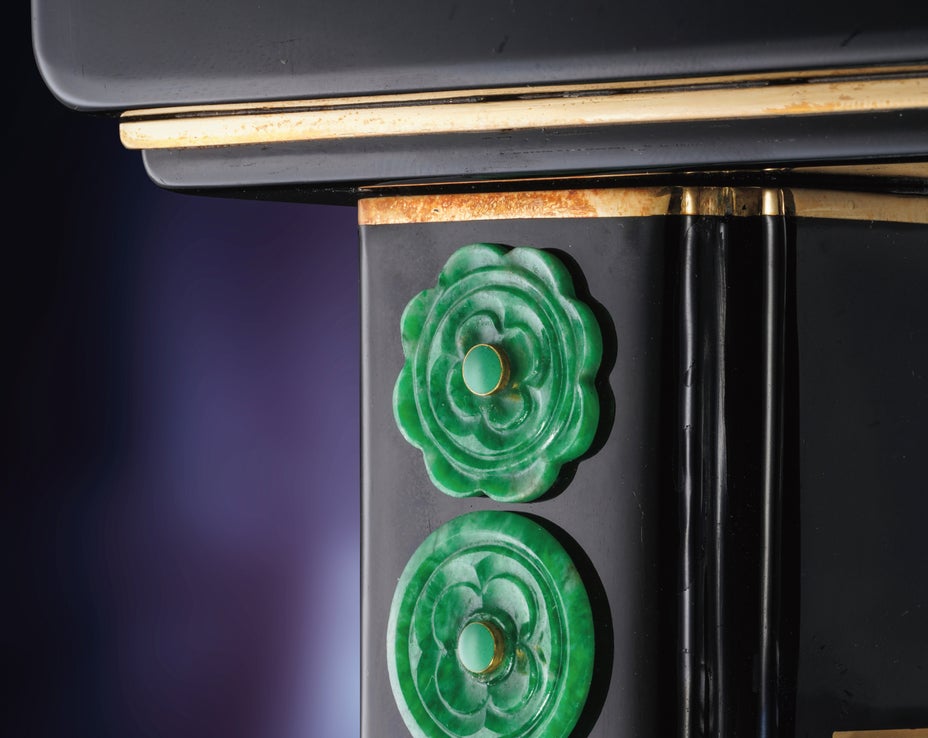
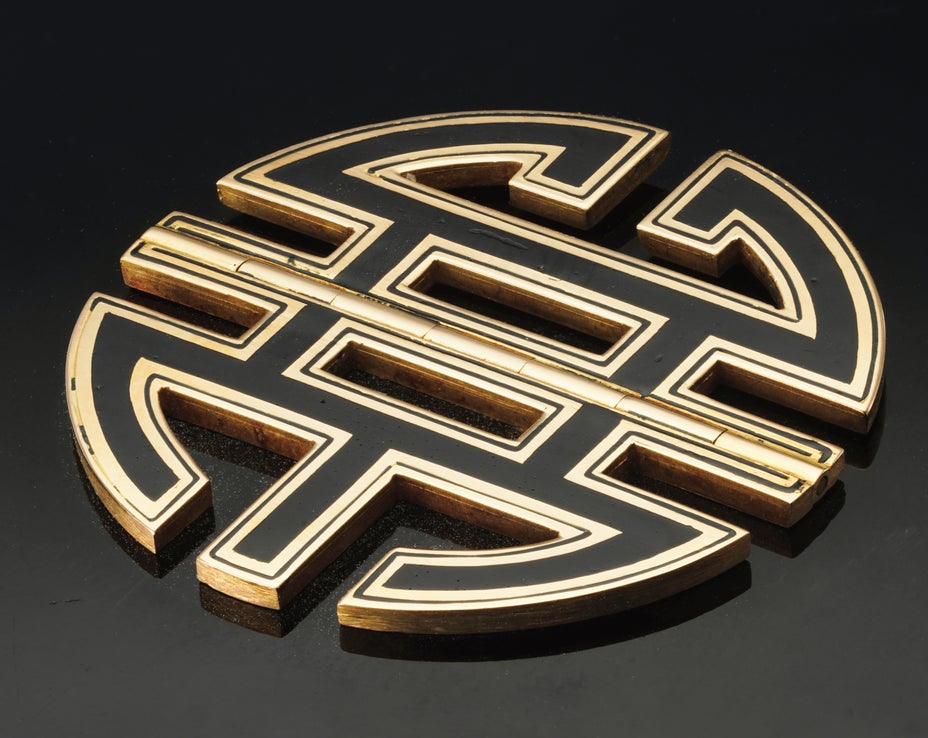
The Portico clocks were very much inspired by the Far East. It was during the production period of the Portico clock series (1923-1925) that Cartier especially took inspiration from Asia in its creations, spearheaded by its inimitable designer, Charles Jacqueau. Already in 1901, Louis Cartier had tasked one of his best salesmen, Jules Glaenzer, to asses its potential as a commercial center. Coming back, Glaenzer not only discovered another culture a world apart, but had also filled his pockets with curiosities, gems and treasures from the Far East. What started as a commercial trip turned into one of the biggest cultural inspirations for the illustrious jeweler. The Portico clocks frequently incorporated Chinese elements, such as carved jade, which are mounted on pillars made of black enamel, rock crystal, or onyx. These objects were famously exhibited at the 1925 Paris Exposition des Arts Decoratifs et Industriels and described in the Gazette du Bon Ton as “marvels of the clockmaker’s art, unreal and seemingly woven from moonbeams, [that] veil the mystery of time in the shadow of an ancient divinity of jade, between two pillars of rose quartz, enameled with black dragons.”
Portico Mystery Clock No. 4
Having resided in a private collection since its public sale on 19th November 1996, the present Portico mystery clock numbered 4 was made in 1924.
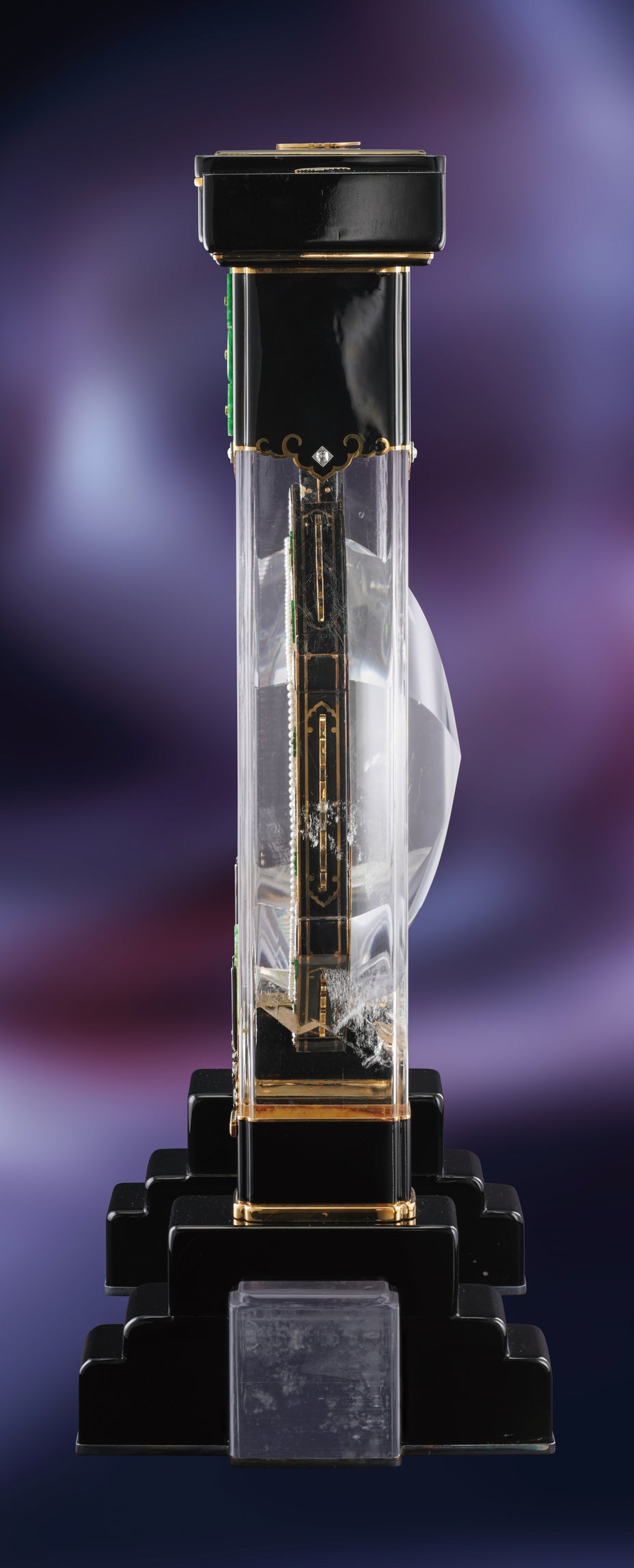
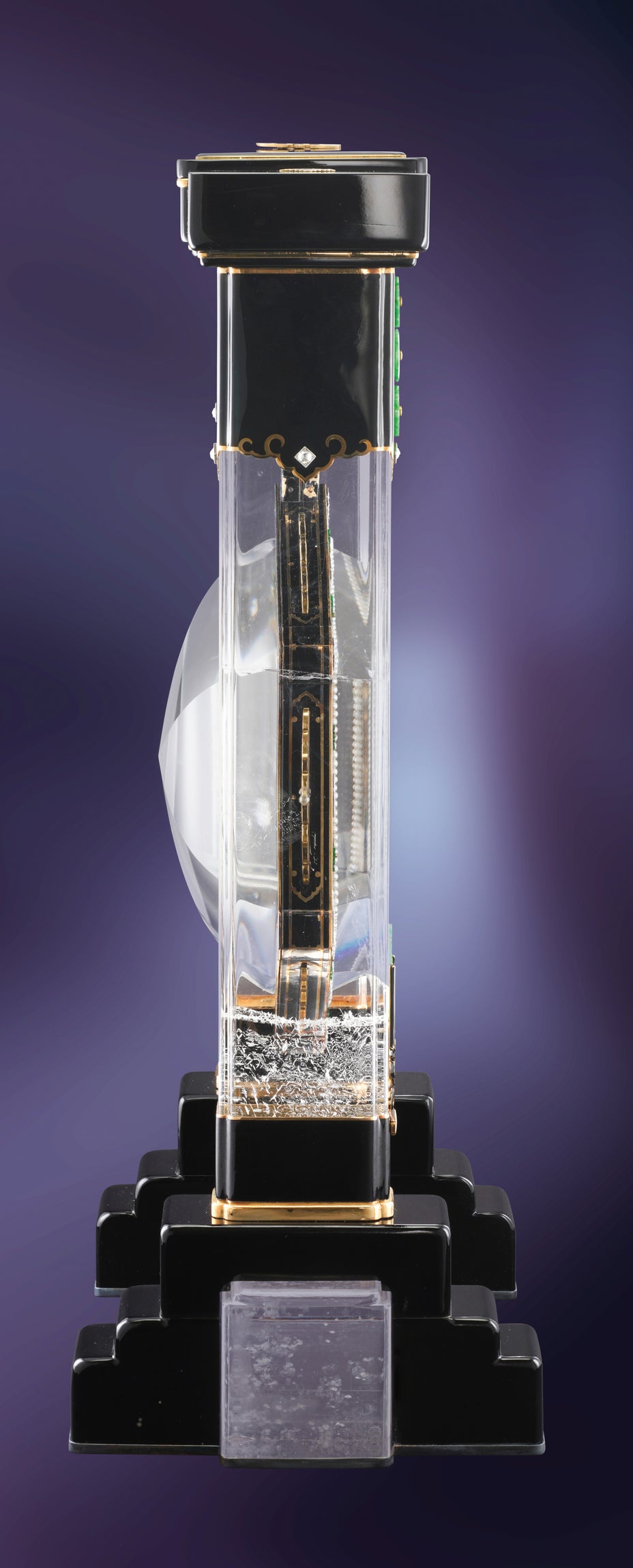
Of the six Portico clocks ever created, it is the Fourth creation by Cartier. Along with No. 3 which was sold The Geneva Watch Auction: XXI, lot 118, it is one of the largest, the most opulent, extravagant and sumptuous version of the Portico Clock. Unlike No. 1,2,5 and 6 which have round columns, No. 3 and 4 have square-shaped columns.
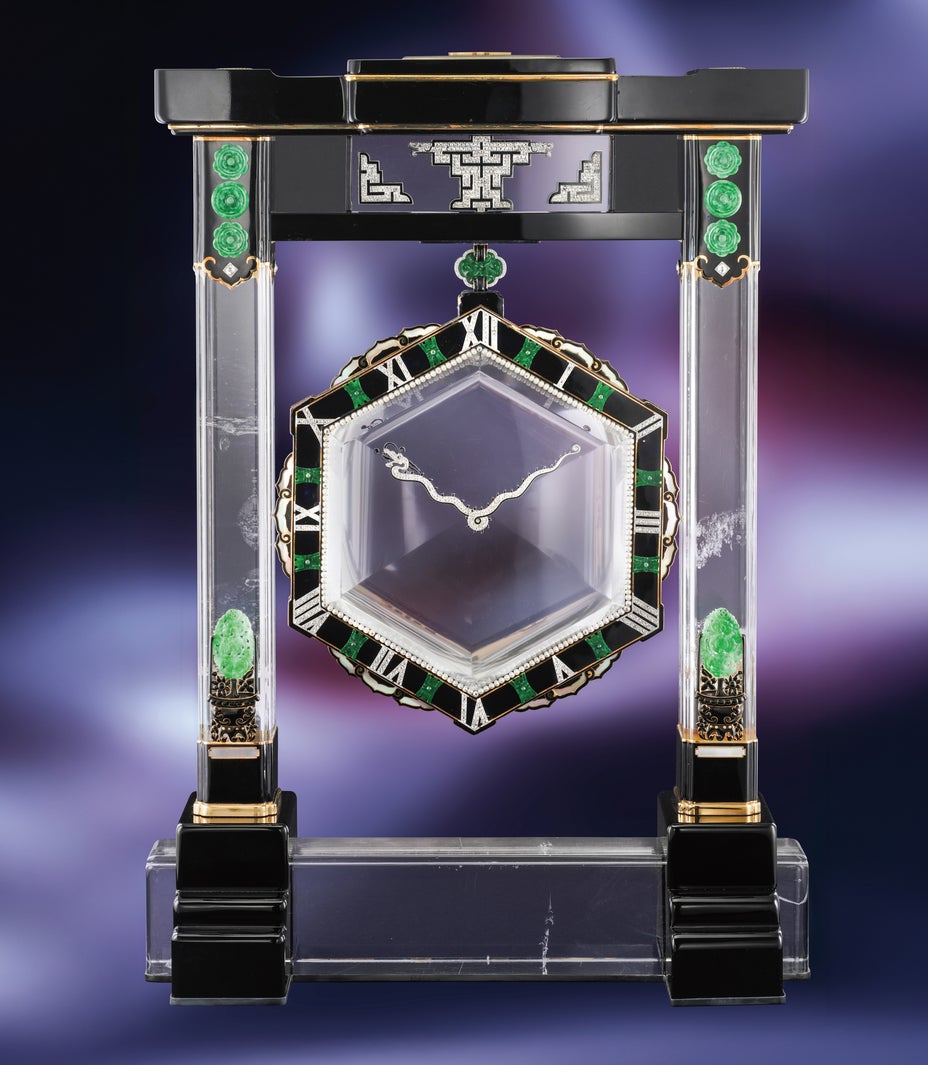
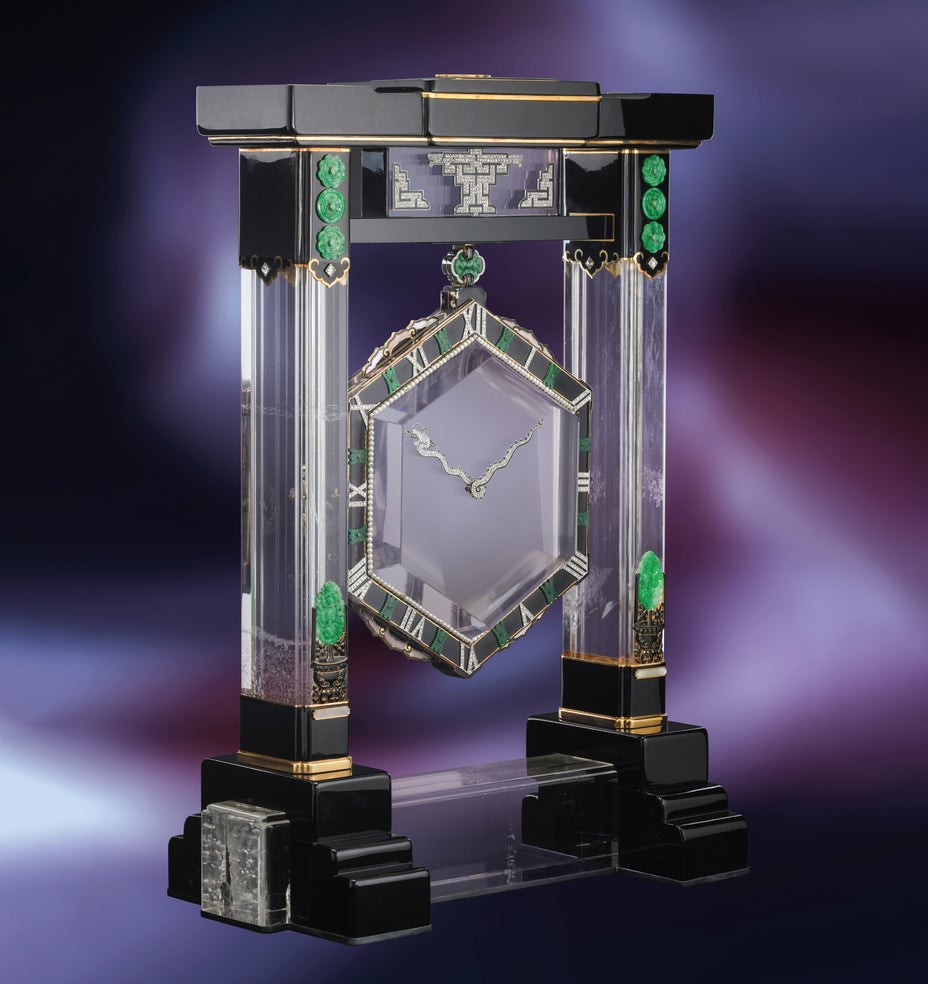
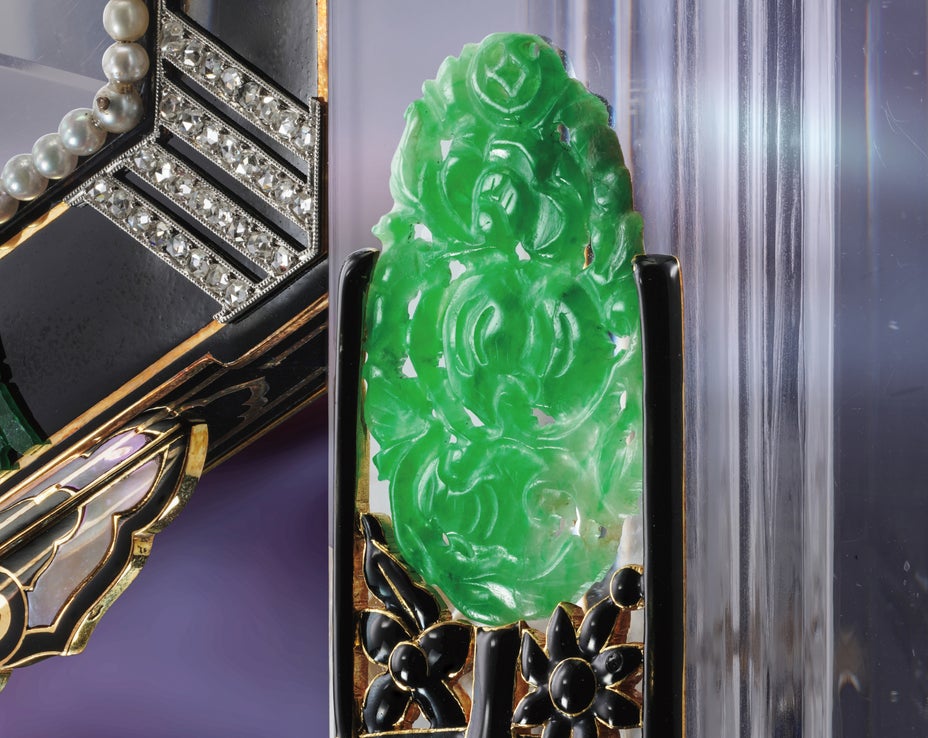
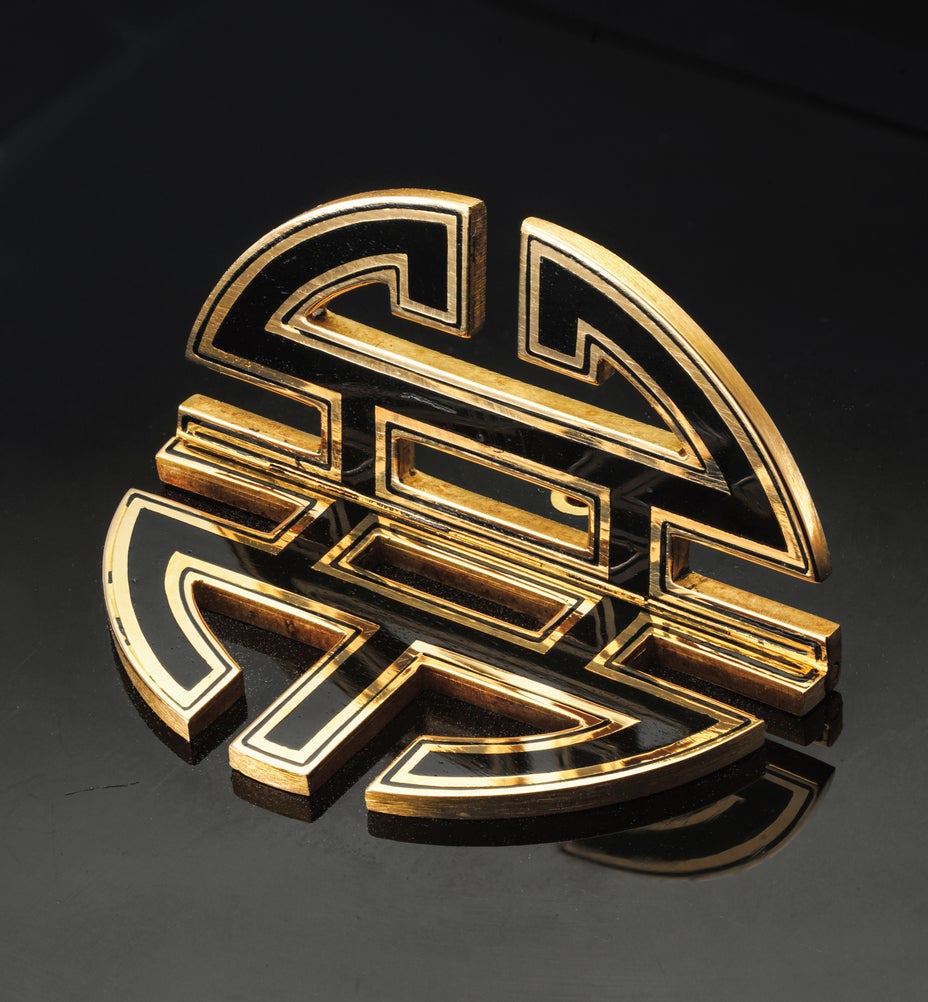
The frame of the Chinese temple is constructed of two rock crystal columns, with the base of the columns decorated with oriental-inspired black enamel motifs. Above the base are two jade trees. In Chinese culture, the symbolism of pairs is deeply rooted in the idea of harmony, balance, and auspicious completeness. The concept is particularly important in decorative arts, where objects are often created or presented in pairs to convey wishes for prosperity, marital harmony, longevity, and good fortune.
The arch of the temple displays a rock crystal and enamel screen with jade decoration. This screen is fixed and suspends the most striking part of the timepiece: the six-sided carved rock crystal “mystery” dial, which displays a pavé set rose cut diamond hands in the form of a dragon. The use of the dragon is especially fitting here. In Chinese cultural imagery, the dragon is a symbol of the emperor, the almighty leader who mediated between Heaven and Earth and is often depicted rising from clouds and waves, symbolizing fortune and prosperity.
The dial is furthermore set with a bezel with onyx, diamond-set Roman numerals and jade decoration. The inside of the bezel is furthermore embellished a row of seed pearls. It is important to note that the present Portico is the only one with a hexagonal dial; the other five are 12-sided, meaning that per panel, there is more space for intricate decoration than other examples where the panels are shorter in length.
The appearance of this historically significant clock marks a historic moment in history. After its sale, it will most likely remain hidden and cherished again for many years to come. Its public sale at auction offers an almost once-in-a-lifetime opportunity to acquire not only an intricate and beautiful piece of horological history, but also an historically important, museum-quality Art Deco piece.
Portico Clocks
No. 1, 1923
Portico mystery clock made of yellow gold and enamel, rock crystal. Dial is also made of rock crystal, with black enamelled gold bezel set with onyx and diamonds. Topped by a rock crystal Billiken, with applied rose-cut diamond-set Roman numerals.
In the Cartier Collection since 1973, to the best of our knowledge it was Cartier's first ever acquisition and the foundation of what is today the Cartier Collection
No. 2, 1924
Portico mystery clock made of yellow gold and enamel, rock crystal. Dial is also made of rock crystal, with black enamelled gold bezel set with onyx and diamonds. Topped by a rock crystal Buddha, with applied rose-cut diamond-set Roman numerals.
In an American Collection
No. 3, 1924
Portico mystery clock made of rose quartz and decorated with jadeite jade, onyx, enamel, enamel and rock crystal. Dial is also made of rock crystal a yellow gold chain suspending the dial.
Most recently sold at the The Geneva Watch Auction: XXI, May 11 2025, lot 118.
In a Private Collection
No. 4, 1924 The Present Clock
Portico mystery clock made of rock crystal and decorated with jadeite jade, onyx, pearls and mother-of-pearl. It is the only one with a hexagonal dial; the other five are 12-sided. The hands are in a form of a dragon, which has black enamel thorns on its back, and the paved diamonds are also outlined in black enamel. With No. 3, it is among the two largest and most lavish Portico Clocks made in the series. Like No. 3, it has square columns while the others are round.
Provenance: Previously the property of Alain Cartier, according to whom this cock was previously in the Collection of the Maharajah of Nawanagar. Sold in The Magical Art of Cartier, Geneva, November 19, 1996 lot 434.
No. 5, 1925
Portico mystery clock made of yellow gold and enamel, rock crystal. Dial is also made of rock crystal, with black enamelled gold bezel set with onyx and diamonds. Topped by a rock crystal Buddha
In an American Collection
No. 6, 1925
Portico mystery clock made of yellow gold and enamel, rock crystal. Dial is also made of rock crystal, with black enamelled gold bezel set with onyx and diamonds. Topped by a rock crystal "Fo Dog"
Gunter Sachs Collection
Cartier
FrenchWith the Constitution of 1848 came a new standard for luxury in France. Founded one year prior by Louis-Francois Cartier, the house of Cartier was one of the first to use platinum in jewelry making. This incredibly expensive material became the stepping-stone for Cartier to experiment in form, mechanisms and attitude. It helped men move from pocket watches to wristwatches, effectively making the watch much more functional and prominent in a man's overall wardrobe.
Cartier did not only touch on functionality. Inspired by a commissioned painting by George Barbier featuring a black panther at the feet of an elegantly bejeweled woman, Cartier began incorporating wild animals in his designs—most notably, Cartier Panthère rings, bangle bracelets and watches. Yet it wasn't until the late 1960s that the house of Cartier debuted their iconic yellow and rose gold LOVE collection, which includes the famous bracelet that only a special screwdriver can open.