6
Richard Prince
Do I Seem Insecure
Full-Cataloguing
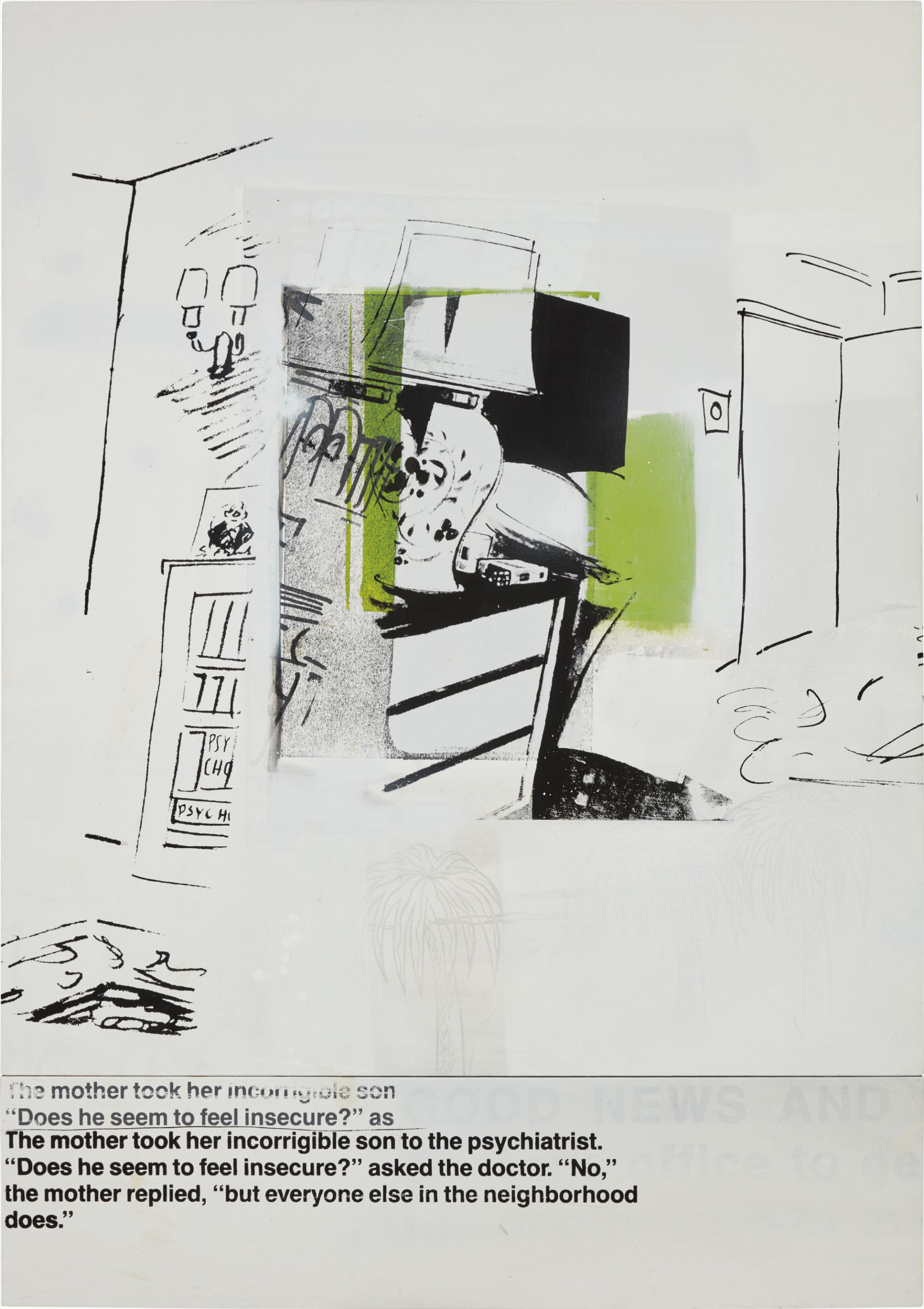
Do I Seem Insecure? is an amalgamation of various elements; from mass media imagery to drawings by the artist himself. Visually cohesive, with a continuity of black lines and text, the blend of discrete fragments imbues the work with an intrinsic sense of chaos and detachment. Prince masterfully weaves non-referential imagery with caustic humour in order to construct a new and obscure relationship between image and text. The canvas is defined by its white pigmented backdrop, in the middle of which floats Prince’s own illustrations of domestic environments, taken from cartoons in the New Yorker, and silkscreened images taken from mass-media publications. A dash of insipid green is the only disruption to an otherwise entirely dichromatic piece. A printed joke lies beneath, the crudeness of its printing evident in the repetition of the first two lines. Lacking easily identifiable focal pictorial elements, one’s eye is drawn to the joke again and again. This emphasis is unsurprising; through this work Prince is daring the viewer to take this one-liner joke as a legitimate piece of high art. Indeed, his radical use of these jokes as the only tangible pictorial theme is what Prince is most proud of, calling the Joke paintings ‘what I wanted to become known for.’
The jest itself is a satirical stab at the American family unit, a common theme amongst the Joke paintings, with Prince drawing on his own experience of growing up as a self-designated ‘loner kid’ and briefly living in the suburbs of Boston. Characterised by deadpan humour, often through rapid-fire one-liners, Prince’s jokes are taken from Borsch-belt humour, the work of Jewish comedians in the summer resorts of the Catskill Mountains throughout the 20th century – where the artist now has a home. By appropriating these comedians preferred themes of employment, family and bad luck, Prince is at once both giving permanence to this sardonic humour and mocking the expectations and absurdity inherent in demotic American culture it implies.
Richard Prince
American | 1947For more than three decades, Prince's universally celebrated practice has pursued the subversive strategy of appropriating commonplace imagery and themes – such as photographs of quintessential Western cowboys and "biker chicks," the front covers of nurse romance novellas, and jokes and cartoons – to deconstruct singular notions of authorship, authenticity and identity.
Starting his career as a member of the Pictures Generation in the 1970s alongside such contemporaries as Cindy Sherman, Robert Longo and Sherrie Levine, Prince is widely acknowledged as having expanded the accepted parameters of art-making with his so-called "re-photography" technique – a revolutionary appropriation strategy of photographing pre-existing images from magazine ads and presenting them as his own. Prince's practice of appropriating familiar subject matter exposes the inner mechanics of desire and power pervading the media and our cultural consciousness at large, particularly as they relate to identity and gender constructs.