21
David Hammons
Untitled
Full-Cataloguing
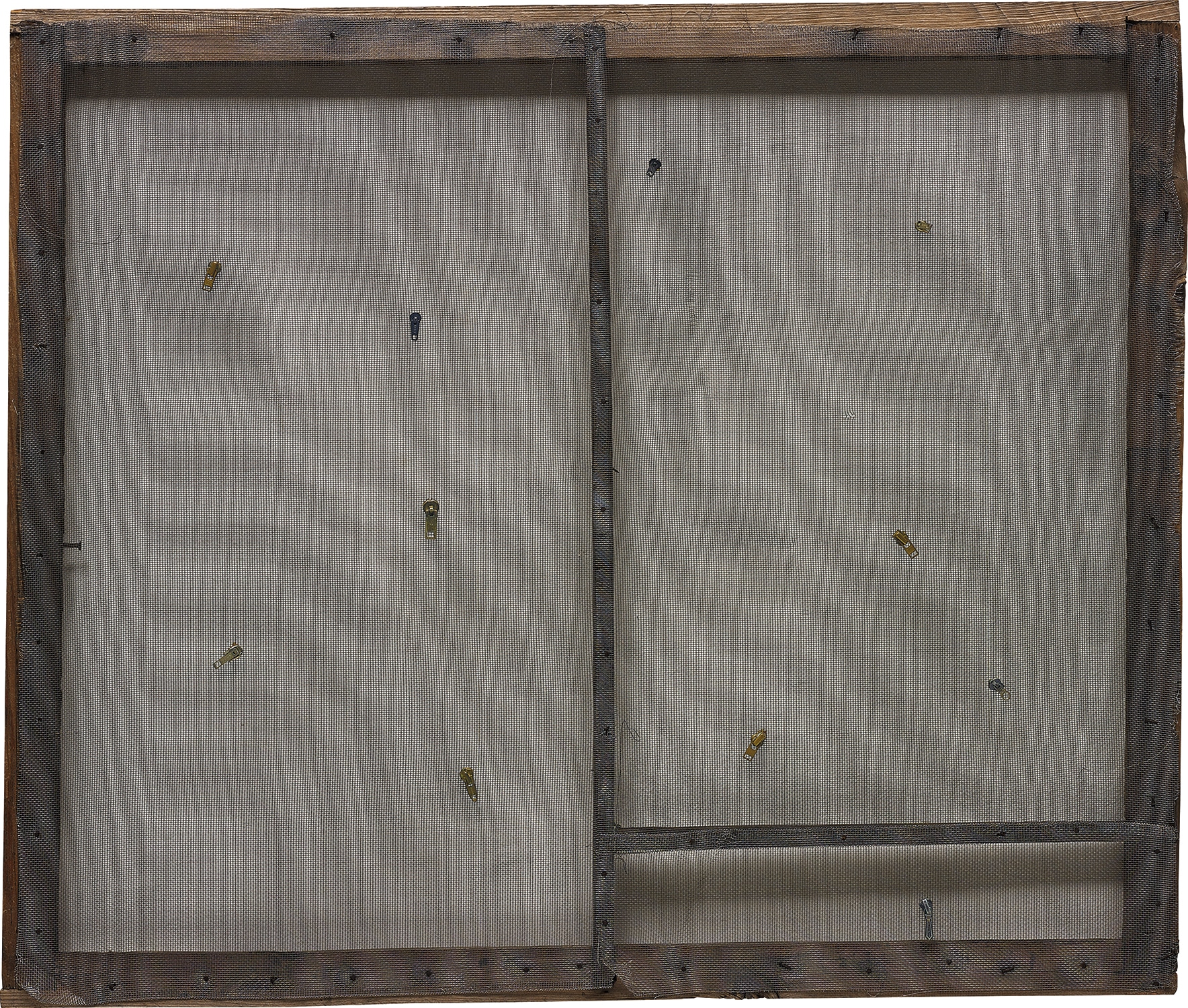
Untitled, exhibited at Wiels, Brussels, in 2018, serves as a biting sartorial comment on the traditional art historical cannon and establishment, an establishment which has traditionally only provided a platform for selected voices; Hammons' work introduces a new dialogue to conceptual art. Poking fun at the modernism of Piet Mondrian, the Dutch painter’s Broadway Boogie Woogie, retrieved from the junkyard, is now punctured with zips and stripped of its colourful geometry. In a Duchampian gesture, Hammons ‘messes’ with the indexical signs latent within everyday objects. Integrating feathers, metal, cigarettes, clothes and discarded food, Hammons’ sculptural works also serve as allegories of the underlying ‘genetic, spiritual, cultural and economic’ connections between people, and inherent within the material processes of consumption (Steve Cannon, Dale Davis, Josine Ianco-Starrels, eds., L.A. OBJECT & David Hammons Body Prints, New York, 2006, p. 126). Hammons rejected the purified forms of American Minimalism and instead, proposes an aesthetic predicated on the abandoned detritus of urban life, encompassing his experiences as an African American man in American society.
The start of Hammons’ career coincided with a period of intense political turmoil in the United States. After the Los Angeles race riots during the 1960’s, Hammons responded to the tension through his practice, particularly evident in his progressive Body Prints series. By greasing his body, pressing up against large sheets of paper – appropriating Yves Klein’s Anthropometry paintings (c. 1960) – and covering the imprint with pigment powder, Hammons sought to re-enact the brutal arrests photographed during the violent outbreaks. Exhibited in the Tate’s 2017 critically acclaimed Soul of a Nation exhibition, David Hammons’ Injustice Case, 1970, directly addressed the violent treatment of Bobby Seale, invoking the courtroom sketch during the 1969 Chicago Eight trial of Seale. Showing his own body, bound, gagged and tied to a chair, Hammons contrasts the unjust scene with the American flag. This body of works set the tone for Hammons’ persistent artistic sedition and innovation, as, throughout the 1980’s, he became renowned for his characteristically wry public installations. These, the artist describes, were created specifically for a ‘street audience’: ‘I will play with the street audience. That audience is much more human, and their opinion is from the heart.’ (‘From An Interview with David Hammons’, Brown University, 1986, online).
Hammons’ oeuvre is a masterful narrative on the experience of the African American community in American society, introducing his own physicality into his work as well as the debris surrounding him. Through a deft reworking of found-objects, Hammons’ sculptures assume a quasi-mystical status; soldered, glued and nailed, these extracted materials are composed into beautifully rendered structures of detritus, utilising quotidian objects which are often loaded with associative connotations. The present work thus forms a crucial part of Hammons’ highly original artistic approach and, at the same time, symbolises a pivotal relationship between innovative artist and curator, both unified in their shared motivations. As Hoet asserted, ‘A curator is an intermediary, we must communicate with the public, protect the artist, and engage with the artist’ (Tanya Kiang and Jan Hoet, ‘The Circa Interview: Jan Hoet: Ends and Means’, Circa, no. 67, Spring 1994, p. 35).
David Hammons
American | 1943Few artists are afforded the liberty to dictate exhibition schedules and public appearances, but David Hammons eschews the spotlight and rebels against the conventions of the art world. Whether intentionally or not, Hammons creates works so laden with spell-binding metaphor that they have become symbols for movements both in the art world as well as in the public domain. (His now-iconic In the Hood sculpture has been used by Black Lives Matter activist group.)
Hammons doesn't work in mediums or any formal or academic theory—he famously has said, "I can't stand art actually." Still, with controversial works including his PETA-paint-splashed Fur Coat sculpture, Hammons remains one of contemporary art's most watched artists. Hammons also doesn't frequently exhibit, and his last major gallery show, 2016's "Five Decades," only featured 34 works. With a controlled market, Hammons saw Untitled, a basketball hoop with dangling candelabra, achieve $8 million at Phillips in 2013.