10
Carmen Herrera
Basque
Full-Cataloguing
One of the most compelling aspects of Herrera’s trajectory is that it lies at the intersection of the many ways geometric abstraction developed as a conceptual and formal movement in Europe, Latin America, and the United States. As a result Herrera’s practice alternates between the rational and formal compositional concerns, and the stillness, movement, and constructedness of the picture plane. It is a variety that makes one painting a great example in line with US abstract painters’ concern with the compositional order of painting, while making other works in her trajectory much more exemplary of the logic of spatial relations apparent in a certain strand of abstraction in Latin America. In this regard it is important to note that many of her works that exemplify a concern for the constructed geometric plane and that play with the logic of paintings as objects predate artists such as Lygia Clark and Hélio Oiticica, who have been far more recognized as forerunners in the development of modernist abstraction in Latin America. Herrera’s practice thus grew quietly, but steadily—mostly from her Manhattan studio—as the result of a true cross-cultural dialogue within the international history of geometric and Concrete abstraction. Looking back on her career, Herrera’s work can be described as unwavering in its concern for the relation between picture and space—a characteristic that is true today as ever—and one that that utilizes a limited palette of just two or three colors for each work.
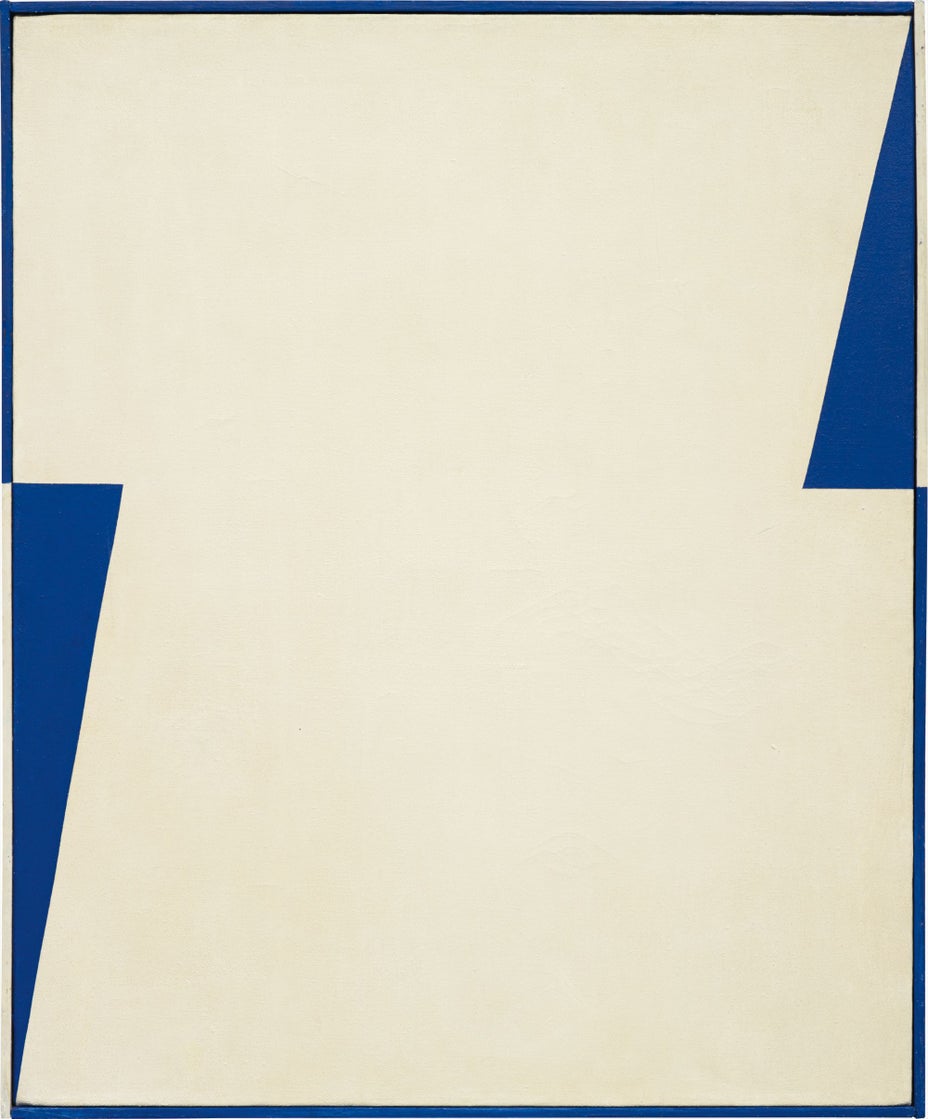
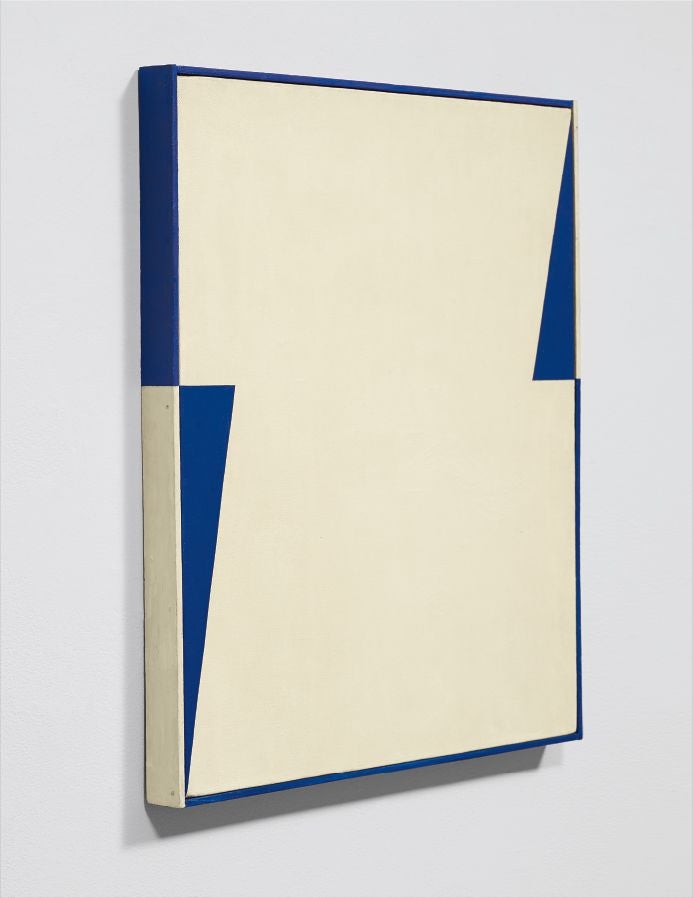
The present lot is a perfect example of such characteristics. Produced in 1965, the work illustrates that by this period Herrera’s formal principals of abstraction were established and resolute. In addition, it marks a moment in her practice where the frame and its relation to the architectural space come into question. The composition consists of a white canvas within a cobalt blue and white frame, which on two points has been interrupted by blue triangles that emerge from a break in the frame and that dominate the bottom left and upper right hand corners of the piece. Unlike other works in Herrera’s oeuvre where the white canvas recedes into the background to allow color to emerge forward, Basque produces a different kind of movement. Here the white is shifted and squeezed in by both the blue frame and triangles. The frame, thus, has an active role beyond containing the picture; it presents the condition by which the blue and the white seep in and out of the picture plane. In fact, it is thanks to these triangles that what appears to be a flat, compressed space is actually revealed to be a space balancing the tension of multiple possibilities: blue and white, frame and canvas, internal or architectural space. This oscillation is perfectly in line to what the artist has referred to as “alternatives,” or her assertion that the picture is in fact a proposition open to visual interpretations.
Carmen Herrera
Cuban / American | B. 1915 D. 2022Carmen Herrera is finally receiving long-deserved recognition for her arresting, hard-edge geometric compositions. Born in Cuba in 1915, Herrera has spent most of her life outside the island, permanently settling in New York in the mid-1950s. Herrera was formally trained as an architect at the Universidad de la Habana, and later completed studies at the Art Students League in New York from 1943 to 1945. During this time she became acquainted with key figures of postwar abstraction including Barnett Newman, whose work undoubtedly influenced Herrera's minimalist aesthetic.
Herrera's work is chiefly concerned with formal simplicity and experimentation with bold color. Through the use of sharp lines and stark color contrasts, she creates dynamic and technically sophisticated compositions that reflect movement, balance and symmetry.