22
Zhang Huan
Family Tree
Estimate
£100,000–150,000‡︎
Sold For
£206,500
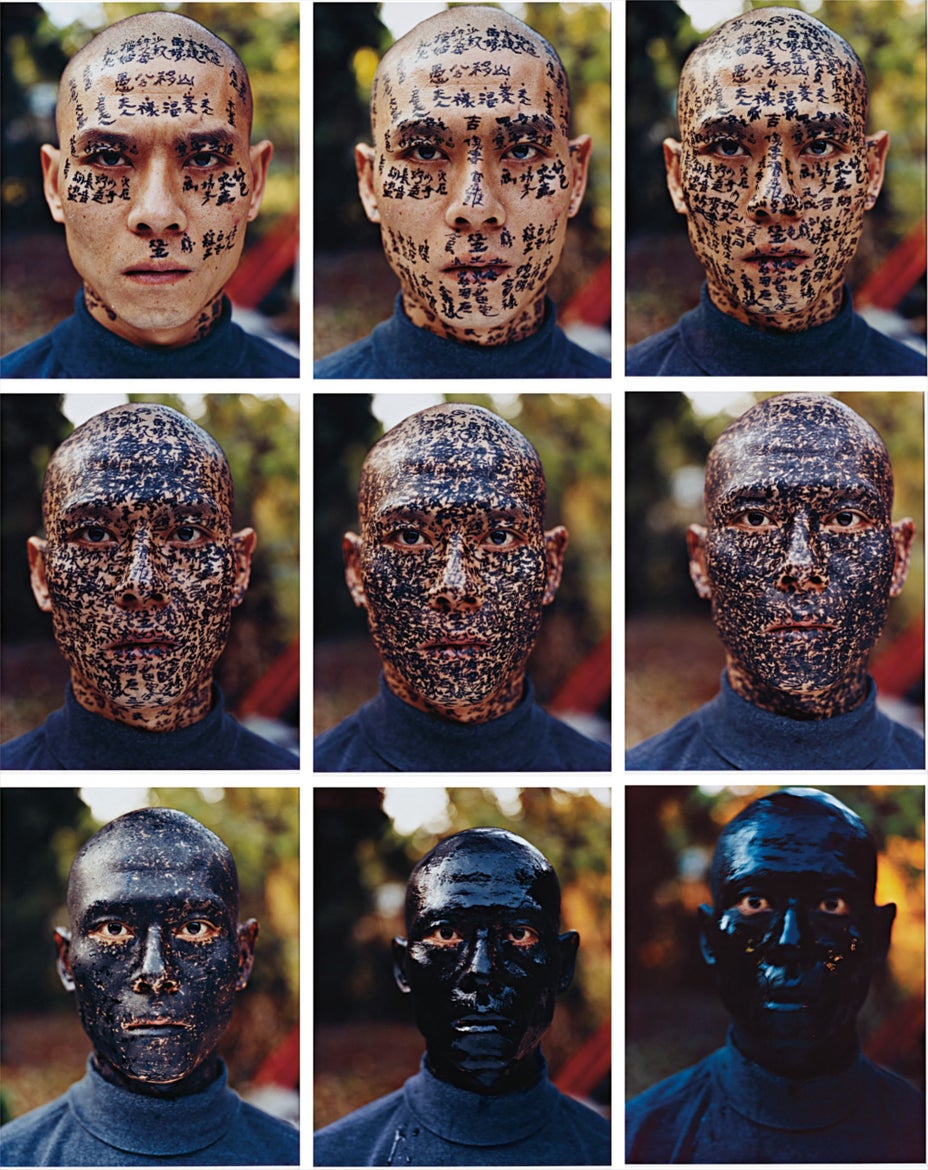
9 chromogenic prints
each 127 x 101 cm (50 x 39 3/4 in.)
Each signed, numbered and dated in Chinese and English ‘2000 Zhang Huan NY ap 1/2.' on a label affixed to the reverse. This work is number 1 of 2 artist's proofs.
Full-Cataloguing
An iconic work of Chinese Contemporary art, Family Tree boldly exemplifies Zhang’s perception of human nature through self-portraiture.
This captivating series documents nine sequential photographs that demonstrate Zhang’s preoccupation with the human condition and interfamily
relationships. Posing questions about personal identity, blood ties and cultural heritage, Zhang commissioned three Chinese calligraphers
to gradually cover his face with poems, family names and popular stories directly related to his family background from dawn until dusk during the
course of a single day. The script inscribed on his forehead refers to the traditional story, ‘Move the Mountain by Fool (Yu Kong Yi Shan)’, well known
across China, which relates to personal endeavour, determination and achievement. Most of the other words derive from concepts of Ancient
Chinese Physiognomy in art, which seek to map personality traits and fate based on one’s facial characteristics. The complexion diagnosis chart
illustrated in the woodcut from 1726, 4th year of the Yongzheng reign period of the Qing dynasty, demonstrates the systematic translation of the
face appearance to personality indicators, where the forehead corresponds to the heart and face and the nose to the spleen and earth.
Zhang Huan is widely recognized for his early radical performances involving nudity, endurance and pain. In reference to his general artistic
inspiration, he stated that “I always have a lot of problems in life, and these problems often become physiological conflict. I often find myself
in conflict among the environment I live in, and feel surrounded by an intolerable self-existence. Therefore, when these problems occur within
my body, I find that my body is the only direct approach that allows me to feel the world, and also let the world know me.” (Xiao Xiaolan, Zhang
Huan: Dawn of Time, Shanghai Literature and Art Publishing House, Lin Zhihan, Qing Dynasty paediatric complexion diagnosis chart showing each
of the sectors of the face. Woodcut, Qing Period. Wellcome Library, London. 2010). The early 1990s, years when the avant-garde artistic community
established itself in Beijing’s East Village, was a crucial period in the development of Chinese performance art. At this time Zhang developed
one of his seminal performances, ‘12 Meters’, which was staged in a public latrine for several hours while insects crawled over his bare skin covered
with fish oil, honey and salt. With the emergence of this experimental avant-garde collective, photography surpassed its initial nature as pure
documentation of performance art to be regarded as a legitimate tool for conceptual art in its own right. Through his association with Beijing’s East
Village, Zhang’s own artistic practice evolved from the single medium of performance art to an expression of body language through a range of
media including photography.
Zhang’s shift away from works of extreme bodily affection to more visually poetic and metaphysical works is associated with his relocation from
Beijing to New York; a move that incited him to revisit his relationship with his cultural heritage. Executed two years after he moved to New
York, Family Tree constitutes a more intimate and personal piece which documents the fleeting passage of time and subsequent loss of identity
through the gradual increase of layers of ink on Zhang’s face and the changing light in the background. By nightfall, the artist’s face was literally
obscured in thick black ink; a second skin of amassed Chinese calligraphy where his visage becomes completely unrecognizable. Reflecting on this,
the artist stated “I cannot tell who I am. My identity has disappeared” (Z. Huan, New York, 2000, www.zhanghuan.com). This notable photographic
work explores the disappearance of personal identity through the complex socio-cultural matrix, reinforcing a core element in Zhang’s oeuvre that
constantly challenges the inextricable boundaries between his identity and the dominant Chinese culture.