88Ο︎
Rolex
Ref. 6239
Cosmograph “The Doctor”
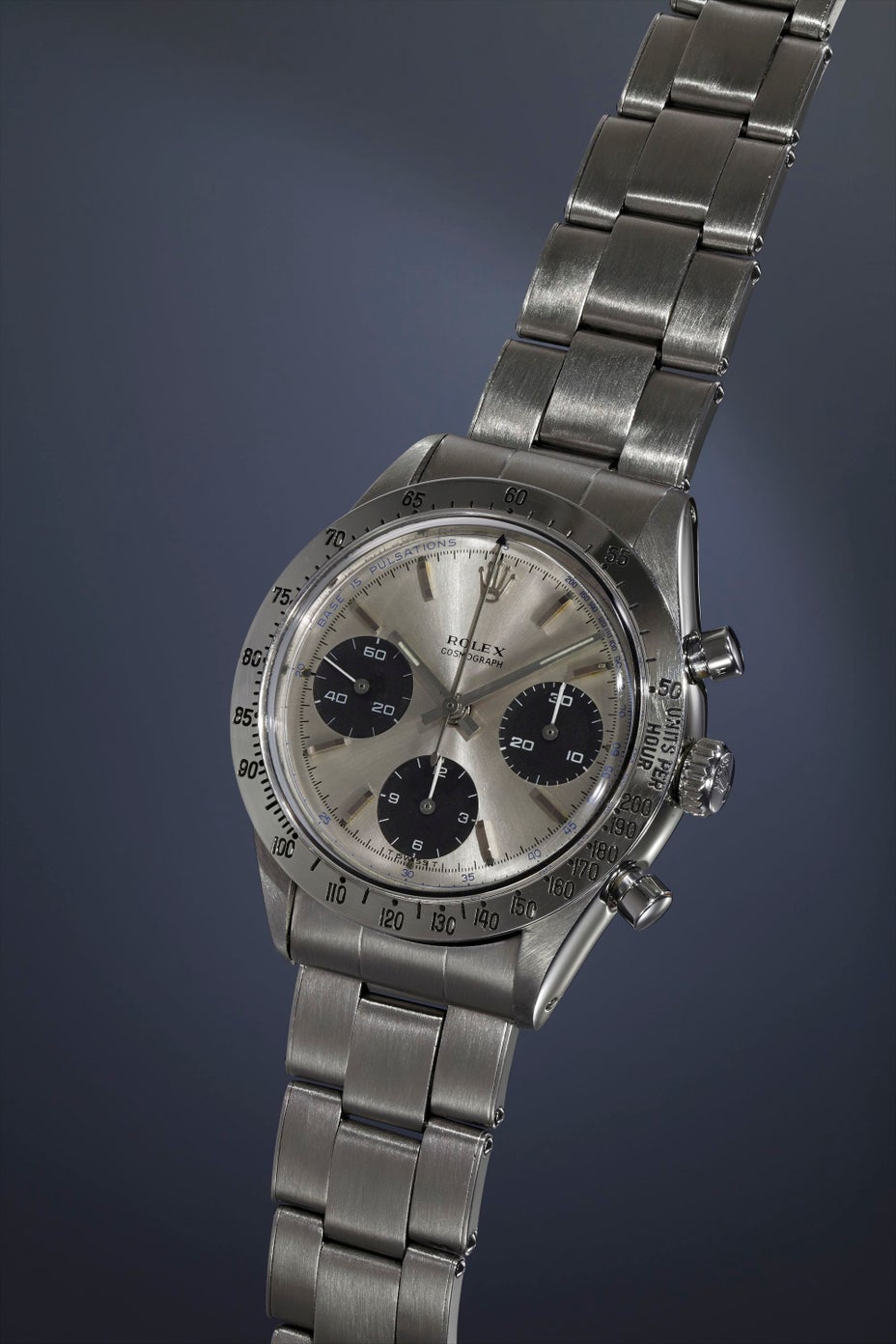
An extremely rare, attractive and important stainless steel chronograph wristwatch with silvered dial, blue pulsation dial, tachometer bezel and bracelet.
Full-Cataloguing
The pulsometer scale is a prestigious and uncommon calibration found on the dials of chronograph watches designed for medical professionals. A doctor would start the chronograph function at the first heartbeat, and stop it based on the number of heartbeats counted as indicated on the scale, in this particular example 15. The stopped chronograph hand would indicate the exact number of heartbeats per minute.
A noteworthy design element is the modified dial layout, as a result of the space occupied by the pulsation scale. One might think the scale was simply added to an existing production dial from a standard reference 6239 of this period. Instead, the applied hour markers have been slightly centered, and the black minute scale and T-SWISS-T designation were repositioned, demonstrating this dial variant was designed to feature the pulsations scale from its inception. This custom configuration perfectly fits within the Cosmograph Daytona’s design language, retaining all of the product line’s attractive, visually pleasing features admired by collectors.
This highly exclusive timepiece targeted a very small, elite audience, and was certainly a custom ordered timepiece for a VIP client. This historically important wristwatch is one of the rarest treasures in the revered Rolex Daytona family of watches. Its desirability is further enhanced by its overall excellent condition.
Since its original owner, the present watch has continued to be cherished in the most esteemed private collections in the world. After one bestows their eyes on this horological gem, their pulse rate will surely rise, and their heart might even skip a beat.
Rolex
Swiss | 1905Founded in 1905 England by Hans Wilsdorf and Alfred Davis as Wilsdorf & Davis, it soon became known as the Rolex Watch Company in 1915, moving its headquarters to Geneva in 1919. Like no other company, the success of the wristwatch can be attributed to many of Rolex's innovations that made them one of the most respected and well-known of all luxury brands. These innovations include their famous "Oyster" case — the world's first water resistant and dustproof watch case, invented in 1926 — and their "Perpetual" — the first reliable self-winding movement for wristwatches launched in 1933. They would form the foundation for Rolex's Datejust and Day-Date, respectively introduced in 1945 and 1956, but also importantly for their sports watches, such as the Explorer, Submariner and GMT-Master launched in the mid-1950s.
One of its most famous models is the Cosmograph Daytona. Launched in 1963, these chronographs are without any doubt amongst the most iconic and coveted of all collectible wristwatches. Other key collectible models include their most complicated vintage watches, including references 8171 and 6062 with triple calendar and moon phase, "Jean Claude Killy" triple date chronograph models and the Submariner, including early "big-crown" models and military-issued variants.