878
Rolex
Ref. 1804
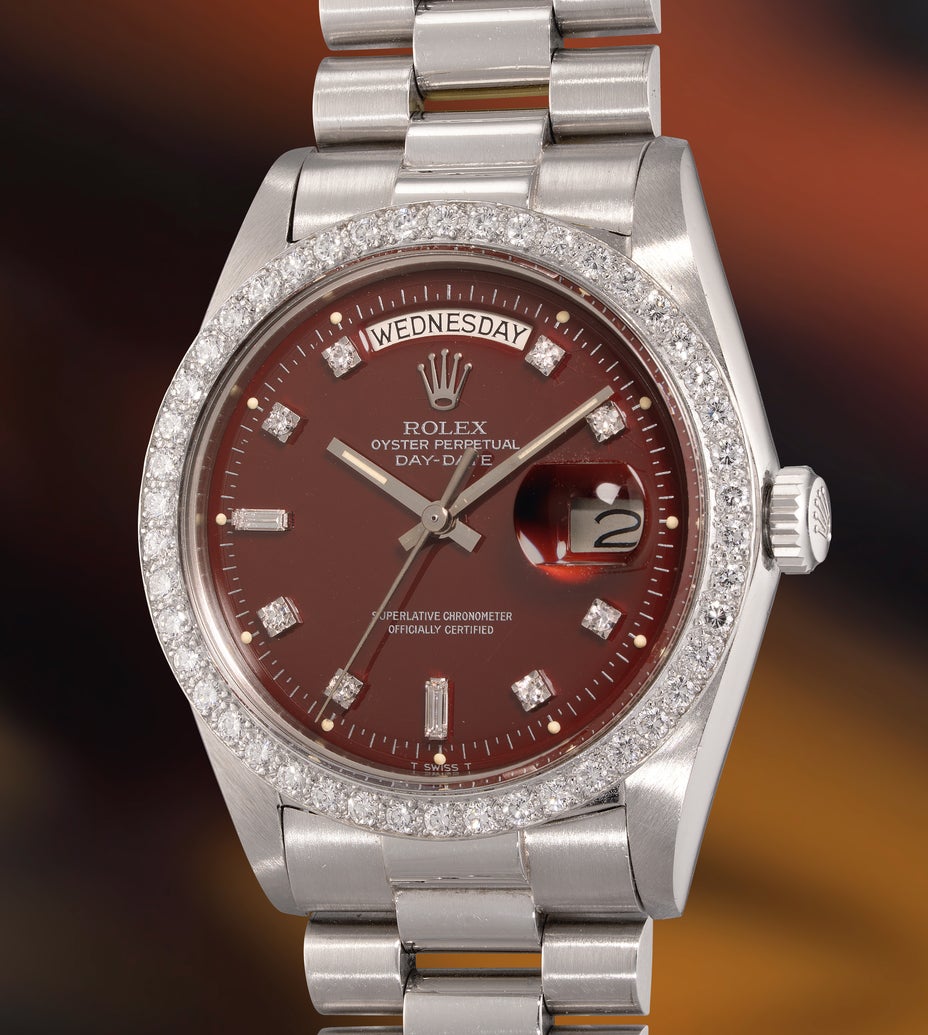
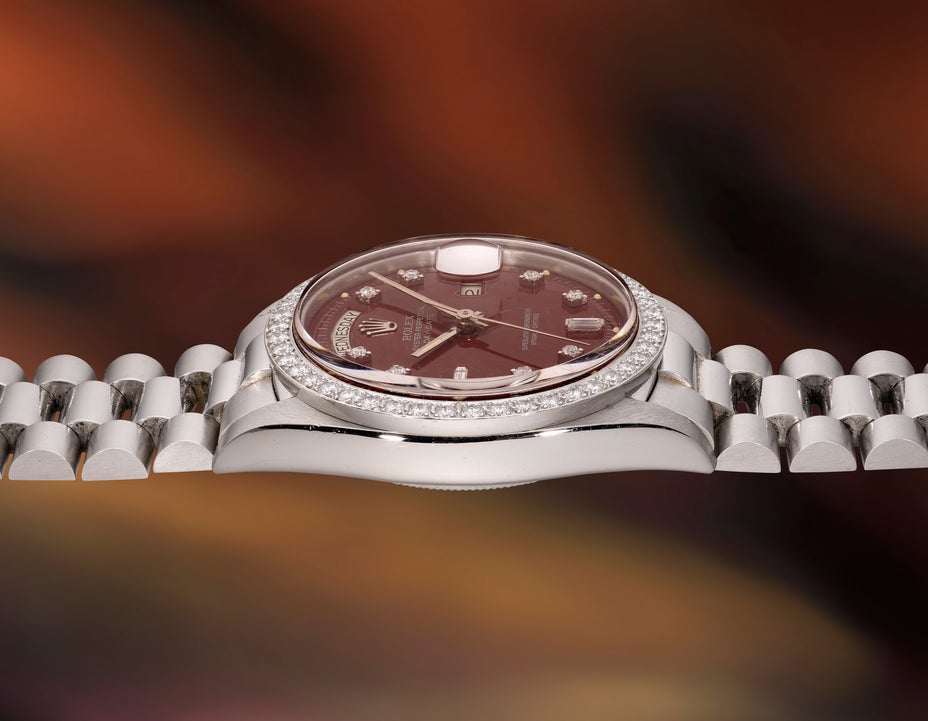
Day-Date “Stella”
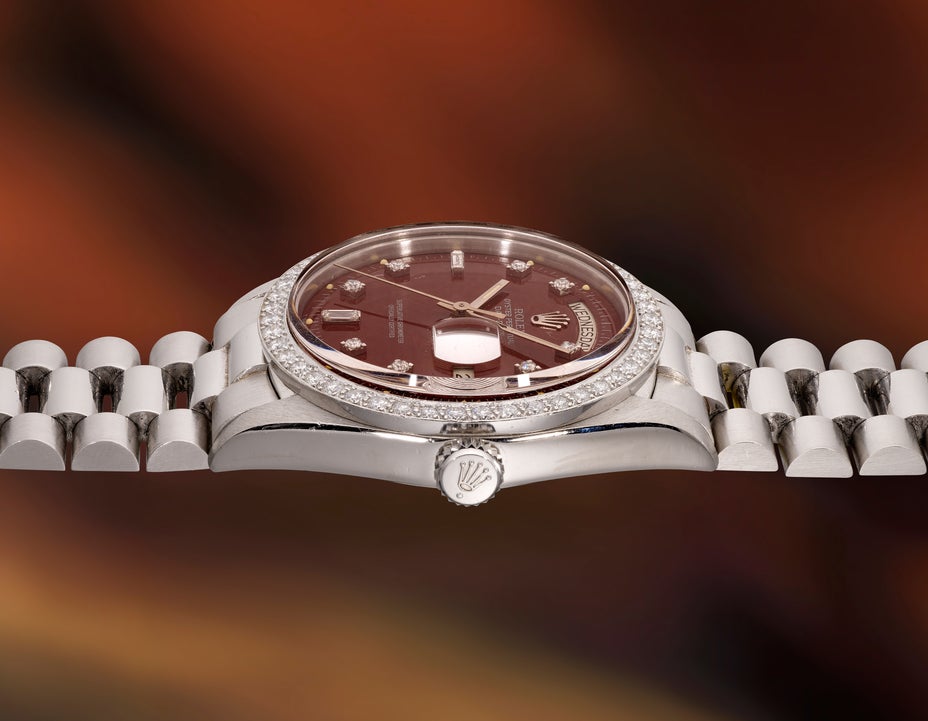
An extremely rare and impressive platinum wristwatch with center seconds, day, date, diamond-set indexes and bezel, burgundy "Stella" dial and bracelet
Full-Cataloguing
- Early burgundy “Stella” pie-pan dial
- Exclusive platinum case paired with diamond bezel and indexes
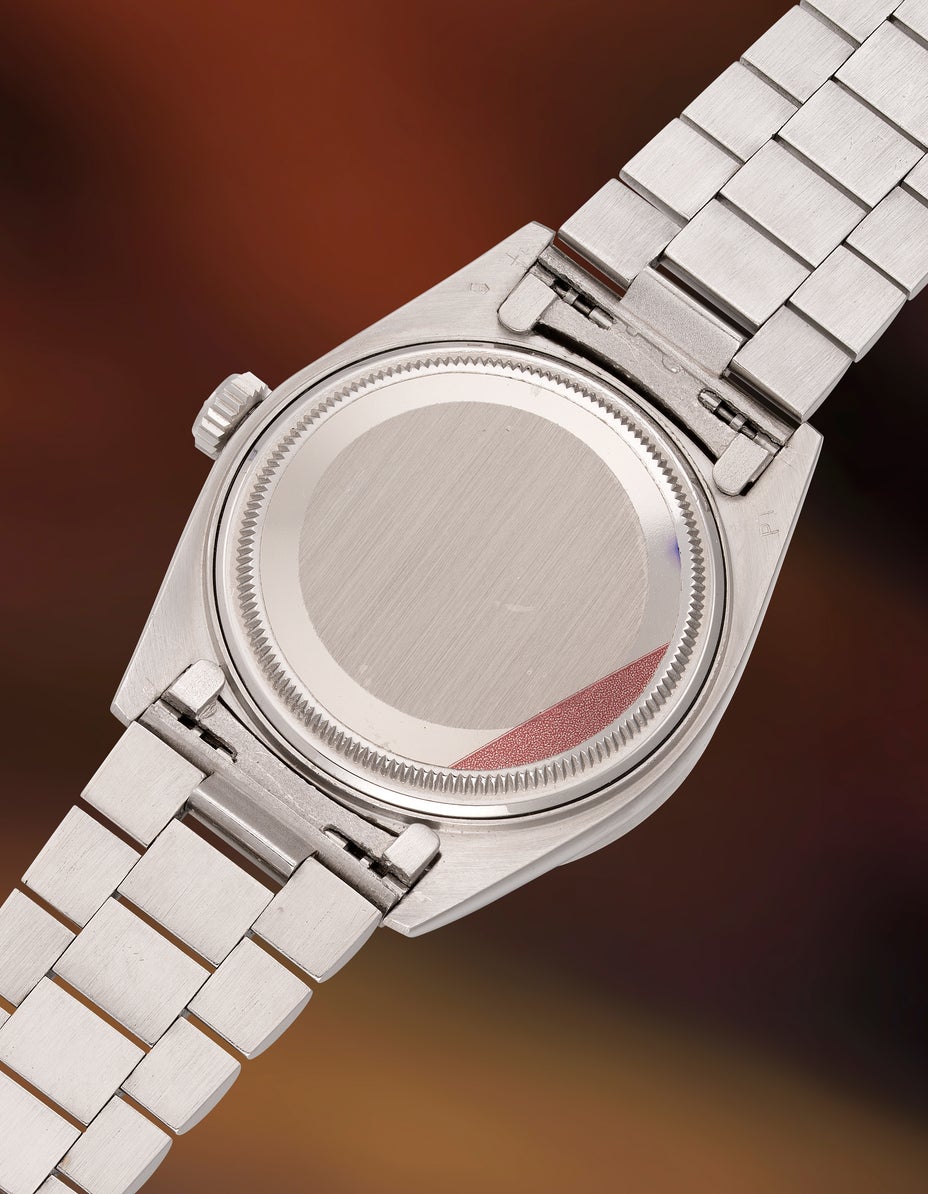
- Excellent case condition with crisp hallmarks
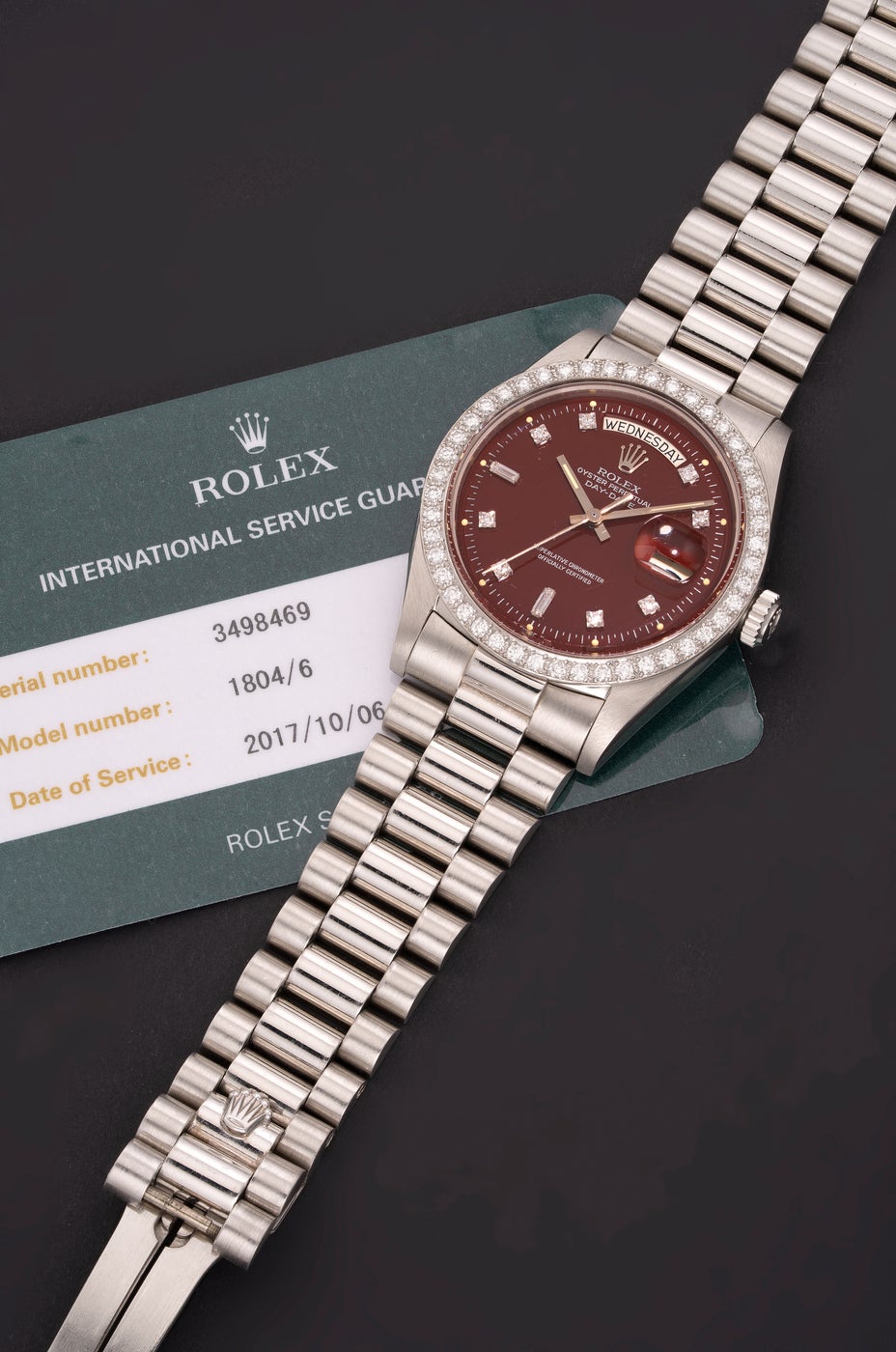
- Serviced by Rolex Japan in 2017
Produced from the 1970s into the 1990s—and enjoying a modern revival of sorts with recent Oyster Perpetual models—Stella dials are distinguished by their brightly colored lacquered surfaces. The nickname itself derives from the Geneva-based company Stella SA, which supplied the specialized paint.
There are four series of Stella dials:
1st: Late ‘60s/early ‘70s found on 180X models, with sloped edge and “T Swiss T” designation (The present watch)
2nd: Late ‘70s, found on 180x and 1803X models, with flat edge and “T Swiss T” designation
3rd: Contemporary to the 2nd, found on 180XX models, with flat edge and “T Swiss Made T” designation
4th: Late ‘80s, railway minute divisions combined with Roman numerals
The reference 1804 belongs to the early four-digit Day-Date generation, characterized by the absence of a quickset mechanism for the day or date functions. The digit "4" in the reference designation denotes a factory diamond-set bezel, making the reference 1804 a standout among early Day-Date references. As with many precious-metal Rolex models of the era, the case was manufactured by Genex S.A. and bears the Geneva Key No. 12 mark on the inner caseback. Its remarkable state of preservation is demonstrated by crisp hallmarks visible beneath the lug.
Serviced by Rolex Japan in 2017, this rare, spectacular piece represents an outstanding opportunity for the collector of exceptional vintage timepieces.
Rolex
Swiss | 1905Founded in 1905 England by Hans Wilsdorf and Alfred Davis as Wilsdorf & Davis, it soon became known as the Rolex Watch Company in 1915, moving its headquarters to Geneva in 1919. Like no other company, the success of the wristwatch can be attributed to many of Rolex's innovations that made them one of the most respected and well-known of all luxury brands. These innovations include their famous "Oyster" case — the world's first water resistant and dustproof watch case, invented in 1926 — and their "Perpetual" — the first reliable self-winding movement for wristwatches launched in 1933. They would form the foundation for Rolex's Datejust and Day-Date, respectively introduced in 1945 and 1956, but also importantly for their sports watches, such as the Explorer, Submariner and GMT-Master launched in the mid-1950s.
One of its most famous models is the Cosmograph Daytona. Launched in 1963, these chronographs are without any doubt amongst the most iconic and coveted of all collectible wristwatches. Other key collectible models include their most complicated vintage watches, including references 8171 and 6062 with triple calendar and moon phase, "Jean Claude Killy" triple date chronograph models and the Submariner, including early "big-crown" models and military-issued variants.