61
Richard Miklosch
"Flying Tourbillon with Detent Escapement"
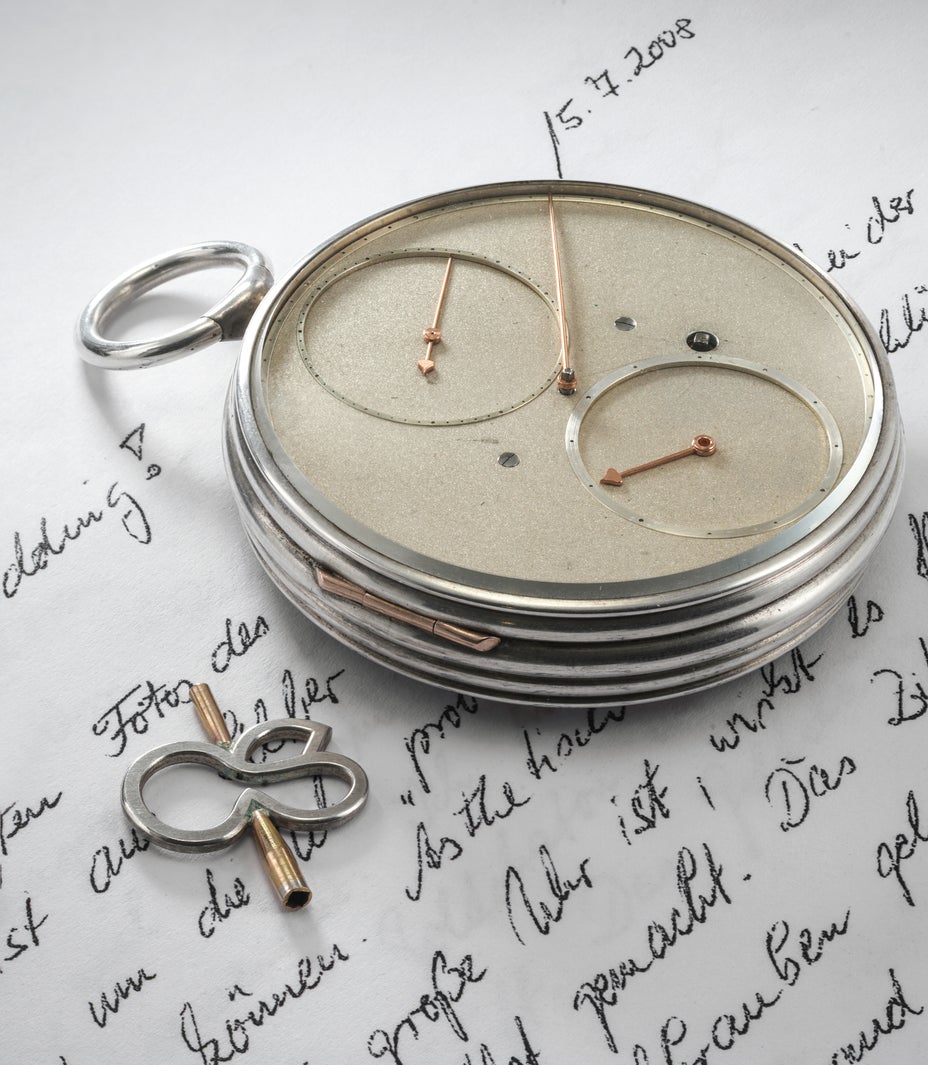
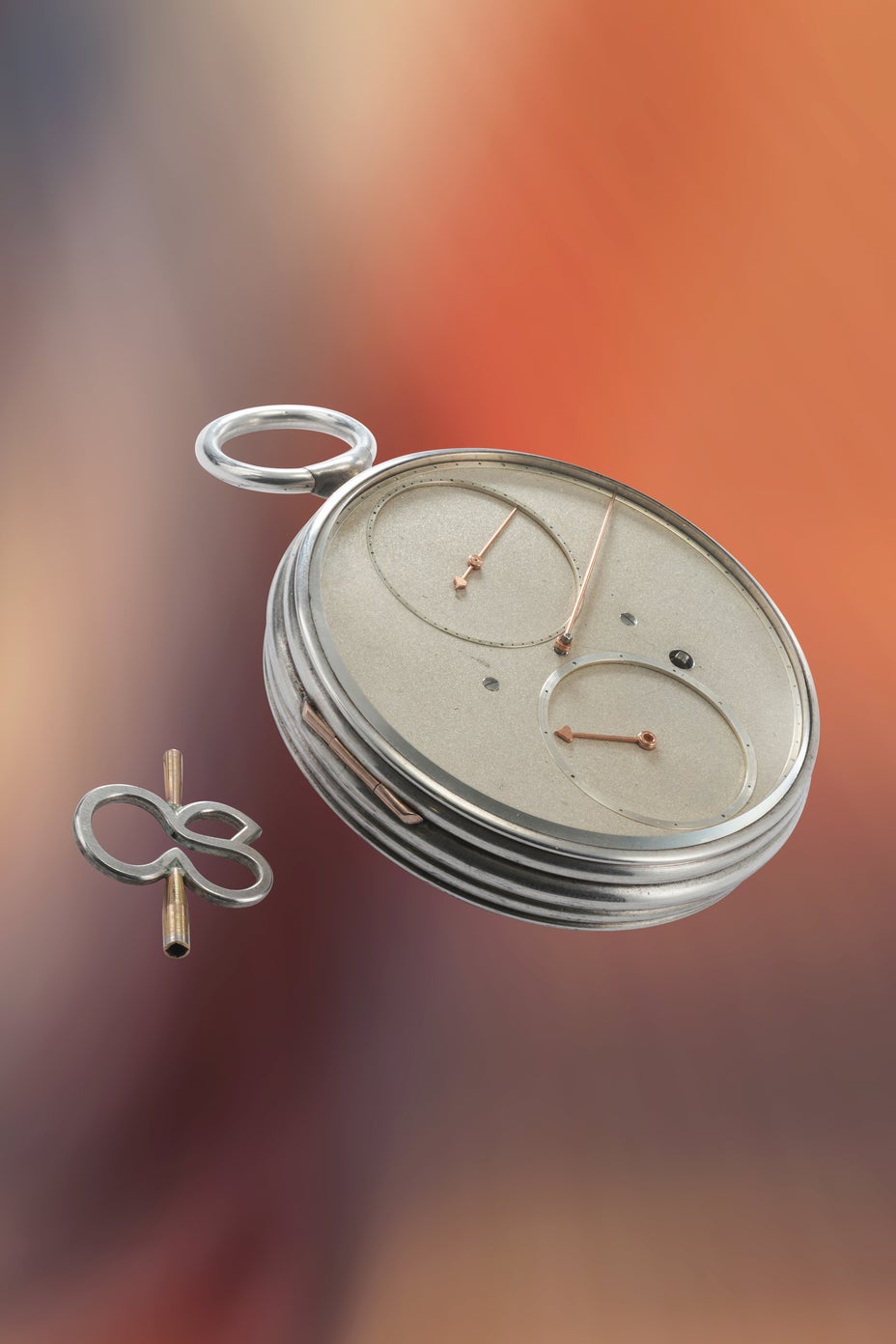
A mind boggling, impressive most probably unique silver flying tourbillon pocket watch with detent escapement
Estimate
CHF300,000–600,000
€321,000–642,000
$361,000–722,000
Manufacturer
Richard Miklosch
Year
Circa 1985
Model Name
"Flying Tourbillon with Detent Escapement"
Material
Silver
Calibre
Manual
Dimensions
60mm diameter
Signed
Movement signed R. Miklosch
Accessories
Winding key
Full-Cataloguing
Good To Know:
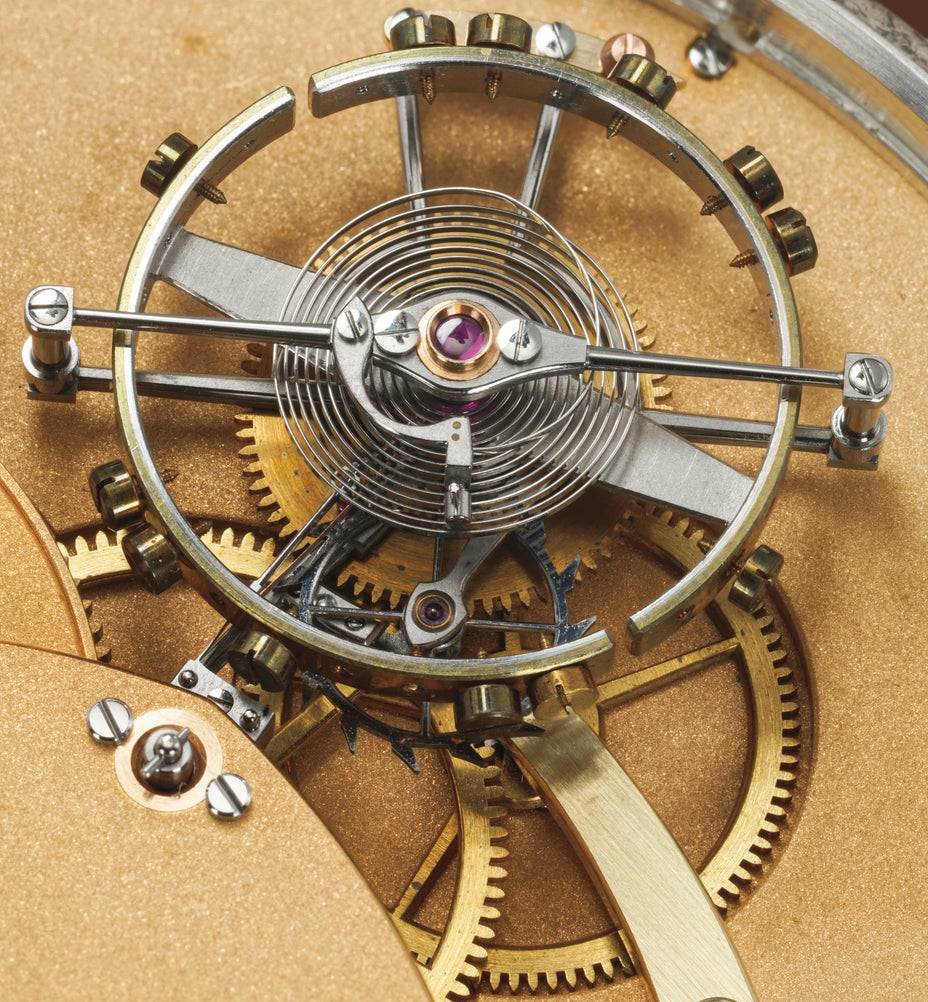
- Detent escapement flying tourbillon with split escapement
- Most probably unique
- Hand made by Richard Miklosch himself
Richard Miklosch may not be among the best-known names in contemporary independent watchmaking, yet his work occupies a singular place in the tradition of modern precision horology. A self-taught watchmaker of remarkable discipline, Miklosch belongs to a generation of craftsmen for whom watchmaking remained above all a pursuit of precision, patience and technical understanding. His work has also influenced a number of later independent watchmakers, among them Kari Voutilainen, who has cited Miklosch as an important inspiration.
Born in 1939 in what was then Czechoslovakia, Miklosch's interest in horology began at an early age. In 1945, while his family was fleeing Czechoslovakia for West Germany, he encountered abandoned watches and clocks in a watchmaker's house. The experience sparked a lifelong fascination with mechanical movements, which he pursued alongside his interests in mathematics and photography.
Miklosch did not initially make watchmaking his profession. He studied mathematics and subsequently spent approximately forty years as a teacher, developing his horological knowledge independently in his spare time through the repair, collection and study of watches. During the 1970s, his interest developed into a more serious study of precision watchmaking. He travelled to East Germany, at the time a difficult and politically sensitive journey from the West, where he sought the guidance of Gustav Gerstenberger and Alfred Helwig, both associated with the German Watchmaking School in Glashütte. Gerstenberger became an important mentor, introducing Miklosch to the construction of detent escapements and the principles of precision timing. Over a period of thirteen years, Miklosch completed four watches under their guidance, including two pocket chronometers and two tourbillons, the latter reflecting Helwig's particular field of expertise.
Following the deaths of his mentors, Miklosch continued his education through direct contact with leading independent watchmakers, including Philippe Dufour, Derek Pratt and George Daniels, while studying the work of earlier precision makers such as Pellaton, Bornand and Charrue. His own watches are predominantly precision pocket chronometers, with or without tourbillons, and reflected a particular interest in Glashütte-style flying tourbillons, spring detent escapements and power-reserve indicators. In his conception of a serious precision timepiece, these elements were not merely technical curiosities but part of a coherent approach to achieving stable and accurate timekeeping: a detent escapement, a large and light balance, a substantial barrel and an up-and-down indicator.
Miklosch's workshop and working methods further illustrated his distinctly individual approach. Rather than relying on sophisticated machines, he worked with a modest collection of traditional equipment, including small watchmaker's lathes, rounding-up tools and hand tools.
He is known to have manufactured almost every component himself, with jewels, mainsprings and certain hairsprings among the few exceptions. The construction of a tourbillon carriage could occupy four to five months, followed by a further month devoted to finishing. Characteristically, Miklosch often dispensed even with a movement holder, holding the movement in one hand while fitting components with the other.
For Miklosch, watchmaking was less a matter of efficiency than of continuous practice and refinement. Partially completed watches and tourbillon carriages in his workshop were regarded not simply as unfinished projects, but as exercises through which techniques could be tested and understood. His philosophy reflects that of an earlier generation of craftsmen, for whom mastery was acquired through repetition, observation and comparison with the work of those who came before.
This approach is particularly apparent in his tourbillons. Miklosch regarded the complication primarily as an instrument for improving the stability of the rate rather than as an opportunity for visual experimentation. His preference for traditional construction and precision over industrial efficiency places his work within a direct lineage of independent precision watchmaking. Despite the unconventional nature of his methods, his pocket chronometers are reported to have achieved an accuracy of approximately one second per day, a fitting testament to a watchmaker whose work was guided above all by the pursuit of precision.
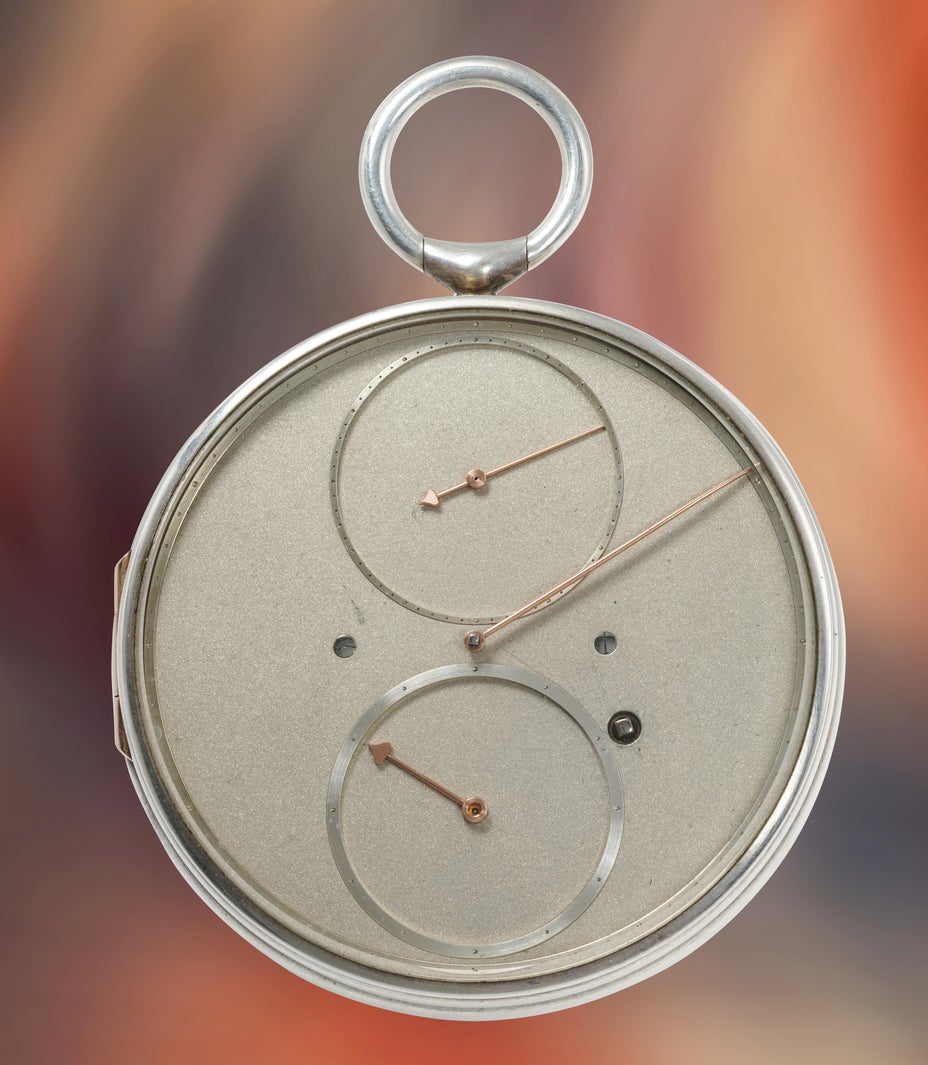
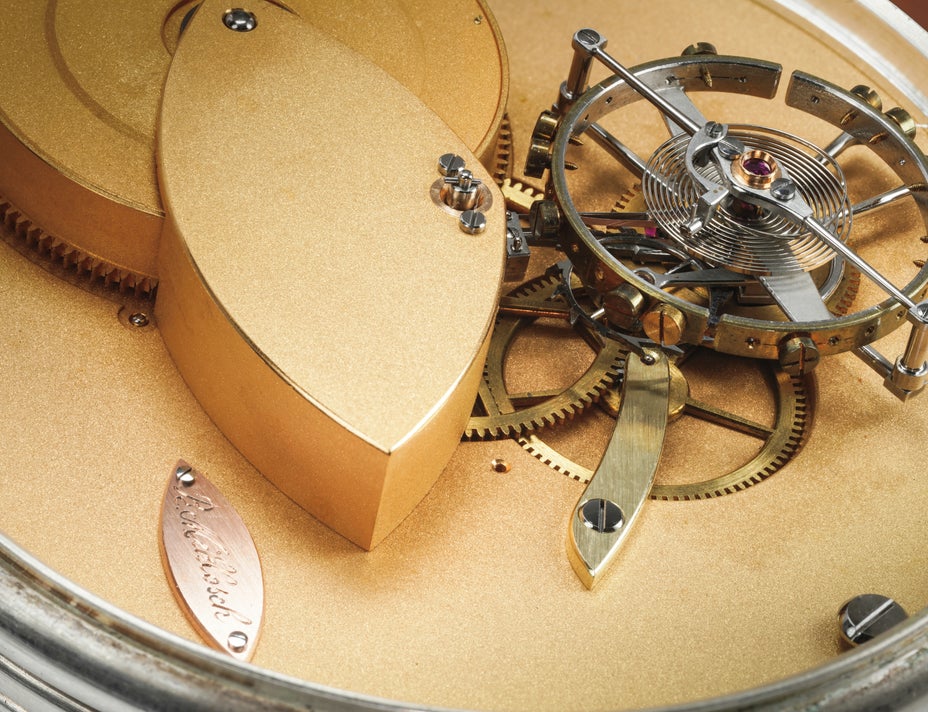
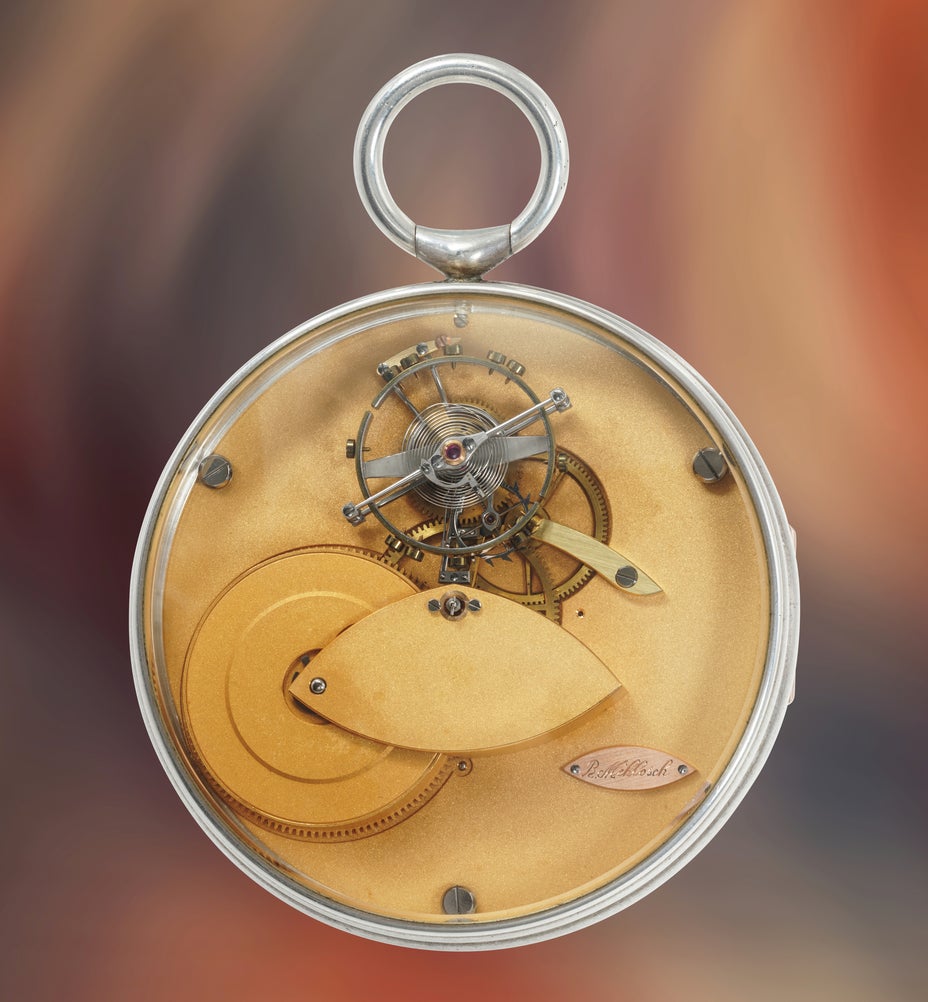
The present unique tourbillon with Earnshaw detent escapement features a grainé dial and regulator style display with the seconds placed at 12 o’clock. The movement is an incredible display in retraint as other than a large tourbillon only the barrel and an lozenge shaped bridge are visible, not only giving centre stage to the tourbillon but also underlining Miklosch’s technical mastery in creating such an incredible piece with no apparent bridges!
Only 14 pocket watches by Miklosch are known 11 tourbillons and 3 chronometers, each different.
List of the watches by Richard Miklosch that have been published to date, either by Miklosch himself in Alte Uhren and Klassik Uhren, by Meis in Das Tourbillon, by Curtis D. Thomson in International Watch, or in the anniversary catalogue of Oeding-Erdel.
- Pocket chronometer, constructed in the traditional Glashütte manner with three-quarter plate, Earnshaw-type chronometer escapement, large chronometer balance, cylindrical hairspring, keyless winding, silver case and regulator dial. Signed on the movement “R. Miklosch fecit 1976”. Published in ALTE UHREN (1979), p. 211.
- Pocket chronometer, featuring an oversized movement based on a raw movement by Gustav Gerstenberger, with skeletonised upper plate, Earnshaw-type chronometer escapement, key winding and silver case. Signed on the dial “R. Miklosch Nr. 2”. Published in ALTE UHREN (1979), p. 211.
- One-minute tourbillon, with semi-flying carriage, based on a raw movement by Gustav Gerstenberger. The movement features a skeletonised upper plate and Earnshaw-type chronometer escapement, while the silver case houses a floral-engraved dial with three eccentrically positioned chapter rings for the hours, minutes and seconds. Signed on the movement “R. Miklosch Nr. 3 – 1977”. Published in ALTE UHREN (1979), p. 211.
- One-minute tourbillon, with fully skeletonised movement and flying carriage, fitted with an Earnshaw-type chronometer escapement. The tourbillon, visible from the dial side, serves as the seconds indication, with central minutes and a 24-hour display. Cased in silver and signed and dated on the barrel and case “Nr. 4”. Conceived as a homage to the foundation of the Deutsche Uhrmacherschule in Glashütte in 1878. Published in ALTE UHREN (1979), p. 214.
- One-minute tourbillon, with flying carriage and Earnshaw-type chronometer escapement, powered by two mainspring barrels arranged in parallel. Fitted with keyless winding, power-reserve indication, silver case and sandblasted silver dial. Signed on the movement “R. Miklosch Nr. 5, 1978”. Published in KLASSIK UHREN (1998), issue 2, p. 38. Notably, the winding wheels and movement plate remain without decorative finishing.
- One-minute tourbillon, with flying carriage and Earnshaw-type chronometer escapement. The sandblasted and gilt brass movement frame itself forms the dial, while the barrel is mounted in a flying configuration on the dial side, with the power-reserve mechanism integrated into the barrel cover. Key winding, silver case and silver chapter rings for the seconds and hours/minutes, with guilloché decoration to the reverse. Signed on the movement “R. Miklosch Nr. 6”. Published in Meis (1986), Das Tourbillon, p. 277. Made for Theodor Beyer, Zurich.
- One-minute tourbillon, with flying carriage and Earnshaw-type chronometer escapement. The movement is sandblasted and gilt and powered by a single mainspring barrel, with key winding and power-reserve indication. The sandblasted silver dial features slightly eccentric hour and minute chapter rings and a seconds indication at 12 o’clock, together with a large recessed sector for the power reserve. Signed on the movement “Richard Miklosch Aachen”. Published in KLASSIK UHREN (1998), issue 2, p. 38; according to the article, made in 1980.
- One-minute tourbillon, with flying carriage and Earnshaw-type chronometer escapement, incorporating a flying escape wheel within the carriage. Powered by two mainspring barrels arranged in series and fitted with power-reserve indication. Silver case glazed on both sides. Signed on the movement “Richard Miklosch fecit 1982”. Published in Meis (1986), Das Tourbillon, p. 274. Made for Dr. Thomas Klett, Stuttgart.
One-minute tourbillon, with flying carriage and Earnshaw-type chronometer escapement. Further details are not recorded in the available documentation. Published in Meis (1986), Das Tourbillon, p. 276, and subsequently in the Cortrie auction catalogue, May 2026, Lot 4223.
- One-minute tourbillon, with flying carriage and Earnshaw-type chronometer escapement. Further details are not recorded in the available documentation. Published in the Crott auction catalogue, November 2008, Lot 62, where it is dated to circa 1980 (?). The watch was reportedly made for Dr. Claus Schäfer, Bergisch Gladbach (the present watch).
- One-minute tourbillon, with flying carriage and Earnshaw-type chronometer escapement, fitted with a Miklosch monometallic balance. The unusually large mainspring barrel measures more than half the diameter of the movement. Key winding and power-reserve indication, with a sandblasted silver dial featuring eccentrically positioned hour and minute chapter rings, seconds at 12 o’clock and gold hands. The power-reserve indication is positioned between 6 o’clock and the edge of the dial. Published in KLASSIK UHREN (1998), issue 2, p. 38; according to the article, made in 1985.
- Pocket chronometer, with Peto chronometer escapement and large Miklosch monometallic balance with recessed screws. The watch has a silver case glazed on both sides and no dial, and appears to be an unfinished experimental piece. Illustrated in Curtis D. Thomson (2006), The Craftsman, in International Watch, p. 141, where it is shown as the first watch from the left on the workbench.
- One-minute tourbillon, with flying carriage and Earnshaw-type chronometer escapement, constructed according to the type of tourbillon most frequently produced under Alfred Helwig at the Deutsche Uhrmacherschule in Glashütte. Signed on the movement “PIAGET – R. Miklosch”. Illustrated in Curtis D. Thomson (2006), The Craftsman, in International Watch, p. 141. Made for Piaget; apparently only the movement was produced, without case or dial. It is possible that a second movement was also made, employing a Breguet-style carriage arrangement.
- One-minute tourbillon, with Breguet-style carriage mounting and Earnshaw-type chronometer escapement, powered by two mainspring barrels and fitted with power-reserve indication and key winding. Gold case, guilloché silver dial and gold hands. Signed on the dial “Oeding-Erdel Münster”. Illustrated in the catalogue commemorating the 100th anniversary of Oeding-Erdel, Münster. Miklosch, however, is not identified as the maker in the catalogue.
- Detent escapement flying tourbillon with split escapement
- Most probably unique
- Hand made by Richard Miklosch himself
Richard Miklosch may not be among the best-known names in contemporary independent watchmaking, yet his work occupies a singular place in the tradition of modern precision horology. A self-taught watchmaker of remarkable discipline, Miklosch belongs to a generation of craftsmen for whom watchmaking remained above all a pursuit of precision, patience and technical understanding. His work has also influenced a number of later independent watchmakers, among them Kari Voutilainen, who has cited Miklosch as an important inspiration.
Born in 1939 in what was then Czechoslovakia, Miklosch's interest in horology began at an early age. In 1945, while his family was fleeing Czechoslovakia for West Germany, he encountered abandoned watches and clocks in a watchmaker's house. The experience sparked a lifelong fascination with mechanical movements, which he pursued alongside his interests in mathematics and photography.
Miklosch did not initially make watchmaking his profession. He studied mathematics and subsequently spent approximately forty years as a teacher, developing his horological knowledge independently in his spare time through the repair, collection and study of watches. During the 1970s, his interest developed into a more serious study of precision watchmaking. He travelled to East Germany, at the time a difficult and politically sensitive journey from the West, where he sought the guidance of Gustav Gerstenberger and Alfred Helwig, both associated with the German Watchmaking School in Glashütte. Gerstenberger became an important mentor, introducing Miklosch to the construction of detent escapements and the principles of precision timing. Over a period of thirteen years, Miklosch completed four watches under their guidance, including two pocket chronometers and two tourbillons, the latter reflecting Helwig's particular field of expertise.
Following the deaths of his mentors, Miklosch continued his education through direct contact with leading independent watchmakers, including Philippe Dufour, Derek Pratt and George Daniels, while studying the work of earlier precision makers such as Pellaton, Bornand and Charrue. His own watches are predominantly precision pocket chronometers, with or without tourbillons, and reflected a particular interest in Glashütte-style flying tourbillons, spring detent escapements and power-reserve indicators. In his conception of a serious precision timepiece, these elements were not merely technical curiosities but part of a coherent approach to achieving stable and accurate timekeeping: a detent escapement, a large and light balance, a substantial barrel and an up-and-down indicator.
Miklosch's workshop and working methods further illustrated his distinctly individual approach. Rather than relying on sophisticated machines, he worked with a modest collection of traditional equipment, including small watchmaker's lathes, rounding-up tools and hand tools.
He is known to have manufactured almost every component himself, with jewels, mainsprings and certain hairsprings among the few exceptions. The construction of a tourbillon carriage could occupy four to five months, followed by a further month devoted to finishing. Characteristically, Miklosch often dispensed even with a movement holder, holding the movement in one hand while fitting components with the other.
For Miklosch, watchmaking was less a matter of efficiency than of continuous practice and refinement. Partially completed watches and tourbillon carriages in his workshop were regarded not simply as unfinished projects, but as exercises through which techniques could be tested and understood. His philosophy reflects that of an earlier generation of craftsmen, for whom mastery was acquired through repetition, observation and comparison with the work of those who came before.
This approach is particularly apparent in his tourbillons. Miklosch regarded the complication primarily as an instrument for improving the stability of the rate rather than as an opportunity for visual experimentation. His preference for traditional construction and precision over industrial efficiency places his work within a direct lineage of independent precision watchmaking. Despite the unconventional nature of his methods, his pocket chronometers are reported to have achieved an accuracy of approximately one second per day, a fitting testament to a watchmaker whose work was guided above all by the pursuit of precision.
The present unique tourbillon with Earnshaw detent escapement features a grainé dial and regulator style display with the seconds placed at 12 o’clock. The movement is an incredible display in retraint as other than a large tourbillon only the barrel and an lozenge shaped bridge are visible, not only giving centre stage to the tourbillon but also underlining Miklosch’s technical mastery in creating such an incredible piece with no apparent bridges!
Only 14 pocket watches by Miklosch are known 11 tourbillons and 3 chronometers, each different.
List of the watches by Richard Miklosch that have been published to date, either by Miklosch himself in Alte Uhren and Klassik Uhren, by Meis in Das Tourbillon, by Curtis D. Thomson in International Watch, or in the anniversary catalogue of Oeding-Erdel.
- Pocket chronometer, constructed in the traditional Glashütte manner with three-quarter plate, Earnshaw-type chronometer escapement, large chronometer balance, cylindrical hairspring, keyless winding, silver case and regulator dial. Signed on the movement “R. Miklosch fecit 1976”. Published in ALTE UHREN (1979), p. 211.
- Pocket chronometer, featuring an oversized movement based on a raw movement by Gustav Gerstenberger, with skeletonised upper plate, Earnshaw-type chronometer escapement, key winding and silver case. Signed on the dial “R. Miklosch Nr. 2”. Published in ALTE UHREN (1979), p. 211.
- One-minute tourbillon, with semi-flying carriage, based on a raw movement by Gustav Gerstenberger. The movement features a skeletonised upper plate and Earnshaw-type chronometer escapement, while the silver case houses a floral-engraved dial with three eccentrically positioned chapter rings for the hours, minutes and seconds. Signed on the movement “R. Miklosch Nr. 3 – 1977”. Published in ALTE UHREN (1979), p. 211.
- One-minute tourbillon, with fully skeletonised movement and flying carriage, fitted with an Earnshaw-type chronometer escapement. The tourbillon, visible from the dial side, serves as the seconds indication, with central minutes and a 24-hour display. Cased in silver and signed and dated on the barrel and case “Nr. 4”. Conceived as a homage to the foundation of the Deutsche Uhrmacherschule in Glashütte in 1878. Published in ALTE UHREN (1979), p. 214.
- One-minute tourbillon, with flying carriage and Earnshaw-type chronometer escapement, powered by two mainspring barrels arranged in parallel. Fitted with keyless winding, power-reserve indication, silver case and sandblasted silver dial. Signed on the movement “R. Miklosch Nr. 5, 1978”. Published in KLASSIK UHREN (1998), issue 2, p. 38. Notably, the winding wheels and movement plate remain without decorative finishing.
- One-minute tourbillon, with flying carriage and Earnshaw-type chronometer escapement. The sandblasted and gilt brass movement frame itself forms the dial, while the barrel is mounted in a flying configuration on the dial side, with the power-reserve mechanism integrated into the barrel cover. Key winding, silver case and silver chapter rings for the seconds and hours/minutes, with guilloché decoration to the reverse. Signed on the movement “R. Miklosch Nr. 6”. Published in Meis (1986), Das Tourbillon, p. 277. Made for Theodor Beyer, Zurich.
- One-minute tourbillon, with flying carriage and Earnshaw-type chronometer escapement. The movement is sandblasted and gilt and powered by a single mainspring barrel, with key winding and power-reserve indication. The sandblasted silver dial features slightly eccentric hour and minute chapter rings and a seconds indication at 12 o’clock, together with a large recessed sector for the power reserve. Signed on the movement “Richard Miklosch Aachen”. Published in KLASSIK UHREN (1998), issue 2, p. 38; according to the article, made in 1980.
- One-minute tourbillon, with flying carriage and Earnshaw-type chronometer escapement, incorporating a flying escape wheel within the carriage. Powered by two mainspring barrels arranged in series and fitted with power-reserve indication. Silver case glazed on both sides. Signed on the movement “Richard Miklosch fecit 1982”. Published in Meis (1986), Das Tourbillon, p. 274. Made for Dr. Thomas Klett, Stuttgart.
One-minute tourbillon, with flying carriage and Earnshaw-type chronometer escapement. Further details are not recorded in the available documentation. Published in Meis (1986), Das Tourbillon, p. 276, and subsequently in the Cortrie auction catalogue, May 2026, Lot 4223.
- One-minute tourbillon, with flying carriage and Earnshaw-type chronometer escapement. Further details are not recorded in the available documentation. Published in the Crott auction catalogue, November 2008, Lot 62, where it is dated to circa 1980 (?). The watch was reportedly made for Dr. Claus Schäfer, Bergisch Gladbach (the present watch).
- One-minute tourbillon, with flying carriage and Earnshaw-type chronometer escapement, fitted with a Miklosch monometallic balance. The unusually large mainspring barrel measures more than half the diameter of the movement. Key winding and power-reserve indication, with a sandblasted silver dial featuring eccentrically positioned hour and minute chapter rings, seconds at 12 o’clock and gold hands. The power-reserve indication is positioned between 6 o’clock and the edge of the dial. Published in KLASSIK UHREN (1998), issue 2, p. 38; according to the article, made in 1985.
- Pocket chronometer, with Peto chronometer escapement and large Miklosch monometallic balance with recessed screws. The watch has a silver case glazed on both sides and no dial, and appears to be an unfinished experimental piece. Illustrated in Curtis D. Thomson (2006), The Craftsman, in International Watch, p. 141, where it is shown as the first watch from the left on the workbench.
- One-minute tourbillon, with flying carriage and Earnshaw-type chronometer escapement, constructed according to the type of tourbillon most frequently produced under Alfred Helwig at the Deutsche Uhrmacherschule in Glashütte. Signed on the movement “PIAGET – R. Miklosch”. Illustrated in Curtis D. Thomson (2006), The Craftsman, in International Watch, p. 141. Made for Piaget; apparently only the movement was produced, without case or dial. It is possible that a second movement was also made, employing a Breguet-style carriage arrangement.
- One-minute tourbillon, with Breguet-style carriage mounting and Earnshaw-type chronometer escapement, powered by two mainspring barrels and fitted with power-reserve indication and key winding. Gold case, guilloché silver dial and gold hands. Signed on the dial “Oeding-Erdel Münster”. Illustrated in the catalogue commemorating the 100th anniversary of Oeding-Erdel, Münster. Miklosch, however, is not identified as the maker in the catalogue.