Property from an Important European Collection
44
René Herbst
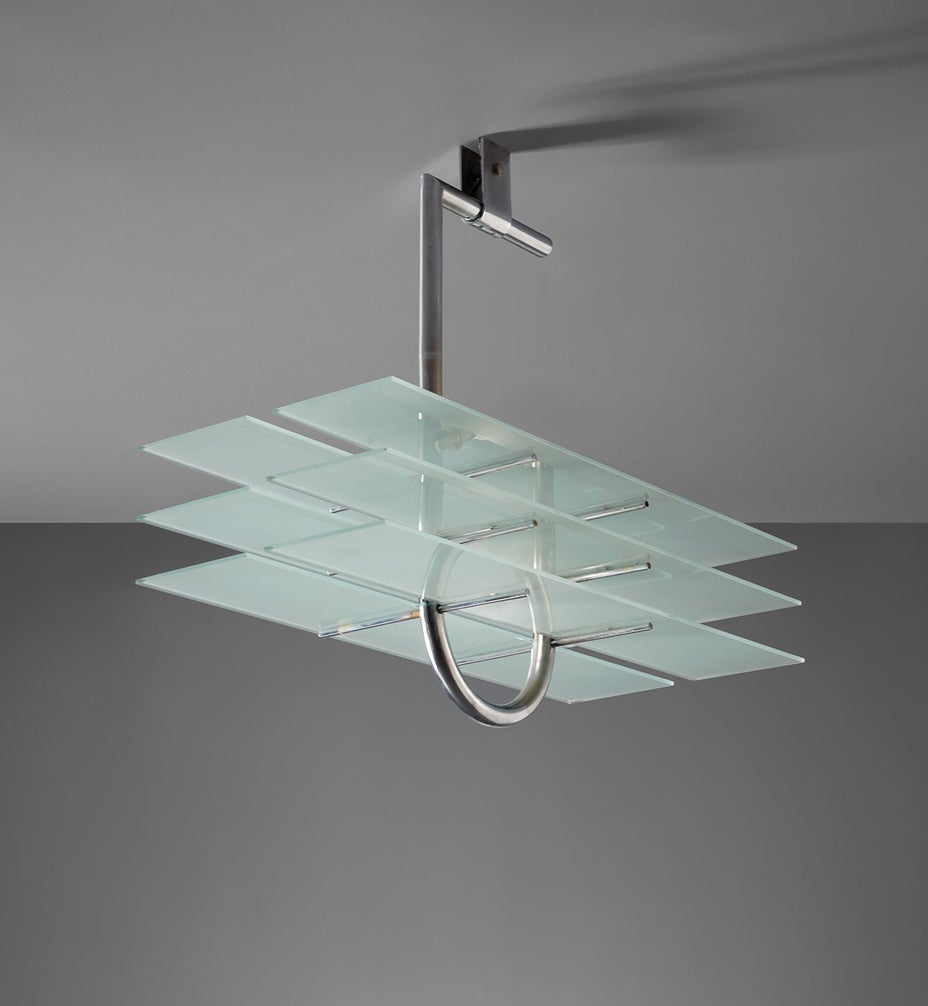
Ceiling light, from the architect's residence
Estimate
$25,000–35,000
1930s
Chromium-plated tubular brass, chromium-plated brass, glass.
30 7/8 in. (78.4 cm) drop, 33 7/8 x 15 3/8 in. (86 x 39.1 cm)
Full-Cataloguing
For the present ceiling light, from René Herbst’s own residence, the designer reimagined the possibilities of two industrial and seemingly unyielding materials – tubular steel and sheet glass – devising a disarmingly poetic composition of reflective metal and floating planes of frosted glass.
Herbst was among the first architect-designers to embrace the use of tubular steel with works such as this ceiling light and his famous Sandows chair, which incorporated the use of bungee cords for the seat and back supports. His interest in industrial materials was part of a larger program to modernize French decorative arts. Along with Robert Mallet-Stevens, Françis Jourdain, and others, Herbst founded the Union des Artistes Modernes (UAM) in 1929. Charlotte Perriand, Jean Prouvé, Pierre Chareau, and Eileen Gray joined soon thereafter.
Often referred to as the “French Bauhaus,” the UAM reacted against more traditional groups such as the Société des Artistes Décorateurs, preferring the useful and the functional over the superfluous and the decorative. “We should advocate for the truth, the simplicity and the coherence,” urged the UAM manifesto of 1934, “Renovate the lifestyle of the French people, liberating them from a conservative and old-fashioned environment in creating a Universe best adapted to the world by using the new techniques.”
Herbst was among the first architect-designers to embrace the use of tubular steel with works such as this ceiling light and his famous Sandows chair, which incorporated the use of bungee cords for the seat and back supports. His interest in industrial materials was part of a larger program to modernize French decorative arts. Along with Robert Mallet-Stevens, Françis Jourdain, and others, Herbst founded the Union des Artistes Modernes (UAM) in 1929. Charlotte Perriand, Jean Prouvé, Pierre Chareau, and Eileen Gray joined soon thereafter.
Often referred to as the “French Bauhaus,” the UAM reacted against more traditional groups such as the Société des Artistes Décorateurs, preferring the useful and the functional over the superfluous and the decorative. “We should advocate for the truth, the simplicity and the coherence,” urged the UAM manifesto of 1934, “Renovate the lifestyle of the French people, liberating them from a conservative and old-fashioned environment in creating a Universe best adapted to the world by using the new techniques.”