76
Patek Philippe
Ref. 4239-1
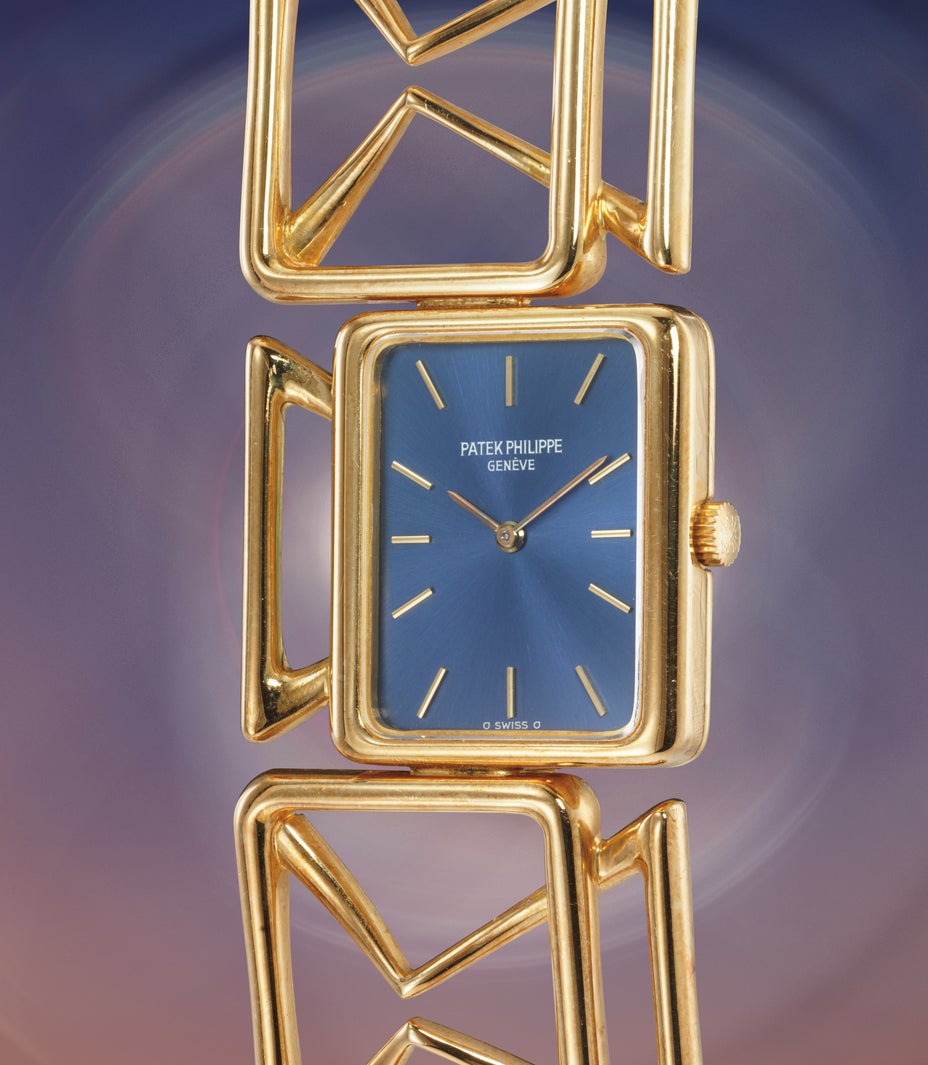
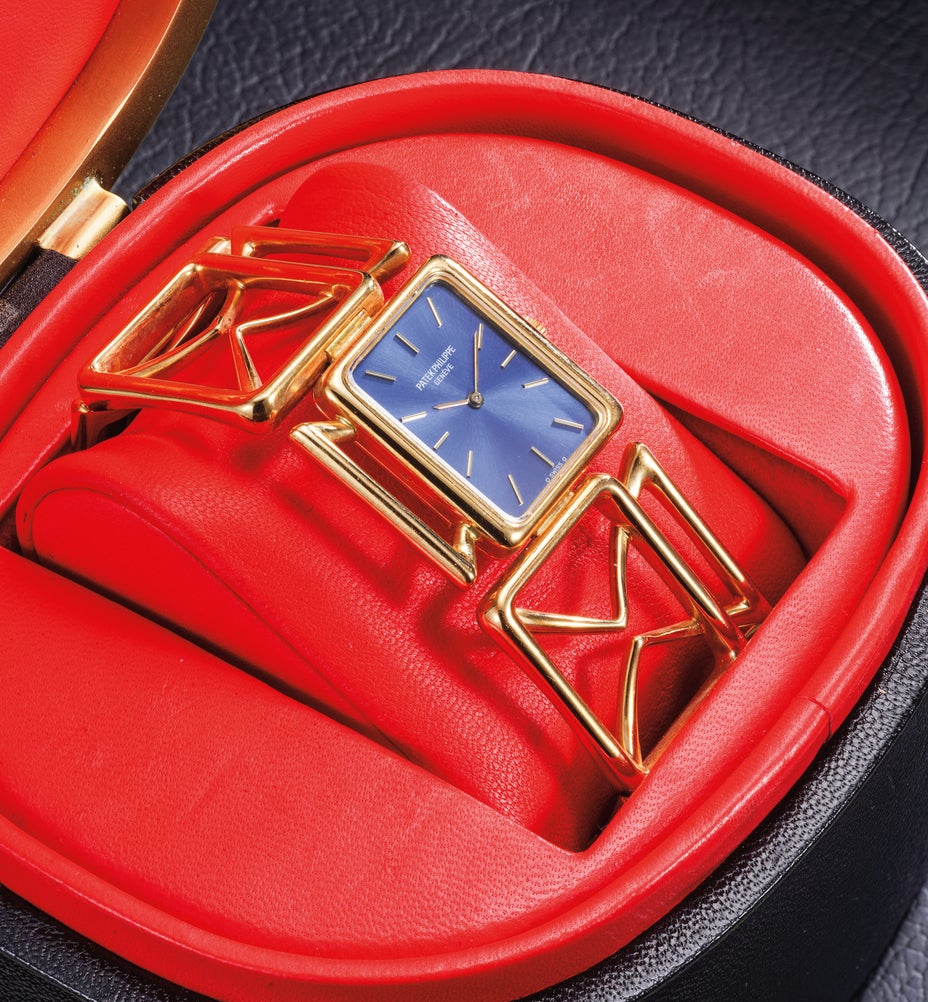
An exquisite and highly uncommon yellow gold bracelet watch with box
Full-Cataloguing
- Time only
- Extremely rare reference with less than 10 examples known from the public market
- Possibly, the only example known with blue dial
While ref. 4239/1 is usually fitted with a “Vermeer dial” - a sunburst dial in brownish and burgundy hues - the present example breaks free from custom with its blue soléil dial.
Beyond the attractiveness of the yellow gold case / blue dial ensemble, the combination exudes Patek Philippe DNA, as it has been profusely employed on one of the most appreciated lines of the brand: the Ellipse. Thus, rarity is only a facet of the appeal of the present watch; the connoisseur will also be infinitely intrigued by what could be thought of - with a bit of imagination - as a rectangular Ellipse with integrated bracelet.
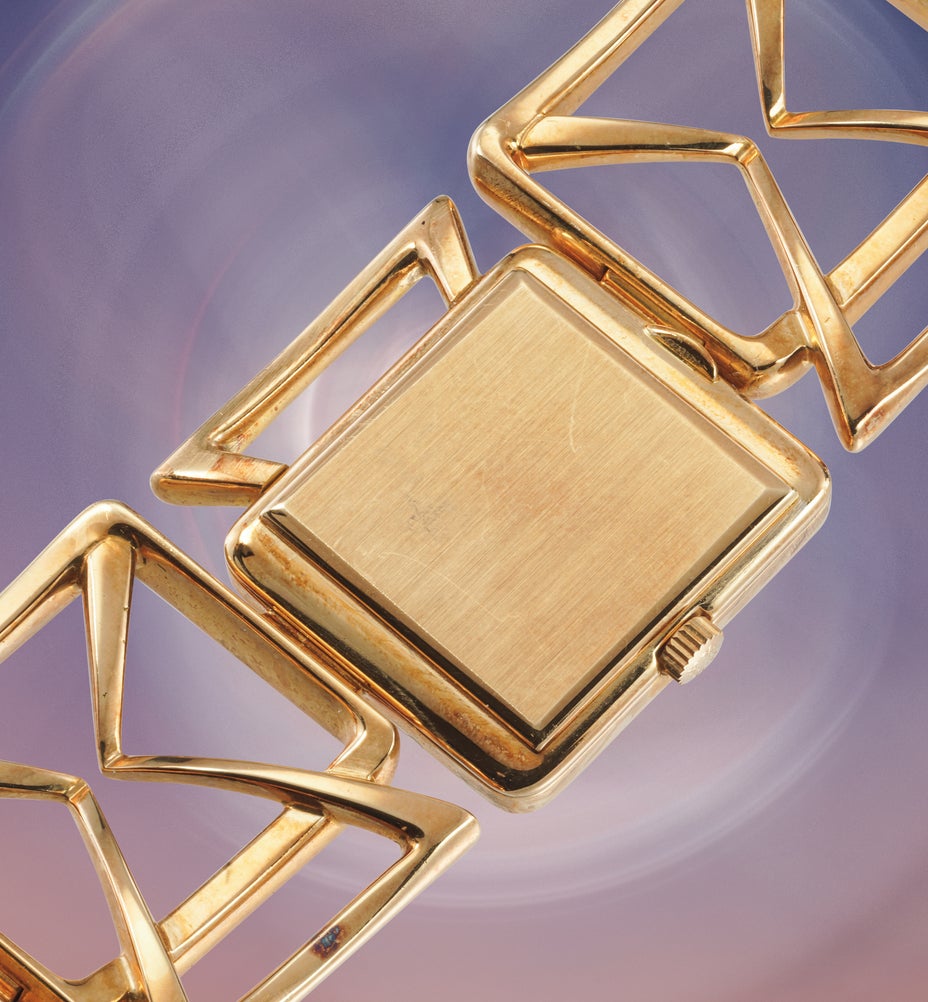
The idea of “continuous design”, where the case and bracelet form a seamless visual unit, was typical of the period and perfectly interpreted by the present creation. This watch features a highly unusual-looking bracelet made of geometrical elements reminiscent of an asymmetric hourglass partly inscribed within rectangles of the same size as the case of the watch - thus allowing the design to continue unbroken throughout the entirety of the bracelet, with the case acting as one of the rectangles. By inspecting the caseback, the Case Maker Key Number 5 can be seen, indicating the case of this watch was made by the renowned George Croisier, who made the cases of three out of four legendary steel Patek Philippe ref. 1518.
Mechanically, it is noteworthy that Patek Philippe experimented with ultra-thin movements in the 1970s, an example being the Ellipse housing the calibre 240. The current watch also sports a remarkable piece of engineering: one of the smallest movements made by the brand, cal. 16-250.
Patek Philippe
Swiss | 1839Since its founding in 1839, this famous Geneva-based firm has been surprising its clientele with superbly crafted timepieces fitted with watchmaking's most prestigious complications. Traditional and conservative designs are found across Patek Philippe's watches made throughout their history — the utmost in understated elegance.
Well-known for the Graves Supercomplication — a highly complicated pocket watch that was the world’s most complicated watch for 50 years — this family-owned brand has earned a reputation of excellence around the world. Patek's complicated vintage watches hold the highest number of world records for results achieved at auction compared with any other brand. For collectors, key models include the reference 1518, the world's first serially produced perpetual calendar chronograph, and its successor, the reference 2499. Other famous models include perpetual calendars such as the ref. 1526, ref. 3448 and 3450, chronographs such as the reference 130, 530 and 1463, as well as reference 1436 and 1563 split seconds chronographs. Patek is also well-known for their classically styled, time-only "Calatrava" dress watches, and the "Nautilus," an iconic luxury sports watch first introduced in 1976 as the reference 3700 that is still in production today.