Property from an Important Private European Collection
20
Liu Ye
Big Pigeon
Estimate
HK$800,000–1,200,000
€90,100–135,000
$103,000–154,000
Sold For
HK$1,875,000
signed and dated '1995 Liu Ye [In Chinese and Pinyin]' upper left
acrylic and oil on canvas
40 x 40 cm. (15 3/4 x 15 3/4 in.)
Executed in 1995.
Full-Cataloguing
To inspect Liu Ye’s oeuvre is to experience a bildungsroman in painting form: armed with a mesmerising cast of revolving characters, one is able to survey the story of the artist’s development, maturation, and evolving artistry.
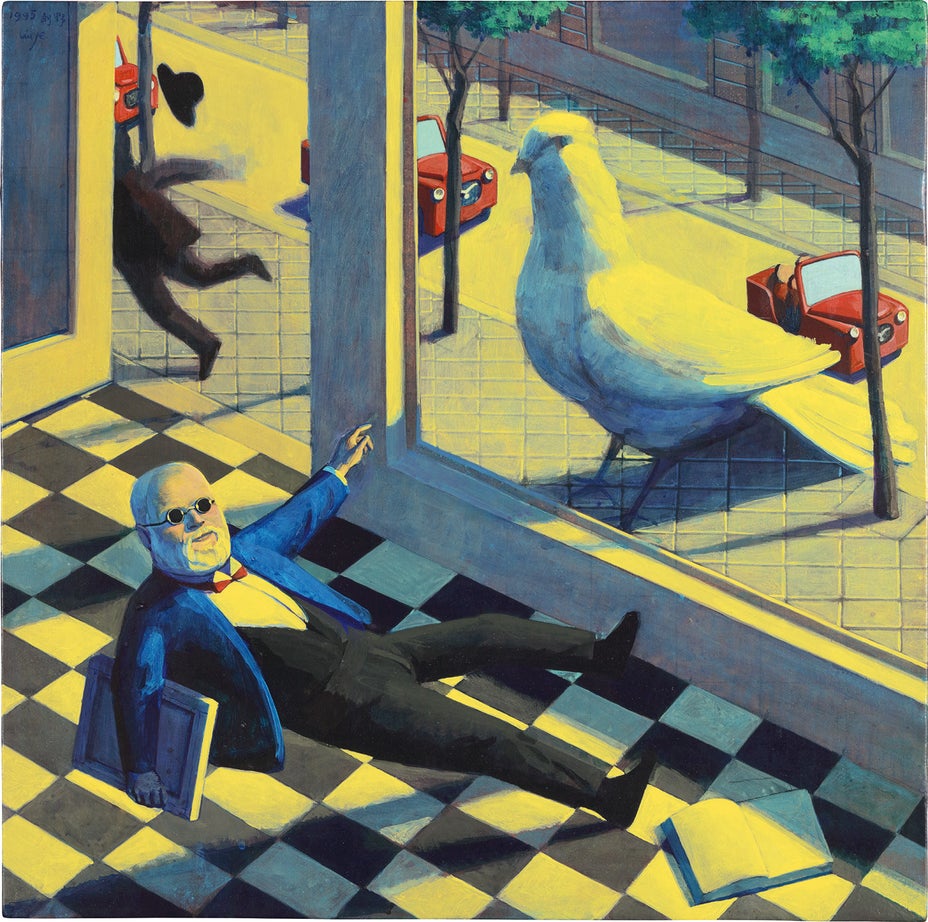
In Big Pigeon, a rare early work, we are presented with a humorous inside-joke spun into a surrealistic scene taken from a real event: the bespectacled protagonist—the artist’s German dealer at the time, Klaus Märtens from Galerie Taube—takes a tumble while clasping a painting. An overgrown, intransigent pigeon—a play on ‘Taube’ being German for ‘pigeon’—peers through a window pane, into the shop-front in which Mr Märtens meets his unfortunate fall. Outside the shop-front, one glimpses Berlin bathed in pale yellow, cars lined in a neat row while another man seems mid-trip himself. A charming little joke between Liu Ye and Mr Märtens thus springs to life.
A painting steeped in personal memories and embedded inspiration, Big Pigeon was painted in 1994, when Liu had just returned to Beijing. It is clear that upon his return to China, the artist was conjuring this old memory; but more importantly, ruminating upon the rich tapestry of influences that filled his earlier pieces, painted during his sojourn in Germany. One is able to detect Liu’s love of René Magritte: the falling men immediately call to mind Magritte’s Golconde, while the namesake of Galerie Taube reminds one of Magritte’s Man in a Bowler Hat, his face obscured by a flying pigeon. In Liu’s version, the pigeon peers on steadfast, while Magritte’s stout little men have here transformed into a comically stoic Mr Märtens, a tell-tale Magritte-esque bowler cap slipping off the pedestrian outside. One can also easily discern the artist’s careful study of Italian Metaphysical art, in particular Giorgio de Chirico—a pioneering artist who would go on to influence a whole generation of surrealists. Big Pigeon’s eschewal of reality and its blatant impossibility is the artist’s transformation of surrealism, all deftly juxtaposed against the orderly geometric interior of the piece: each line painstakingly drawn, thanks to the artist’s penchant for the Flemish School and later on, De Stijl. We find Liu’s iconic lineal drawing of the fairytale book too, open onto a blank page on the tiled ground: a sentimental nod to his father’s occupation as a children’s storybook writer. Big Pigeon is itself a scene from a fairytale, a whimsical, visually arresting work that also aches with Romanticism, its tonal preoccupation redolent of Edward Hopper, whose treatment of light is a particular favourite of Liu’s. In the present work, one is captivated by Liu’s ability to weave various threads of stimulus into a compelling narrative, executed in a language that is entirely his own.
Phillips would like to thank Liu Ye for his assistance with this essay.
In Big Pigeon, a rare early work, we are presented with a humorous inside-joke spun into a surrealistic scene taken from a real event: the bespectacled protagonist—the artist’s German dealer at the time, Klaus Märtens from Galerie Taube—takes a tumble while clasping a painting. An overgrown, intransigent pigeon—a play on ‘Taube’ being German for ‘pigeon’—peers through a window pane, into the shop-front in which Mr Märtens meets his unfortunate fall. Outside the shop-front, one glimpses Berlin bathed in pale yellow, cars lined in a neat row while another man seems mid-trip himself. A charming little joke between Liu Ye and Mr Märtens thus springs to life.
A painting steeped in personal memories and embedded inspiration, Big Pigeon was painted in 1994, when Liu had just returned to Beijing. It is clear that upon his return to China, the artist was conjuring this old memory; but more importantly, ruminating upon the rich tapestry of influences that filled his earlier pieces, painted during his sojourn in Germany. One is able to detect Liu’s love of René Magritte: the falling men immediately call to mind Magritte’s Golconde, while the namesake of Galerie Taube reminds one of Magritte’s Man in a Bowler Hat, his face obscured by a flying pigeon. In Liu’s version, the pigeon peers on steadfast, while Magritte’s stout little men have here transformed into a comically stoic Mr Märtens, a tell-tale Magritte-esque bowler cap slipping off the pedestrian outside. One can also easily discern the artist’s careful study of Italian Metaphysical art, in particular Giorgio de Chirico—a pioneering artist who would go on to influence a whole generation of surrealists. Big Pigeon’s eschewal of reality and its blatant impossibility is the artist’s transformation of surrealism, all deftly juxtaposed against the orderly geometric interior of the piece: each line painstakingly drawn, thanks to the artist’s penchant for the Flemish School and later on, De Stijl. We find Liu’s iconic lineal drawing of the fairytale book too, open onto a blank page on the tiled ground: a sentimental nod to his father’s occupation as a children’s storybook writer. Big Pigeon is itself a scene from a fairytale, a whimsical, visually arresting work that also aches with Romanticism, its tonal preoccupation redolent of Edward Hopper, whose treatment of light is a particular favourite of Liu’s. In the present work, one is captivated by Liu’s ability to weave various threads of stimulus into a compelling narrative, executed in a language that is entirely his own.
Phillips would like to thank Liu Ye for his assistance with this essay.