IMPORTANT PHOTOGRAPHS FROM THE COLLECTION OF DR. ANTHONY TERRANA
7
László Moholy-Nagy
Lyon Stadium
Estimate
$90,000–120,000
Sold For
$278,500
circa 1929
Gelatin silver print.
9 1/4 x 6 7/8 in. (23.5 x 17.5 cm)
Signed ‘Foto: Moholy-Nagy’, titled in ink, ‘foto Moholy-Nagy’, ‘moholy-nagy/ berlin’, reproduction limitation and ‘VU Photo’ stamps on the verso.
Full-Cataloguing
Hungarian born László Moholy-Nagy survived WWI as an artillery soldier on the Russian front and proceeded to become one of modernism’s leading advocates for art as a tool for social change through the exploration of perception. His theories were a revolutionary response to the social and political upheaval of his time.
He noted: Under the impact of violent changes, artists, writers, scientists and philosophers became the revolutionaries of a realistic Utopia awakened from the mere
enjoyment of their crafs to the essential duties and responsibilities toward the community.
Since the development of Renaissance Perspective (circa 1500), art has served to describe the phenomena of the visual world. László Moholy-Nagy was at the center of
the radical modernist transition from art being about what we see in the world – to an exploration of perception. Rejecting the notion that art should reflect the ideas and values of the past, Moholy-Nagy called for a new art form - one that heightens our awareness of NOW and reconfigures how we view the world. For Moholy-Nagy the relatively new medium of photography ft the bill.
…thanks to the photographer humanity has acquired the power of perceiving its surroundings, and its very existence, with new eyes. A creative photographer must
try to enlarge the habitual scope of vision; create new relationships between known elements; utilize the expressive power of surprise growing out of the potentialities of the photographic means.
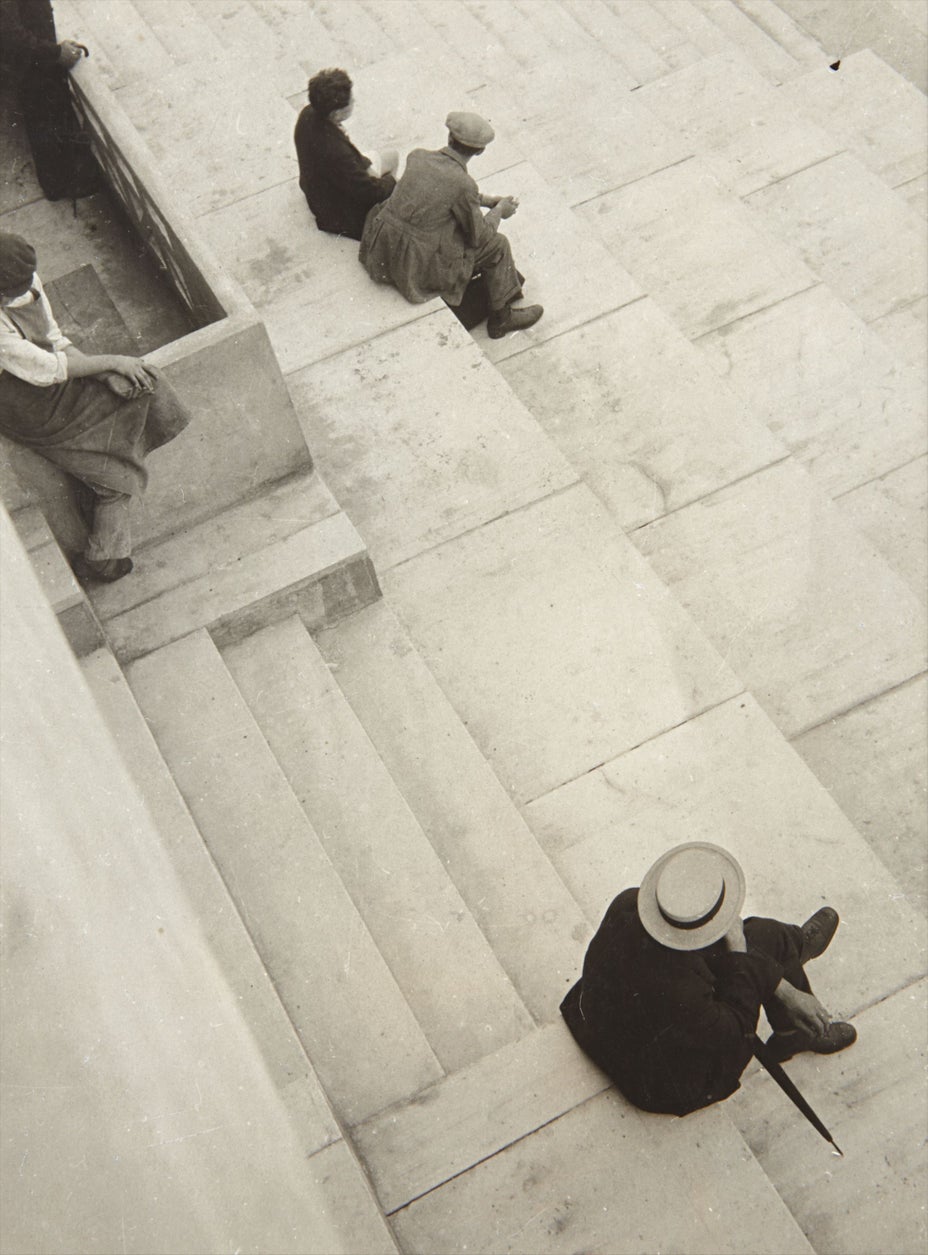
In Lyon Stadium, 1929 four seated figures and one standing are viewed from above. The white marble stairs that they inhabit on various levels gives them a common ground. Taken from a radically new vantage point, Moholy-Nagy is altering our perspective on society by creating an image in which individuals are positioned in their own space while also serving as structural elements of an inter-related whole. And he is not doing this by moralizing or telling us a story - but rather through the photograph’s power to visually realign our perception, leading us to grasp new types of relationships. The elements of the visual have not ….an absolute logical connection with one another: their photographic, visual relationships, nevertheless, make them knit together into a virtual association of events in space and time and brings the viewer actively into the dynamic of the city.
In 1923, Moholy-Nagy became an instructor of the foundation course at the Bauhaus, the radical German school of art and industrial design. He left in 1928 with the
Bauhaus founder Walther Gropius to set up a freelance design office in Berlin. Many of his photographs taken from a birds-eye or worms-eye view (including Lyon Stadium) were taken during the late 1920s early 1930s after his stint at the Bauhaus while he was working in Berlin.
Because of Germany’s increasing restrictions on artists, Moholy–Nagy left Germany in 1934, first settling in Amsterdam and then in London. Though he was seeking a means to support his family, his dream was to establish a new community of artists, educators, scientists, and students who sought to develop the creative self as a means of rebuilding a more just and balanced society. His search ended in 1937, when he was brought to Chicago to start a school - the New Bauhaus - that would combine art, technology, and a modern vision.
He noted: Under the impact of violent changes, artists, writers, scientists and philosophers became the revolutionaries of a realistic Utopia awakened from the mere
enjoyment of their crafs to the essential duties and responsibilities toward the community.
Since the development of Renaissance Perspective (circa 1500), art has served to describe the phenomena of the visual world. László Moholy-Nagy was at the center of
the radical modernist transition from art being about what we see in the world – to an exploration of perception. Rejecting the notion that art should reflect the ideas and values of the past, Moholy-Nagy called for a new art form - one that heightens our awareness of NOW and reconfigures how we view the world. For Moholy-Nagy the relatively new medium of photography ft the bill.
…thanks to the photographer humanity has acquired the power of perceiving its surroundings, and its very existence, with new eyes. A creative photographer must
try to enlarge the habitual scope of vision; create new relationships between known elements; utilize the expressive power of surprise growing out of the potentialities of the photographic means.
In Lyon Stadium, 1929 four seated figures and one standing are viewed from above. The white marble stairs that they inhabit on various levels gives them a common ground. Taken from a radically new vantage point, Moholy-Nagy is altering our perspective on society by creating an image in which individuals are positioned in their own space while also serving as structural elements of an inter-related whole. And he is not doing this by moralizing or telling us a story - but rather through the photograph’s power to visually realign our perception, leading us to grasp new types of relationships. The elements of the visual have not ….an absolute logical connection with one another: their photographic, visual relationships, nevertheless, make them knit together into a virtual association of events in space and time and brings the viewer actively into the dynamic of the city.
In 1923, Moholy-Nagy became an instructor of the foundation course at the Bauhaus, the radical German school of art and industrial design. He left in 1928 with the
Bauhaus founder Walther Gropius to set up a freelance design office in Berlin. Many of his photographs taken from a birds-eye or worms-eye view (including Lyon Stadium) were taken during the late 1920s early 1930s after his stint at the Bauhaus while he was working in Berlin.
Because of Germany’s increasing restrictions on artists, Moholy–Nagy left Germany in 1934, first settling in Amsterdam and then in London. Though he was seeking a means to support his family, his dream was to establish a new community of artists, educators, scientists, and students who sought to develop the creative self as a means of rebuilding a more just and balanced society. His search ended in 1937, when he was brought to Chicago to start a school - the New Bauhaus - that would combine art, technology, and a modern vision.