IMPORTANT PHOTOGRAPHS FROM THE COLLECTION OF DR. ANTHONY TERRANA
6
Tina Modotti
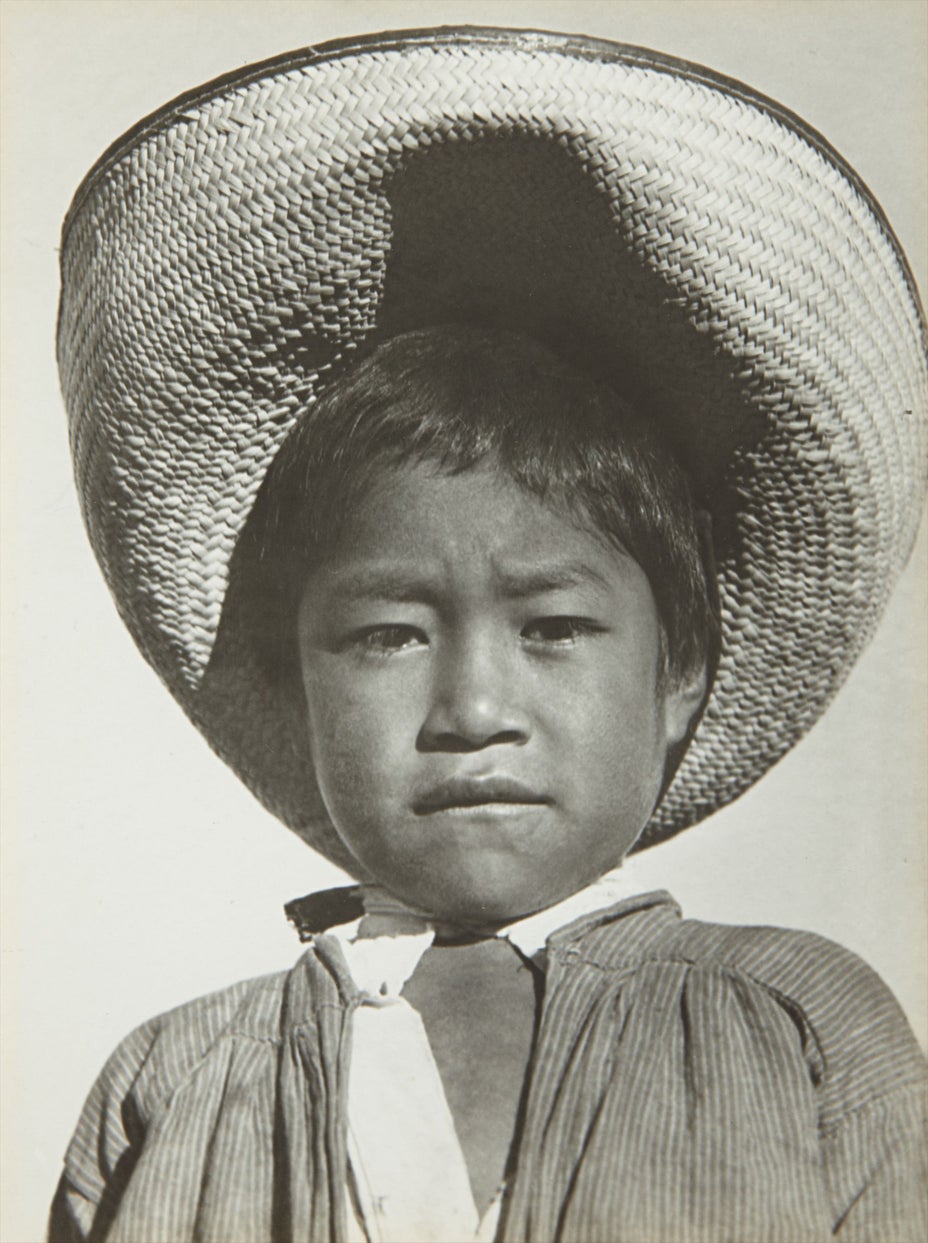
A proud little agrarista (Mexican peasant boy)
Estimate
$60,000–80,000
circa 1927
Gelatin silver print.
9 x 6 3/4 in. (22.9 x 17.1 cm)
Full-Cataloguing
Other prints of this image are in the collections of The Museum of Modern Art, New York and The George Eastman House, International Museum of Photography and Film, Rochester.
Known as a radical photographer, revolutionary muse, social activist, and romantic intellectual, Tina Modotti was a pioneer who moved with the rhythms of the
early twentieth-century avant-garde. Born in Italy in 1896, she immigrated to the United States in 1913, the first annus mirabilis of high modernism. From San Francisco, she first made her way to Los Angeles, where she explored a film career as an actress and met a number of intellectuals and artists, including Edward Weston, with whom she moved to Mexico in 1923.
It was Mexico that became a vessel for Modotti’s political inclinations and artistic sensibility. The country had erupted into revolution in 1910, and the 1920s were years of agrarian reform, social upheaval and artistic experimentation. While Modotti studied photography with Weston, whose formalist aesthetic influenced her work, she
quickly developed her own photographic awareness, shaped by an attention to social causes, local customs and folk art. Modotti and Weston eventually parted ways after he left Mexico in 1926. Whereas Weston’s style moved closer to abstraction, initially with the shells series of 1927 – evident in lot 14 – and culminating in Pepper No. 30 in 1930, Modotti’s eye was instead influenced by her heightened political involvement.
Modotti’s relation to the formal demands of modernism and the political experimentation of the 1920s is summarized in the current lot. Taken around the time she joined the Mexican Communist Party, the photograph shows a child wearing a sombrero. Modotti referred to him as “a proud little agrarista or son of one.” Agrarismo was a political and social movement that demanded the redistribution of land among peasants and the end of latifundismo, the concentration of land ownership among a few families. The plight of the little boy is thus that of humanity, his serious gaze and wrinkled forehead a symbol for the suffering of the destitute. Weston’s influence is apparent in the sombrero, which on its own becomes an abstract form, much like a shell or a pepper. Finally, the strong light that creates the contrast between the
boy’s face and the sombrero seems to point to the dawn of a better age.
Known as a radical photographer, revolutionary muse, social activist, and romantic intellectual, Tina Modotti was a pioneer who moved with the rhythms of the
early twentieth-century avant-garde. Born in Italy in 1896, she immigrated to the United States in 1913, the first annus mirabilis of high modernism. From San Francisco, she first made her way to Los Angeles, where she explored a film career as an actress and met a number of intellectuals and artists, including Edward Weston, with whom she moved to Mexico in 1923.
It was Mexico that became a vessel for Modotti’s political inclinations and artistic sensibility. The country had erupted into revolution in 1910, and the 1920s were years of agrarian reform, social upheaval and artistic experimentation. While Modotti studied photography with Weston, whose formalist aesthetic influenced her work, she
quickly developed her own photographic awareness, shaped by an attention to social causes, local customs and folk art. Modotti and Weston eventually parted ways after he left Mexico in 1926. Whereas Weston’s style moved closer to abstraction, initially with the shells series of 1927 – evident in lot 14 – and culminating in Pepper No. 30 in 1930, Modotti’s eye was instead influenced by her heightened political involvement.
Modotti’s relation to the formal demands of modernism and the political experimentation of the 1920s is summarized in the current lot. Taken around the time she joined the Mexican Communist Party, the photograph shows a child wearing a sombrero. Modotti referred to him as “a proud little agrarista or son of one.” Agrarismo was a political and social movement that demanded the redistribution of land among peasants and the end of latifundismo, the concentration of land ownership among a few families. The plight of the little boy is thus that of humanity, his serious gaze and wrinkled forehead a symbol for the suffering of the destitute. Weston’s influence is apparent in the sombrero, which on its own becomes an abstract form, much like a shell or a pepper. Finally, the strong light that creates the contrast between the
boy’s face and the sombrero seems to point to the dawn of a better age.