PROPERTY OF STEVEN KORFF AND MARCIA VAN WAGNER
13
Ken Price
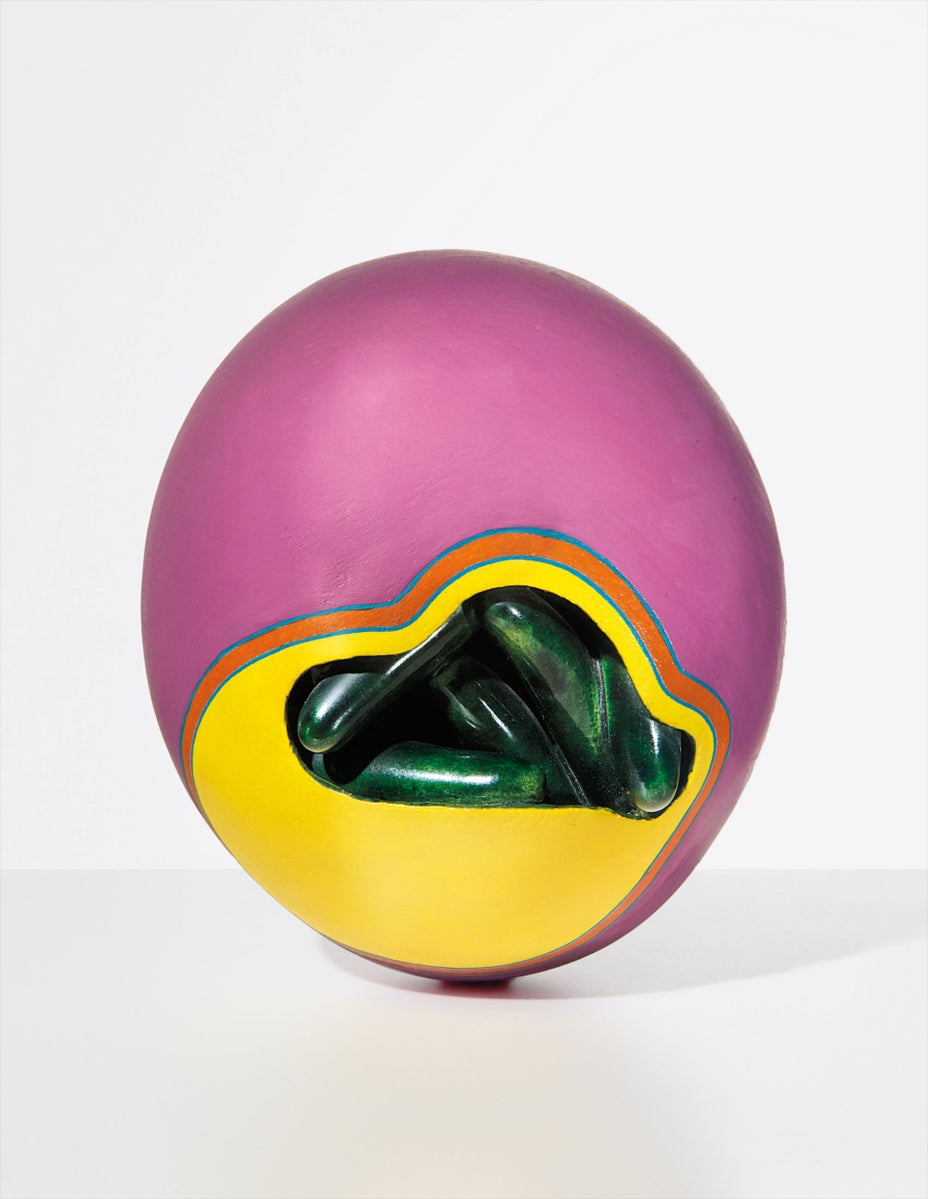
Pink Egg
Estimate
$300,000–400,000
Sold For
$509,000
glazed and painted ceramic, artist's painted wood pedestal
Sculpture: 6 x 5 3/8 x 5 5/8 in. (15.2 x 13.7 x 14.3 cm)
Pedestal: 59 5/8 x 12 x 12 in. (151.4 x 30.5 x 30.5 cm)
Pedestal: 59 5/8 x 12 x 12 in. (151.4 x 30.5 x 30.5 cm)
Full-Cataloguing
Pink Egg (1964), among the most iconic works of Ken Price’s long career, represents an important early transition for the artist as he embarked on an extended exploration into color, surface and form. His series of Egg sculptures, vivid personalities elevated on pedestals, rose up from the artist’s subdued Mounds of the late 1950s and signaled the arrival of a fearsome new talent, independent and daring. Price’s ceramic sculptures are formally characterized by his treatment of color and by the unsettling forms that might more often be described as organic if they were not so alien.
Price’s Eggs from this period are noted for a shocking characteristic: orifices open onto dark depths revealing amoeba-like forms that threaten to protrude—and sometimes they do. On the topic of viewer’s reaction to the Eggs, Price recounted: “People would come and tell me that they were repulsed and fascinated…like looking at a bad automobile accident or something, that you can’t take your eyes off, you know what I mean? With the eggs, I got that response from a lot of people, that they really didn’t like them, but there was something about them that made them keep coming back for another look.” (Michele D. De Angelus, interview with Ken Price, 1980, Archives of American Art, Smithsonian Institution, p. 33)
Have we seen these shapes before? The Eggs in particular invite critics to draw comparisons with other artists enamored of this universal form. In her catalogue essay for a 1966 LACMA exhibition, Lucy Lippard argues that Price’s use of egg shapes was in fact ahistorical, “a logical evolution from the last of the conical or mound-shaped pots he made around 1959.” (Lippard, “Kenneth Price,” Robert Irwin / Kenneth Price, exh. cat., LACMA, 1966, n.p.) But Constantin Brancusi casts a long shadow over the 20th century—he died in 1957 as Price gave birth to his own postgraduate career. What symmetry to think that the early 20th Century’s most otherworldly sculptor passed his torch to an equal in the latter half. Brancusi’s icons, raised on elaborate pedestals of carved wood and stone, would seem logical progenitors to Price’s later distortions: the former’s egg-like Newborn (1915) achieved a supreme distillation of the terror and primacy of childbirth; his fractured, oblong Mademoiselle Pogany (1912) tilted away into air. But Price famously resisted analysis of his work: “Why give up ambiguity for naming and categorizing.” (Mary-Kay Lombino and Constance Glenn, ed. Ken Price: Small is Beautiful, exh. cat. University Art Museum, Long Beach, 2002, p. 2) The younger artist may have been impatient with such explicit comparisons to others. Regardless, Price no doubt would have felt kinship with Brancusi’s statement: “When one is immersed in beauty, there is no need for explanations.”
Price’s use of color merits as powerful a response as his forms. He describes awareness of its effect in a 2007 interview with Vija Celmins: “Color has been an integral part of most of the work I’ve made, but there’s not much to say about it. Color is complete in itself. It doesn’t need any support from art, representation, language, or anything else. It’s hard to control. There’s no formula for using color successfully on 3-D forms. Color conveys emotion, but you can’t really control that either.” (Vija Celmins, “Ken Price with Vija Celmins,” Ken Price, exh. cat. Matthew Marks Gallery, New York, 2007, p. 7)
Price pushed clay out of bounds; that is to say, he got weird. As fellow Ferus Gallery alumnus Ed Ruscha stated, “Those eggs and dome-shaped ceramics were psycho-erotic. They made you scratch your palms.” Despite his outpourings and effusive eruptions—all those inhibitions—Price wasn’t looking for cheap thrills. His earnest desire outstripped animal lust and lumps. From an early point in his career, when he began to coat his ceramics in automotive enamel, he revealed a greater ambition. “I’m trying for an organic fusion of color with surface and form…If the viewers can touch the pieces, and feel how smooth they are, it helps create the illusion that they’re made out of color like things in nature are.” In his search for pure color, in his desire to touch “the things in nature,” Price held out for a deeper union.
Over the last fifty years, Pink Egg has traveled widely, appearing first in March 1964 at Ferus Gallery, Los Angeles; years later at the Centre Pompidou, Paris; and most recently in the triumphant exhibition, Ken Price Sculpture: A Retrospective, which traveled from the Los Angeles County Museum of Art to the Nasher Sculpture Center in Dallas and finally to the Metropolitan Museum of Art, New York.
Price’s Eggs from this period are noted for a shocking characteristic: orifices open onto dark depths revealing amoeba-like forms that threaten to protrude—and sometimes they do. On the topic of viewer’s reaction to the Eggs, Price recounted: “People would come and tell me that they were repulsed and fascinated…like looking at a bad automobile accident or something, that you can’t take your eyes off, you know what I mean? With the eggs, I got that response from a lot of people, that they really didn’t like them, but there was something about them that made them keep coming back for another look.” (Michele D. De Angelus, interview with Ken Price, 1980, Archives of American Art, Smithsonian Institution, p. 33)
Have we seen these shapes before? The Eggs in particular invite critics to draw comparisons with other artists enamored of this universal form. In her catalogue essay for a 1966 LACMA exhibition, Lucy Lippard argues that Price’s use of egg shapes was in fact ahistorical, “a logical evolution from the last of the conical or mound-shaped pots he made around 1959.” (Lippard, “Kenneth Price,” Robert Irwin / Kenneth Price, exh. cat., LACMA, 1966, n.p.) But Constantin Brancusi casts a long shadow over the 20th century—he died in 1957 as Price gave birth to his own postgraduate career. What symmetry to think that the early 20th Century’s most otherworldly sculptor passed his torch to an equal in the latter half. Brancusi’s icons, raised on elaborate pedestals of carved wood and stone, would seem logical progenitors to Price’s later distortions: the former’s egg-like Newborn (1915) achieved a supreme distillation of the terror and primacy of childbirth; his fractured, oblong Mademoiselle Pogany (1912) tilted away into air. But Price famously resisted analysis of his work: “Why give up ambiguity for naming and categorizing.” (Mary-Kay Lombino and Constance Glenn, ed. Ken Price: Small is Beautiful, exh. cat. University Art Museum, Long Beach, 2002, p. 2) The younger artist may have been impatient with such explicit comparisons to others. Regardless, Price no doubt would have felt kinship with Brancusi’s statement: “When one is immersed in beauty, there is no need for explanations.”
Price’s use of color merits as powerful a response as his forms. He describes awareness of its effect in a 2007 interview with Vija Celmins: “Color has been an integral part of most of the work I’ve made, but there’s not much to say about it. Color is complete in itself. It doesn’t need any support from art, representation, language, or anything else. It’s hard to control. There’s no formula for using color successfully on 3-D forms. Color conveys emotion, but you can’t really control that either.” (Vija Celmins, “Ken Price with Vija Celmins,” Ken Price, exh. cat. Matthew Marks Gallery, New York, 2007, p. 7)
Price pushed clay out of bounds; that is to say, he got weird. As fellow Ferus Gallery alumnus Ed Ruscha stated, “Those eggs and dome-shaped ceramics were psycho-erotic. They made you scratch your palms.” Despite his outpourings and effusive eruptions—all those inhibitions—Price wasn’t looking for cheap thrills. His earnest desire outstripped animal lust and lumps. From an early point in his career, when he began to coat his ceramics in automotive enamel, he revealed a greater ambition. “I’m trying for an organic fusion of color with surface and form…If the viewers can touch the pieces, and feel how smooth they are, it helps create the illusion that they’re made out of color like things in nature are.” In his search for pure color, in his desire to touch “the things in nature,” Price held out for a deeper union.
Over the last fifty years, Pink Egg has traveled widely, appearing first in March 1964 at Ferus Gallery, Los Angeles; years later at the Centre Pompidou, Paris; and most recently in the triumphant exhibition, Ken Price Sculpture: A Retrospective, which traveled from the Los Angeles County Museum of Art to the Nasher Sculpture Center in Dallas and finally to the Metropolitan Museum of Art, New York.