35
Jean-Michel Basquiat
Untitled (3 Text Pieces)
Full-Cataloguing
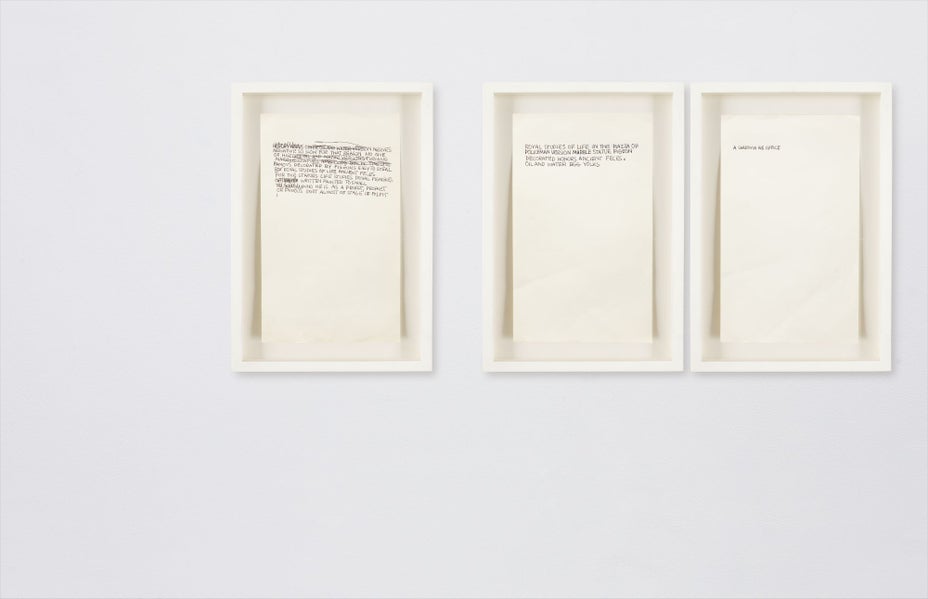
Untitled (3 Text Pieces), matches stark words of poetry on three otherwise blank pieces of notebook paper. Throughout the late 1970s, Basquiat’s personal legacy as a poet had been honed on the New York streets with his close friend and early collaborator Al Diaz. Together as SAMO, an acronym for “same old shit”, Basquiat and Diaz spread their poetic and sparse messages of anti-establishment and social critique across the city of New York, embodying the movement of hip-hop and colliding with transformative symbols and text-based art. Though Basquiat was often scant and deliberately succinct in his interviews, his surviving text gives us insight into a profoundly brilliant and unconventional mind, where visual representation was as important as the words used to explain it. Though Basquiat broke his partnership with Diaz in 1980 in order to further pursue a career in painting, the present lot is a testament to Basquiat’s continuous investigation of language; enhancing some of his most acclaimed canvases with the inherent power of text. Exploring semiotic contexts as much as reveling in their aesthetic and formal appeal, the allure of the present lot exemplifies astute comparisons between Basquiat and Cy Twombly. Revealing a quick-wittedness and intimate aura of presence the Untitled (3 Text Pieces), 1982 distills a humble séance between man and word.
Jean-Michel Basquiat
American | B. 1960 D. 1988One of the most famous American artists of all time, Jean-Michel Basquiat first gained notoriety as a subversive graffiti-artist and street poet in the late 1970s. Operating under the pseudonym SAMO, he emblazoned the abandoned walls of the city with his unique blend of enigmatic symbols, icons and aphorisms. A voracious autodidact, by 1980, at 22-years of age, Basquiat began to direct his extraordinary talent towards painting and drawing. His powerful works brilliantly captured the zeitgeist of the 1980s New York underground scene and catapulted Basquiat on a dizzying meteoric ascent to international stardom that would only be put to a halt by his untimely death in 1988.
Basquiat's iconoclastic oeuvre revolves around the human figure. Exploiting the creative potential of free association and past experience, he created deeply personal, often autobiographical, images by drawing liberally from such disparate fields as urban street culture, music, poetry, Christian iconography, African-American and Aztec cultural histories and a broad range of art historical sources.