Priority Bidding is here! Secure a lower Buyer’s Premium today (excludes Online Auctions and Watches). Learn More

369

Jean Prouvé

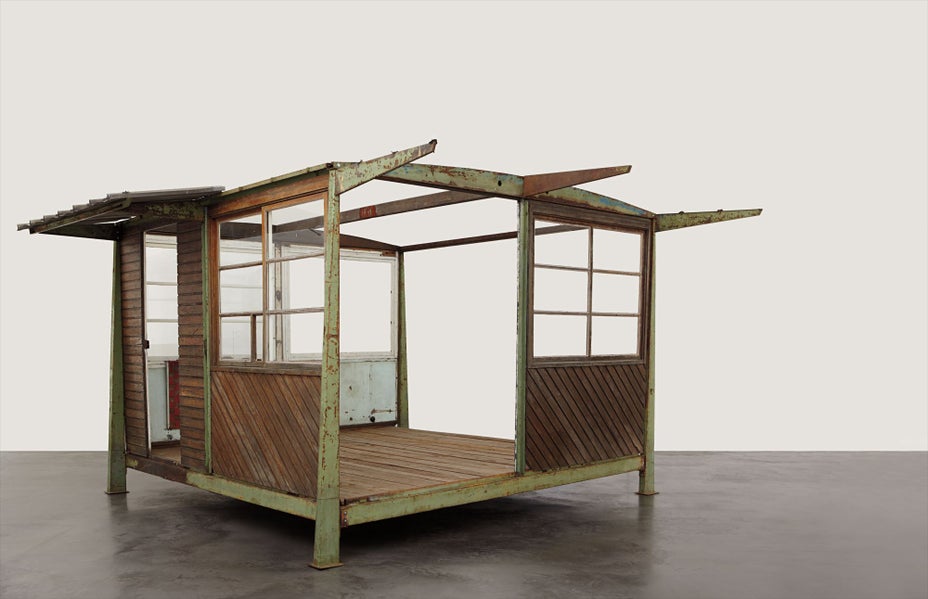
Demountable entry lodge, from Ferembal, Nancy

Estimate
£180,000 - 240,000
£178,500
Lot Details
Painted steel, corrugated aluminium, pine, painted wood, glass.
circa 1943-1944
297.2 x 502.9 x 502.9 cm (117 x 198 x 198 in.)
Catalogue Essay
In the fall of 1939, as France was urgently preparing for the second World War, Jean Prouvé was asked to design a combat unit that could be constructed in just a few hours by a limited number of men. Prouvé stayed up all night completing the request, drawing upon a design of the same year for a demountable refectory. Within a week his brother Pierre Prouvé readied a prototype for presentation to General Dumontier, the director of École Polytechnique. Twenty examples were required immediately and two-hundred and seventy-five were ordered shortly after. It is not known precisely how many were made. During this period, Prouvé’s staff had been reduced from 120 to thirty as his factory workers were called to the battlefield, which may be why the barracks were produced elsewhere. The model was conceived in three sizes to accommodate various numbers of men: 4 x 4 meters, 4 x 6 meters and 4 x 12 meters. Its simple construction consisting of steel structural elements into which siding, windows and floorboards could be fitted allowed for easy transport and assembly. In 1940 the design was patented as “Baraque demountable,” brevet no. 865.235.

The present lot is based on the 1939 barrack, adapted by Robert Geck in 1943-1944 for use at the Ferembal factory in Nancy, France. The present lot is the only known surviving example of this historically important design.

Jean Prouvé

French | B. 1901 D. 1984
Jean Prouvé believed in design as a vehicle for improvement. His manufactory Les Ateliers Jean Prouvé, located in Nancy, France, produced furniture for schools, factories and municipal projects, both within France and in locations as far flung as the Congo. Though he designed for the masses, pieces such as his "Potence" lamps and "Standard" chairs are among the most iconic fixtures in sophisticated, high-design interiors today. Collectors connect with his utilitarian, austere designs that strip materials down to the bare minimum without compromising on proportion or style.

Prouvé grew up in Nancy, France, the son of Victor Prouvé, an artist and co-founder of the École de Nancy, and Marie Duhamel, a pianist. He apprenticed to master blacksmiths in Paris and opened a small wrought iron forge in Nancy. However it was sheet steel that ultimately captured Prouvé's imagination, and he ingeniously adapted it to furniture, lighting and even pre-fabricated houses, often collaborating with other design luminaries of the period, such as Robert Mallet-Stevens, Le Corbusier and Charlotte Perriand.
Browse Artist