Property from a Private Collection
410
Isamu Noguchi
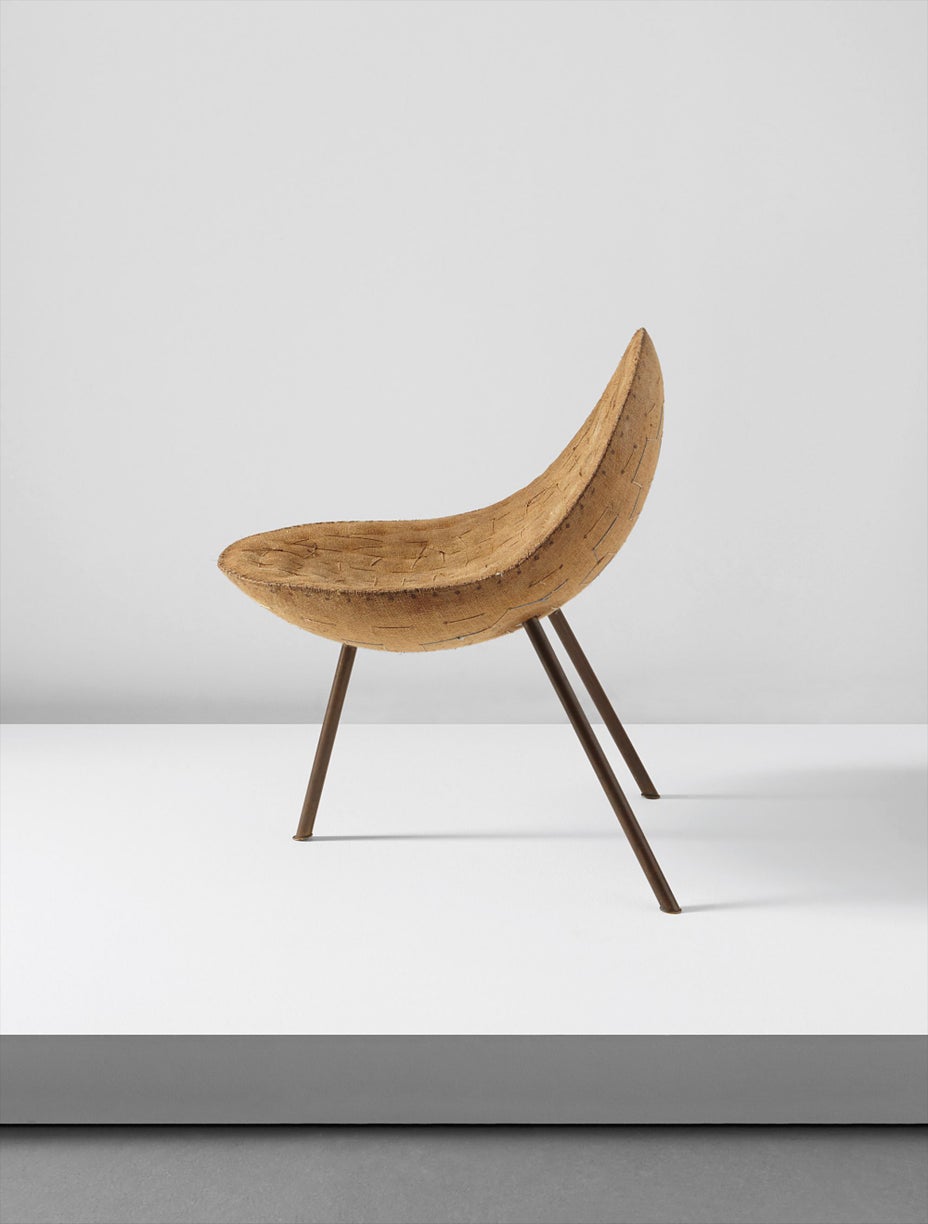
Prototype chair, for William A.M. Burden, Northeast Harbor, Maine
Estimate
$200,000–300,000
Sold For
$225,000
1947
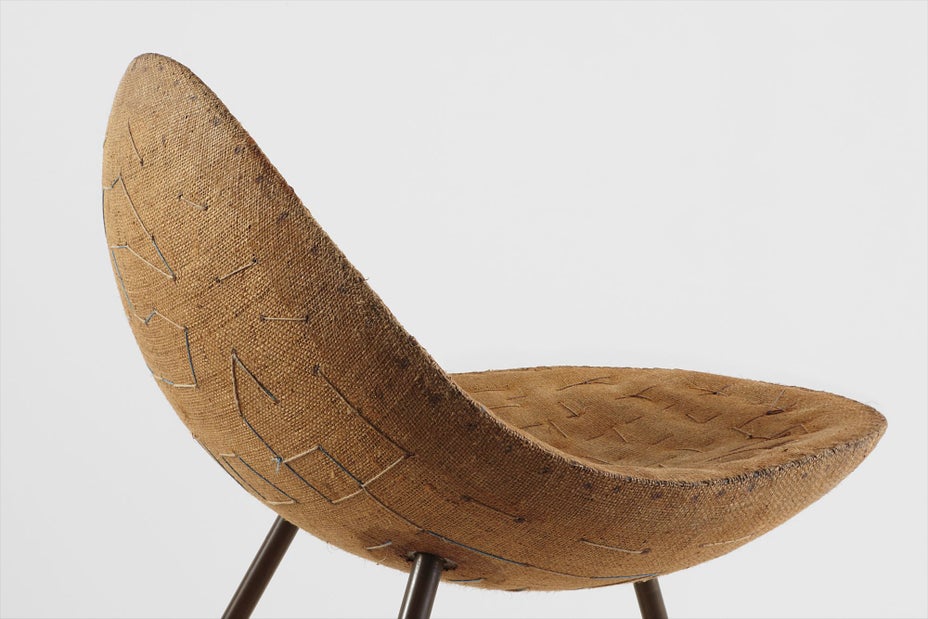
Burlap-covered steel, copper.
28 x 20 3/4 x 25 in. (71.1 x 52.7 x 63.5 cm)
Together with original and period copies of Noguchi's and Burden's correspondence between 1946 and 1948, and an undated volume of photographs of the Burden residence in Northeast Harbor.
Full-Cataloguing
The present chair is listed as artwork number 281-4 in The Isamu Noguchi Catalogue Raisonné.
The Burden Chair
By James Zemaitis
The summer residence in Northeast Harbor, Maine of William A.M. Burden and his wife, Margaret Livingston Partridge Burden, designed by Wallace K. Harrison with interior design contributions by Isamu Noguchi, is a seaside modernist masterpiece. The interior and exterior walls, floors and furniture mirrored the coastline and ocean waves, and period photographs show expanses of stunning whitewashed knotty pine board-and-batten hung with modernist paintings of lighthouses and rocky coasts, serving as a backdrop for Noguchi's carved built-in and freestanding furniture. Never before had architect and artist so successfully married the International Style with the rusticity and geography of a vacation retreat by the sea.
Among Noguchi's original designs for the house were a built-in desk for the master bedroom, andirons for two fireplaces, and in the dining area, a majestic sculptural table and set of dining chairs. In late 1946, Noguchi created an initial maquette for the dining table and a single dining chair (later illustrated in an article on his work in the 1949 Interiors), and sent an invoice to the architects on December 1st for the design. One of Harrison's colleagues passed the bill on to Burden with the comment "Enclosed is Noguchi's bill which is fair enough. I would suggest, however, that you delay payment a bit until we are convinced that the chairs are practical to build and until we have had Noguchi make any minor changes in the design that you may want him to make."
Throughout the spring of 1947, Noguchi made several trips to Maine to oversee the execution on site of the furniture, and one undated invoice from this period includes a line item expense for "chair enlargement and changes in plaster. 4 days @ $35." In a letter dated May 9th, Noguchi sent a letter to Burden stating that "I have just returned from Maine where I saw to the carving of your table. Everything was done that is necessary for the finishing up to and including the first sanding and the insertion of the legs which I had made out of aluminum (sic) with gold anodic treatment. This last will assure its not tarnishing and the chair legs will match with the same light material." Reading through the documentation, it is remarkable to witness Noguchi’s insecurity about his position as a contractor for hire. The artist as furniture designer openly expresses his discomfort with how much he should be paid for his time and services.
However, at some point during this period, while the present lot, a working prototype of the chair was fully realized, it would be rejected by the Burdens as not being suitable for everyday dining use, and they instead opted to acquire a set of DCMs by Charles and Ray Eames to go around Noguchi's finished dining table. As illustrated in both the April 1950 Progressive Architecture as well as in a spiral-bound scrapbook of photographs of the house and family, offered together with the present lot, the chair was placed in one of the bedrooms facing the ocean.
Completed in 1947 by the firm Harrison, Fouilhoux & Abramovitz, the house was destroyed by fire in 1999, and rebuilt by the family in 2006. Only this chair, which had been moved to a storage shed, and a single pair of andirons survived.
Although the global influence of the fiberglass shells of Charles and Ray Eames is frequently cited when discussing the great Danish chair designs of the 1950s, one cannot help but wonder if the appearance of Noguchi’s chair in two major architectural publications with an international audience played any role in the early three-legged chair experiments of Poul Kjærholm, especially the upholstered and aluminum prototypes he exhibited in 1953, or in Arne Jacobsen’s furniture designs for the SAS Hotel, in particular the “Drop” chair.
The Burden Chair
By James Zemaitis
The summer residence in Northeast Harbor, Maine of William A.M. Burden and his wife, Margaret Livingston Partridge Burden, designed by Wallace K. Harrison with interior design contributions by Isamu Noguchi, is a seaside modernist masterpiece. The interior and exterior walls, floors and furniture mirrored the coastline and ocean waves, and period photographs show expanses of stunning whitewashed knotty pine board-and-batten hung with modernist paintings of lighthouses and rocky coasts, serving as a backdrop for Noguchi's carved built-in and freestanding furniture. Never before had architect and artist so successfully married the International Style with the rusticity and geography of a vacation retreat by the sea.
Among Noguchi's original designs for the house were a built-in desk for the master bedroom, andirons for two fireplaces, and in the dining area, a majestic sculptural table and set of dining chairs. In late 1946, Noguchi created an initial maquette for the dining table and a single dining chair (later illustrated in an article on his work in the 1949 Interiors), and sent an invoice to the architects on December 1st for the design. One of Harrison's colleagues passed the bill on to Burden with the comment "Enclosed is Noguchi's bill which is fair enough. I would suggest, however, that you delay payment a bit until we are convinced that the chairs are practical to build and until we have had Noguchi make any minor changes in the design that you may want him to make."
Throughout the spring of 1947, Noguchi made several trips to Maine to oversee the execution on site of the furniture, and one undated invoice from this period includes a line item expense for "chair enlargement and changes in plaster. 4 days @ $35." In a letter dated May 9th, Noguchi sent a letter to Burden stating that "I have just returned from Maine where I saw to the carving of your table. Everything was done that is necessary for the finishing up to and including the first sanding and the insertion of the legs which I had made out of aluminum (sic) with gold anodic treatment. This last will assure its not tarnishing and the chair legs will match with the same light material." Reading through the documentation, it is remarkable to witness Noguchi’s insecurity about his position as a contractor for hire. The artist as furniture designer openly expresses his discomfort with how much he should be paid for his time and services.
However, at some point during this period, while the present lot, a working prototype of the chair was fully realized, it would be rejected by the Burdens as not being suitable for everyday dining use, and they instead opted to acquire a set of DCMs by Charles and Ray Eames to go around Noguchi's finished dining table. As illustrated in both the April 1950 Progressive Architecture as well as in a spiral-bound scrapbook of photographs of the house and family, offered together with the present lot, the chair was placed in one of the bedrooms facing the ocean.
Completed in 1947 by the firm Harrison, Fouilhoux & Abramovitz, the house was destroyed by fire in 1999, and rebuilt by the family in 2006. Only this chair, which had been moved to a storage shed, and a single pair of andirons survived.
Although the global influence of the fiberglass shells of Charles and Ray Eames is frequently cited when discussing the great Danish chair designs of the 1950s, one cannot help but wonder if the appearance of Noguchi’s chair in two major architectural publications with an international audience played any role in the early three-legged chair experiments of Poul Kjærholm, especially the upholstered and aluminum prototypes he exhibited in 1953, or in Arne Jacobsen’s furniture designs for the SAS Hotel, in particular the “Drop” chair.