20
Isamu Noguchi
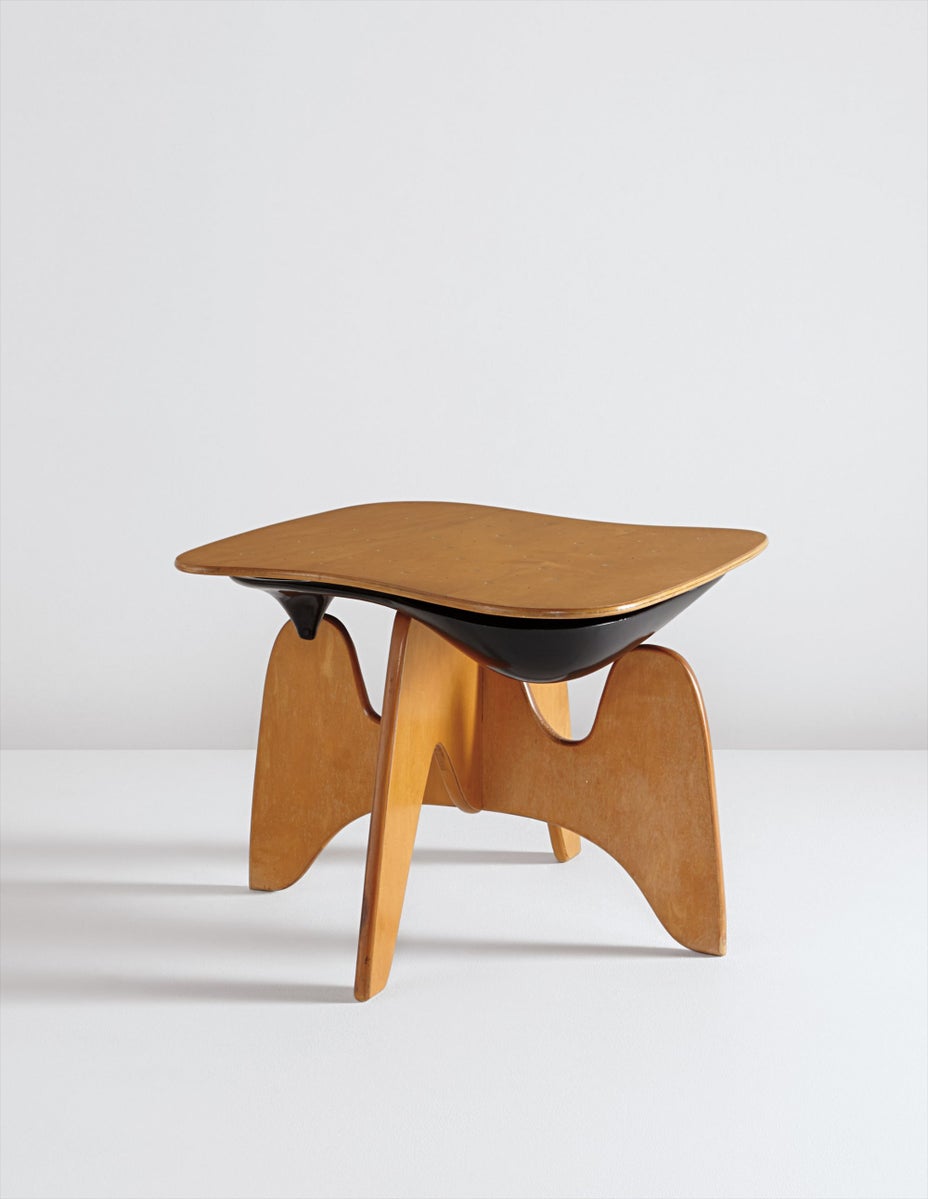
Rare "Chess Table," model no. IN-61
Estimate
$150,000–200,000
Sold For
$242,500
circa 1947-1949
Laminated bird's-eye maple, painted steel, the top with clear and red acrylic inlays.
19 1/4 x 33 7/8 x 30 3/4 in. (48.9 x 86 x 78.1 cm)
Produced by The Herman Miller Furniture Company, USA.
Full-Cataloguing
Phillips would like to thank The Isamu Noguchi Foundation and Garden Museum and Larry List, New York, for their assistance cataloguing the present lot.
THE CHESS TABLE
The 20th century sculptor and designer Isamu Noguchi devoted a large part of his career to re-envisioning functional, traditional objects as expressions of modernism. Noguchi regarded furniture as sculptural forms with which people often had meaningful, prolonged, and intimate connection as part of their environment, hence objects worthy of serious aesthetic design and appreciation.
This chess table design was developed by Noguchi in his Greenwich Village studio for the legendary 1944 Imagery of Chess exhibition organized by his friends Marcel Duchamp and Max Ernst and held at the Julien Levy Gallery in New York. Newsweek magazine proclaimed that “the sculptor Noguchi…has created the most beautiful piece in the show…” The original design was bought the night of the gallery opening by prominent architect and furniture designer George Nelson, who, in 1947 convinced The Herman Miller Furniture Company to manufacture the Chess Table and Noguchi’s ovoid glass top coffee table design.
While the glass coffee table has become a design standard, produced to this day, its companion piece, a rarity, was produced for only three years. The few extant examples are predominantly in solid, ebonized black finish. This version, in mildly-figured bird’s-eye maple, may be unique, a custom order intended to harmonize with a specific interior.
In this table design Noguchi pioneered his technique of notching together flat biomorphic shapes to create free-standing forms, an approach with which he later generated a signature group of sculptures, his notched planar abstractions of the mid-to-late 1940s. An artistic nomad, Noguchi presaged the concept of “pack flat to ship” by designing the table to break down into a table top, two flat leg pieces, a cast aluminum tray, and a metal rod.
The child of an American mother and Japanese father, Noguchi sought to integrate elements of Eastern and Western culture in his work. In this versatile design, the table top could be raised to Western-style dining or gaming height, or lowered to a level at which one traditionally knelt to play games in Eastern cultures. A long metal rod fastened to the tabletop and running down through a clamp in the central leg joint facilitated the height changes in the original. The current example has the Herman Miller factory-made rod with a fixed table top mount.
Alluding to the traditional inlaid mother of pearl center-points found on the earliest Asian game boards, Noguchi devised a subtle but perfectly functional 8 x 8 grid of red dots and translucent acrylic discs, instead of a Western-style grid of squares, ensuring the table was not exclusively used for gaming.
Originally designed during WW II for chess, a “war game," the table is comprised of what were then high-tech, cutting edge wartime materials: cast aluminum, laminated lumber-core veneered plywood, and acrylic plastic. The tabletop also swiveled to reveal two protected deeply scooped out aluminum “fox hole” pockets in which playing cards, game pieces, sewing supplies, cigarettes, or what-have-you could be kept neatly out of sight.
Like the cardinal points of a compass, the table legs intersect at a common central point. Inspired by the models he made of stage sets for the Martha Graham Dance Company, the artist saw tables as stages upon which entertainments are offered; places where one shares nourishment of body or mind; or social spaces that are meeting places, presaging his later-realized ambitions to design entire plazas, parks and playgrounds. This table exemplifies Noguchi’s life-long devotion to the “… relationship of objects in totality, to life, and to people.”
LARRY LIST
Author of The Imagery of Chess Revisited
New York, November 2014
THE CHESS TABLE
The 20th century sculptor and designer Isamu Noguchi devoted a large part of his career to re-envisioning functional, traditional objects as expressions of modernism. Noguchi regarded furniture as sculptural forms with which people often had meaningful, prolonged, and intimate connection as part of their environment, hence objects worthy of serious aesthetic design and appreciation.
This chess table design was developed by Noguchi in his Greenwich Village studio for the legendary 1944 Imagery of Chess exhibition organized by his friends Marcel Duchamp and Max Ernst and held at the Julien Levy Gallery in New York. Newsweek magazine proclaimed that “the sculptor Noguchi…has created the most beautiful piece in the show…” The original design was bought the night of the gallery opening by prominent architect and furniture designer George Nelson, who, in 1947 convinced The Herman Miller Furniture Company to manufacture the Chess Table and Noguchi’s ovoid glass top coffee table design.
While the glass coffee table has become a design standard, produced to this day, its companion piece, a rarity, was produced for only three years. The few extant examples are predominantly in solid, ebonized black finish. This version, in mildly-figured bird’s-eye maple, may be unique, a custom order intended to harmonize with a specific interior.
In this table design Noguchi pioneered his technique of notching together flat biomorphic shapes to create free-standing forms, an approach with which he later generated a signature group of sculptures, his notched planar abstractions of the mid-to-late 1940s. An artistic nomad, Noguchi presaged the concept of “pack flat to ship” by designing the table to break down into a table top, two flat leg pieces, a cast aluminum tray, and a metal rod.
The child of an American mother and Japanese father, Noguchi sought to integrate elements of Eastern and Western culture in his work. In this versatile design, the table top could be raised to Western-style dining or gaming height, or lowered to a level at which one traditionally knelt to play games in Eastern cultures. A long metal rod fastened to the tabletop and running down through a clamp in the central leg joint facilitated the height changes in the original. The current example has the Herman Miller factory-made rod with a fixed table top mount.
Alluding to the traditional inlaid mother of pearl center-points found on the earliest Asian game boards, Noguchi devised a subtle but perfectly functional 8 x 8 grid of red dots and translucent acrylic discs, instead of a Western-style grid of squares, ensuring the table was not exclusively used for gaming.
Originally designed during WW II for chess, a “war game," the table is comprised of what were then high-tech, cutting edge wartime materials: cast aluminum, laminated lumber-core veneered plywood, and acrylic plastic. The tabletop also swiveled to reveal two protected deeply scooped out aluminum “fox hole” pockets in which playing cards, game pieces, sewing supplies, cigarettes, or what-have-you could be kept neatly out of sight.
Like the cardinal points of a compass, the table legs intersect at a common central point. Inspired by the models he made of stage sets for the Martha Graham Dance Company, the artist saw tables as stages upon which entertainments are offered; places where one shares nourishment of body or mind; or social spaces that are meeting places, presaging his later-realized ambitions to design entire plazas, parks and playgrounds. This table exemplifies Noguchi’s life-long devotion to the “… relationship of objects in totality, to life, and to people.”
LARRY LIST
Author of The Imagery of Chess Revisited
New York, November 2014