
19
Eileen Gray
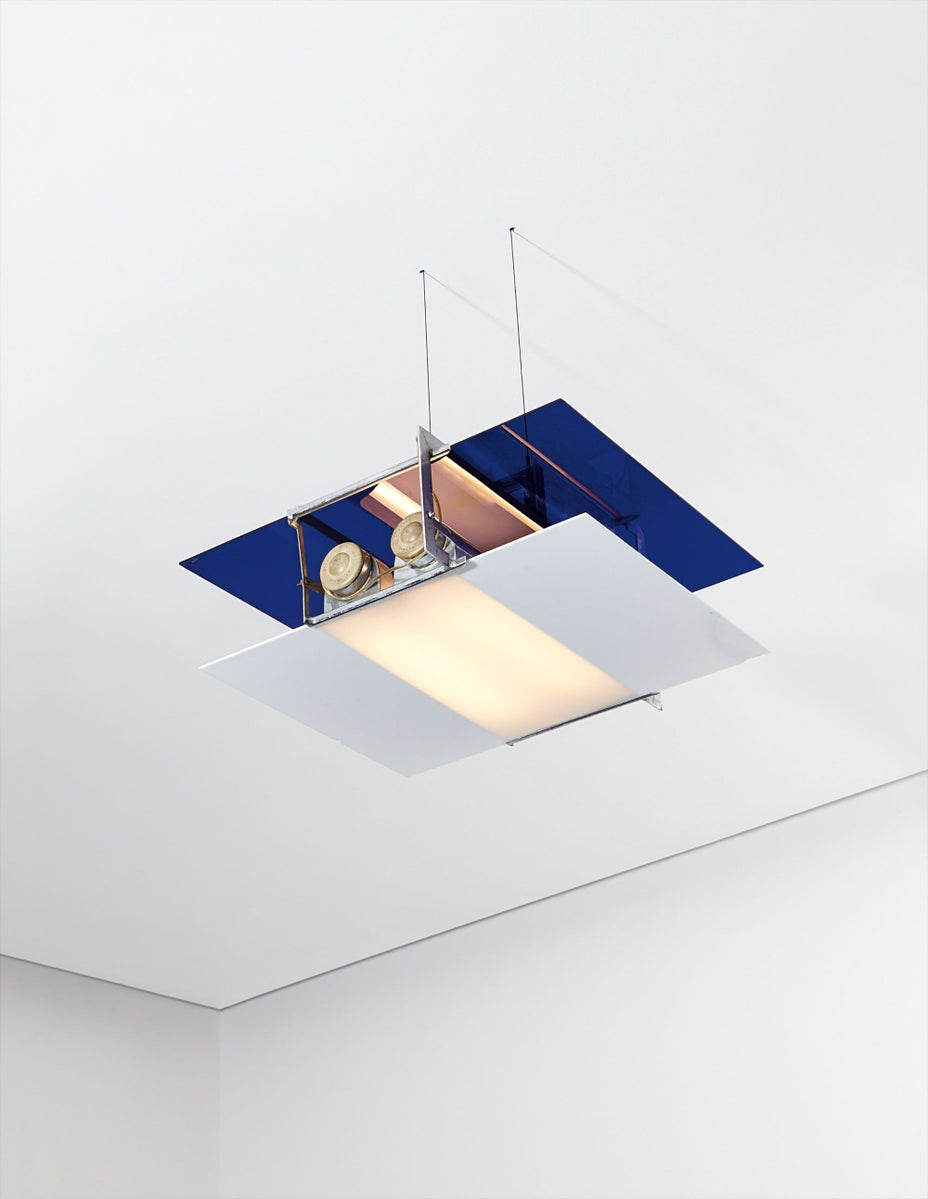
Rare "Aéroplane" ceiling light
- Estimate
- $250,000 - 350,000
$350,500
Lot Details
Chromium-plated metal, rubber, cobalt blue plate glass, white plate glass.
circa 1930
7 3/4 x 16 1/8 x 16 3/4 in. (19.7 x 41 x 42.5 cm); variable drop
Each rubber cap molded with ETRANGER-BREVETÉ-FRANCE. Together with the original correspondence between Eileen Gray and Gladys Fabre.
Specialist
Full-Cataloguing
Catalogue Essay
Eileen Gray is known to have produced at least five “Aéroplane” ceiling lights. Four appeared in the historic auction of Gray’s collection at Sotheby Parke Bernet, Monaco, May 25, 1980. The fifth known example, the present lot, was purchased directly from the artist by Gladys Fabre, Paris, in January 1973.
Provenance
Exhibited
Literature
Eileen Gray
Irish | B. 1878 D. 1976One of the most important designers working in early twentieth-century Paris was in fact an unlikely expatriate: an extraordinary, aristocratic woman from provincial Ireland named Eileen Gray. After completing studies in painting at the Slade in London, Gray moved to Paris in 1906. There she partnered with the Japanese lacquer master Seizo Sugawara, applying the traditional technique to her original designs. She opened her gallery, Jean Désert, in 1922 and found steady work producing luxury objects for an elite clientele.
Soon, however, she branched out to larger projects. As an interior designer, she completed apartments for Juliette Lévy and her friend Jean Badovici. Encouraged by Badovici, she learned architectural drawing and designed the villa E-1027 in Roquebrune-Cap-Martin, which was completed in 1929. Gray was largely forgotten until 1968, when the architectural historian Joseph Rykwert praised her in an article for Domus. Four years later her lacquer screen "Le Destin" achieved the top price in the historic auction of couturier Jacques Doucet's collection in Paris. Recognition — in the form of scholarship, exhibitions and collecting — has gained steady momentum ever since. As curator Jennifer Goff has written, "Collectors vie to own her furniture; historians compete to document her life."
Browse ArtistSoon, however, she branched out to larger projects. As an interior designer, she completed apartments for Juliette Lévy and her friend Jean Badovici. Encouraged by Badovici, she learned architectural drawing and designed the villa E-1027 in Roquebrune-Cap-Martin, which was completed in 1929. Gray was largely forgotten until 1968, when the architectural historian Joseph Rykwert praised her in an article for Domus. Four years later her lacquer screen "Le Destin" achieved the top price in the historic auction of couturier Jacques Doucet's collection in Paris. Recognition — in the form of scholarship, exhibitions and collecting — has gained steady momentum ever since. As curator Jennifer Goff has written, "Collectors vie to own her furniture; historians compete to document her life."