7
Irving Penn
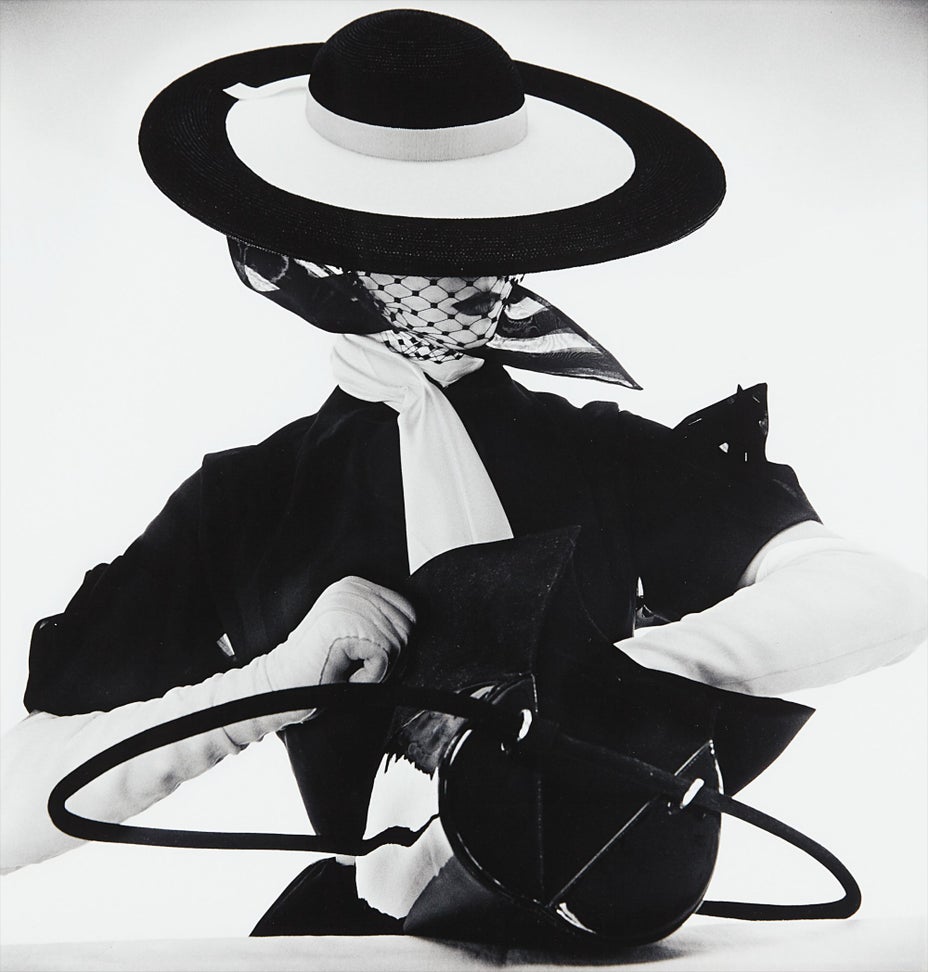
Black and White Fashion with Handbag (Jean Patchett) (C), New York
Full-Cataloguing
Irving Penn’s Black and White Fashion with Handbag (Jean Patchett) (C), New York was taken in 1950, less than a year after the young American photographer was commissioned by Vogue to photograph the Paris haute couture collections for the first time. By then, Penn had been with the magazine for eight years, during which he worked under legendary editor Alexander Liberman. Decades later, Liberman would recall Penn’s skillful innovation: “Penn immediately plunged into the vital question of inventing ‘his’ light, a key to a personal statement different from the accepted unreality of the fashion photography of the period: overburdened backgrounds, theatrical lighting.” Editorial images by the leading photographers up until then were largely over-stylized, and heavy-handed in their narratives. Penn’s minimalist counterapproach was, by his own humble admission, ignorance—lacking the art historical savoire faire in styling his shoots. Consequently, cumbersome and indulgent sets were replaced by stark, luminous tents. The resulting images, perhaps for their serendipitous nature, were striking in their clarity and simplicity, allowing the readers to closely study and appreciate the couture. For Penn, the clothes were not about telling an underlying story, but about the elegance of line and the grace of silhouette.
As Vogue’s leading fashion photographer in the Post-War years, Penn collaborated with some of the most popular models of the period to create his trailblazing work. The current lot depicts Jean Patchett, among Penn’s favored models and a widely acclaimed beauty. Black and White Fashion with Handbag (Jean Patchett) (C), New York, is one of only a handful of images from the photoshoot that Penn would later select for printing. The celebrated shoot was remarkable for its sparse, minimalist aesthetic, which allowed Penn to showcase his strength and distinct vision. In the image offered in the current lot, the hat’s concentric circles are echoed by the straps of the handbag, and the model’s pose and head tilt jointly create a series of intersecting diagonals. The resulting image emphasizes the structured nature of the outfit, the crisp line of the designs, and the undeniable finesse of the garment. As a fashion work it is at its most quintessential—and successful—in its ability to extricate the bare minimum to produce an image of striking elegance and effortless timelessness. Nearly seventy years later, the image appears as fresh and exciting as the day it was first made.
This is the first time this image has been offered at auction.
Irving Penn
American | B. 1917 D. 2009Irving Penn was one of the 20th century’s most significant photographers, known for his arresting images, technical mastery, and quiet intensity. Though he gained widespread acclaim as a leading Vogue photographer for over sixty years, Penn remained a private figure devoted to his craft. Trained under legendary art director Alexey Brodovitch in Philadelphia, he began his career assisting at Harper’s Bazaar before joining Vogue in 1943, where editor and artist Alexander Liberman recognized Penn’s distinctive eye and encouraged him to pursue photography. Penn’s incomparably elegant fashion studies reset the standard for the magazine world, and his portraits, still lifes, and nude studies broke new ground. His 1960 book Moments Preserved redefined the photographic monograph with its dynamic layout and high-quality reproductions. In 1964, Penn began printing in platinum and palladium, reviving this 19th-century process to serve his own distinct vision. An innovator in every sense, Penn’s approach to photography was endlessly adventurous. Few photographers of his generation experimented as widely with both conventional and historic print processes, and none achieved Penn’s level of excellence in all.