6
Irving Penn
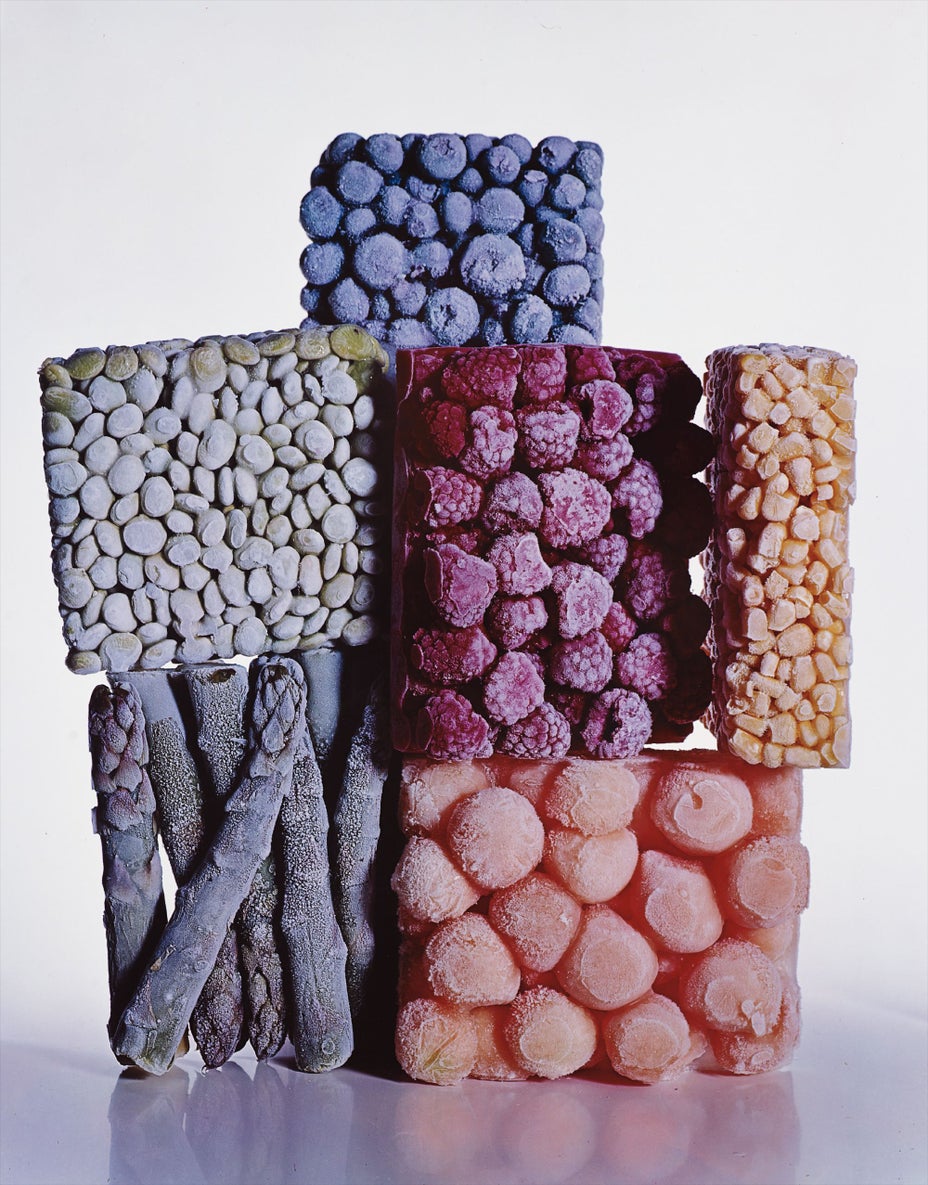
Frozen Foods, New York
Full-Cataloguing
As a budding photographer at Vogue under the tutelage of Alexander Liberman in 1943, Irving Penn was tasked with sketching and ultimately staging and photographing the first would-be still life cover for the magazine. The cover, released on October 1943 (i) featured an assortment of ladies’ accessories arranged with a Cubist sensibility: the layering of text and objects, the flattening of depth and the conflation of two and three dimensional objects. The cover was successfully received, and Penn subsequently joined the ranks of Vogue’s most revered photographers.
Throughout his career, Penn would return to the subject of still-life with a variety of objects—from cigarettes to liqueurs, flora, apples, diamond, bones, and as seen in the current lot, frozen food. The genre presented a set of challenges for Penn, who from his early days chose to challenge aesthetic conventions. Penn’s approach, it seems, was to strip the object from its expected surrounding and re-present it in an innovative way, most often against a stark white background. This simplicity allowed Penn to focus on form, line, texture and volume. In the current lot, Penn eschewed traditional depiction of produce—be it on a plate or in a bowl—and arranged blocks of frozen food with a deeply architectural undertone. Each block presents its own texture, color and shape. The seemingly haphazard composition is cohesive and harmonious, transforming an otherwise ordinary subject into a fresh, contemporary and abstract sculptural configuration.
Irving Penn
American | B. 1917 D. 2009Irving Penn was one of the 20th century’s most significant photographers, known for his arresting images, technical mastery, and quiet intensity. Though he gained widespread acclaim as a leading Vogue photographer for over sixty years, Penn remained a private figure devoted to his craft. Trained under legendary art director Alexey Brodovitch in Philadelphia, he began his career assisting at Harper’s Bazaar before joining Vogue in 1943, where editor and artist Alexander Liberman recognized Penn’s distinctive eye and encouraged him to pursue photography. Penn’s incomparably elegant fashion studies reset the standard for the magazine world, and his portraits, still lifes, and nude studies broke new ground. His 1960 book Moments Preserved redefined the photographic monograph with its dynamic layout and high-quality reproductions. In 1964, Penn began printing in platinum and palladium, reviving this 19th-century process to serve his own distinct vision. An innovator in every sense, Penn’s approach to photography was endlessly adventurous. Few photographers of his generation experimented as widely with both conventional and historic print processes, and none achieved Penn’s level of excellence in all.